
Daily Podcast full article
Georgia ballot flaw threatens voter privacy
A long-known weakness in Georgia’s voting system has become newly urgent as researchers show that widely available AI tools can help connect supposedly anonymous ballots to individual voters. The flaw does not alter vote totals, but it challenges a core democratic promise: that a citizen’s choices remain secret after the ballot is cast.
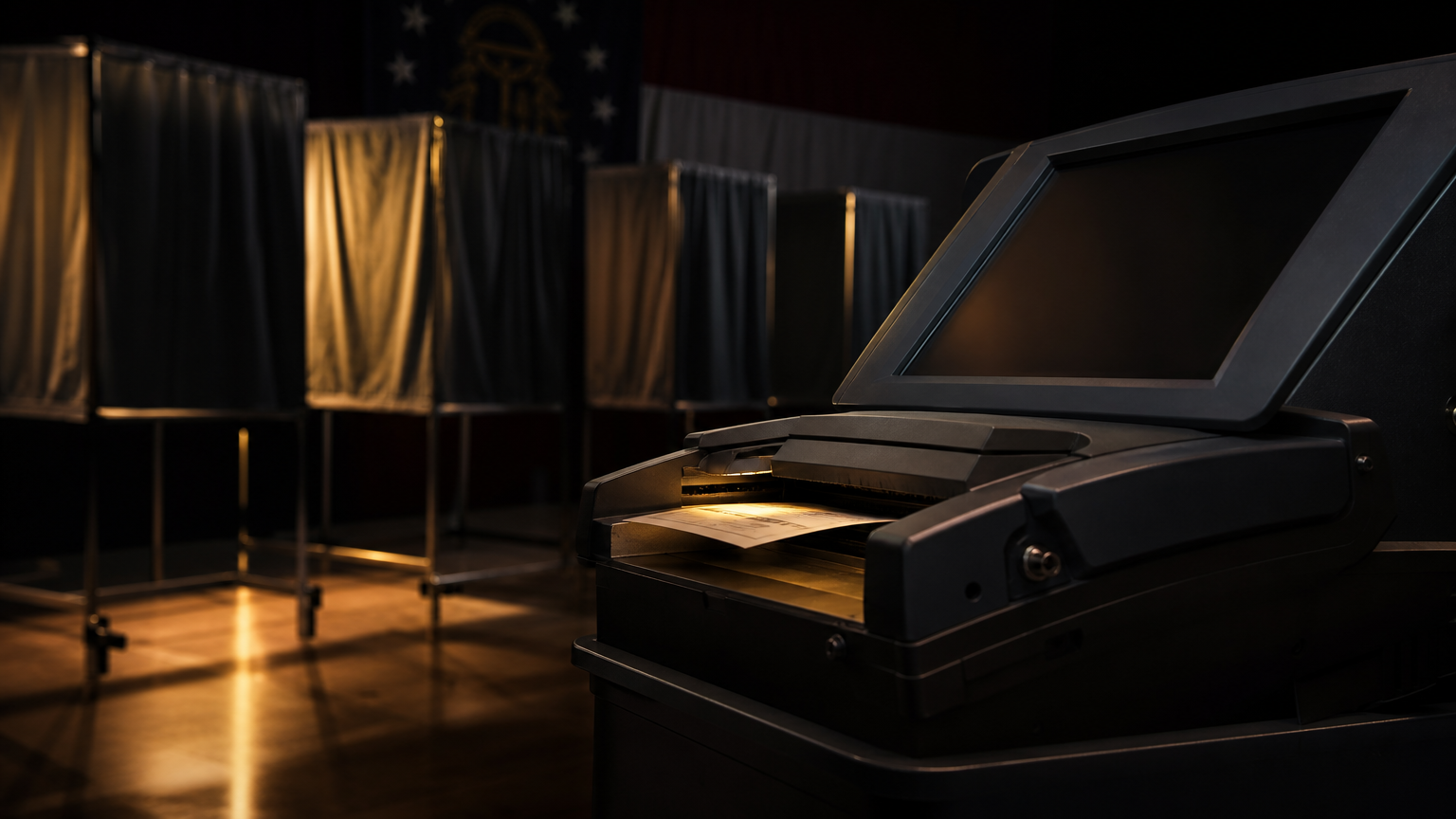
The privacy problem inside a transparent election system
Georgia’s voting infrastructure is facing renewed scrutiny after researchers warned that artificial intelligence can make it easier to exploit a lingering flaw in the state’s election records and potentially match voters with the ballots they cast . The danger is not that votes are being changed, erased, or fabricated. The danger is more basic and more corrosive: a system designed to prove the accuracy of an election may also disclose enough information to reconstruct how people voted .
The vulnerability matters because ballot secrecy is not a decorative feature of democracy. It is the mechanism that protects voters from pressure by employers, campaigns, political groups, family members, or anyone else who might try to reward, punish, buy, or coerce a vote. Georgia’s own legal framework is built around that principle; the Associated Press reported that the state constitution requires elections to be conducted by secret ballot and that state law requires voting machines to permit voting in absolute secrecy .
The immediate concern is Georgia’s use of touchscreen ballot-marking devices, printed paper ballots, and scanners. Voters make selections on a touchscreen, receive a printed paper ballot, and insert that ballot into a scanner for tabulation . The scanner produces electronic records, including cast-vote records and ballot images, that are valuable for audits, recounts, transparency, and public verification. Georgia also maintains a public ballot image library for past elections, with the state site describing the system as a way to search for ballot images from prior contests .
Transparency, however, becomes dangerous when the data released for oversight can be combined with other public records. According to the reporting, electronic ballot records and images are supposed to be randomized, but a software flaw allows the order to be reconstructed . Once the order of ballot scanning is recovered, an attacker can combine it with records showing who voted and when, narrowing or even identifying the link between a voter and a ballot .
AI changes the scale of the threat
The flaw has reportedly been known for years, but the reason it has become urgent now is automation. A privacy attack that once required specialized skill, patience, and custom code can be accelerated by modern AI coding tools . That is the threshold change: AI does not need to invent the vulnerability; it can operationalize it.
Max Springer, a Princeton University researcher who studies AI, told the AP that he used a publicly available AI assistant after giving it the earlier research on the vulnerability . The assistant was able to reverse the shuffling of electronic ballot records from Georgia’s May primary and identify what other records would be needed to match names to ballots . Springer then supplied early voting lists and cast-vote record files that could be obtained through public records requests, and the system generated groupings of ballots and possible voters .
In many cases, that was enough to match voters to their ballots, according to the report . Where ambiguity remained, Springer said public audit logs from ballot scanners and precinct check-in records helped match most ballots to specific voters . His conclusion was blunt: AI coding tools are enabling non-specialists to exploit weaknesses that previously would have been harder to turn into a working attack .
That is why this story is not simply another election-technology dispute. It is about the way AI compresses the distance between a theoretical vulnerability and a practical exploit. In cybersecurity, a weakness can remain dormant if it is too difficult, costly, or slow to exploit. But when a chatbot can guide a user through the technical work, the number of people capable of exploiting the weakness expands dramatically.
Accuracy is not the same as secrecy
Georgia officials and vendors can fairly point out that the reported flaw does not let an attacker change votes . That distinction is essential. This is not an allegation that the wrong candidates are being credited with votes. It is not evidence that tabulation results are unreliable. It is a privacy failure, not a vote-counting failure .
But that does not make it minor. Election legitimacy has more than one pillar. Accuracy is one pillar. Eligibility is another. Access is another. Ballot secrecy is another. A system can count votes correctly while still harming voters if it fails to keep their choices private.
That distinction is especially important in Georgia, where election administration remains politically sensitive and where technical claims about voting equipment are often pulled into partisan arguments. A privacy vulnerability should not be confused with discredited claims that machines switched votes or stole an election. The risk described here is narrower, more concrete, and still serious: if records can be linked back to people, the secret ballot is weakened even when the count is right.
Georgia’s election rules underscore the state’s dependence on optical scanning and paper records. Current state rules describe elections being conducted through an optical scanning voting system and require post-poll procedures involving scanner ballot totals, provisional ballots, and other reconciliation steps . Other rules state that a vote cast on an optical scan ballot is detected and tabulated directly from the paper ballot, not from an exported electronic image . These rules reflect the modern election bargain: paper records, scanners, audits, and transparency are supposed to reinforce trust.
The problem is that transparency must be designed with privacy in mind. Ballot images and cast-vote records can be powerful tools for public accountability, but if they preserve hidden sequencing information or identifiers, they can become a map back to the voter.
Georgia’s response: restrict release or fix the system?
The state has taken steps to reduce immediate exposure. The secretary of state’s office sent guidance instructing county election officials to refer open-records requests for certain records to the state office, which would release some records with problematic information blacked out and withhold other information . Gabriel Sterling, a senior official in the secretary of state’s office, said the office is working with a vendor to scramble the original order of ballot images and cast-vote records before they are made public .
That may reduce the risk from casual public-records requests. But critics argue that the deeper fix is to stop creating traceable records in the first place . Marilyn Marks, executive director of the Coalition for Good Governance, told the AP that withholding documents is not the proper solution when election records contain identifiers that can trace ballots to voters . In her view, the state must prevent the records from being linkable, not merely limit who can see them .
That debate is the heart of the matter. Restricting access can protect privacy in the short term, but it can also weaken public transparency. Election watchdogs, journalists, campaigns, researchers, and citizens rely on election records to verify outcomes. If secrecy is protected only by limiting access, the public may be asked to trust insiders more and verify less.
A durable solution must preserve both values: voters should not be identifiable, and election results should remain auditable. That likely requires technical remediation, including the vendor software update reportedly used in other jurisdictions . Mark Lindeman of Verified Voting told the AP that other jurisdictions using the same equipment have applied an update to fix the flaw, while some states avoid the problem by not releasing the records needed to exploit it . Georgia is especially exposed because the system is used statewide and because open records can make the necessary documents available .
The November pressure point
The timing is politically and operationally difficult. Georgia is approaching November elections, and the AP reported that election security advocates are criticizing officials for not fixing the problem before voters go to the polls . A proposed State Election Board rule in August would have required the secretary of state’s office to apply a manufacturer-recommended software update by a Tuesday deadline, but the board rejected the proposal amid questions about authority, certification, funding, and the short timeline .
Those concerns are not trivial. Changing certified election software close to an election can create its own risks: rushed deployment, uneven county implementation, training gaps, and legal challenges. But leaving a known privacy weakness unremediated also carries risks, especially once researchers have demonstrated that AI can lower the barrier to exploitation.
The strongest interim measures would be those that reduce linkability without disrupting tabulation: removing or redacting record identifiers, preventing release of raw sequencing clues, scrambling record order before publication, and physically or procedurally separating the act of voting from the order in which ballots are scanned. Marks suggested an interim approach in which ballots would be collected in locked boxes at precincts, then shuffled and scanned at a central tabulation center . That approach would target the sequence problem directly.
A democratic design failure
The deeper lesson is that election systems must be evaluated not only for whether they count correctly, but also for what metadata they create. Modern election records can be extraordinarily detailed. They can show ballot styles, scanner batches, timestamps, record identifiers, ballot images, cast-vote records, and audit logs. Each element can serve a legitimate purpose. Combined carelessly, they can defeat anonymity.
AI makes this design discipline more urgent. Public records that were once difficult to combine are now easier to parse, clean, correlate, and test. The relevant adversary is no longer only a well-funded state actor or an expert programmer. It may be a campaign operative, a data broker, a local activist, a curious insider, or anyone using a general-purpose AI assistant.
Georgia’s problem is therefore a warning to every jurisdiction that publishes granular election data. Transparency is essential, but transparency cannot mean releasing a puzzle whose solution is a voter’s private choice. Democracy should be auditable without being deanonymized.
The count can be accurate and the system can still need repair. That is the uncomfortable point Georgia officials now face. If a ballot can be traced back to the person who cast it, the system is not merely leaking data. It is leaking confidence.
Sources from the last 72 hours
- [1]The secret ballot has been an article of faith in US elections. That's being tested in GeorgiaSep 13, 2026, 11:36 AM UTC
- [2]Ballot Image Library | Georgia Secretary of StateSep 11, 2026, 12:00 AM UTC
- [3]GA R&R - GAC - Subject 183-1-12 PREPARATION FOR AND CONDUCT OF PRIMARIES AND ELECTIONSSep 11, 2026, 12:00 AM UTC
- [4]GA R&R - GAC - Subject 183-1-15 RETURNS OF PRIMARIES AND ELECTIONSSep 11, 2026, 12:00 AM UTC
AI-generated article based on recent web research, then preserved as a dated editorial snapshot.
Comments
Be the first to comment.