
Daily Podcast full article
StarCraft returns as open-world shooter
Blizzard has formally revived StarCraft, but not as StarCraft 3 or a traditional real-time strategy sequel: the next game is an original, story-driven open-world shooter planned for spring 2030, with Dan Hay leading a project that asks longtime fans to trade the commander’s chair for boots in the mud.
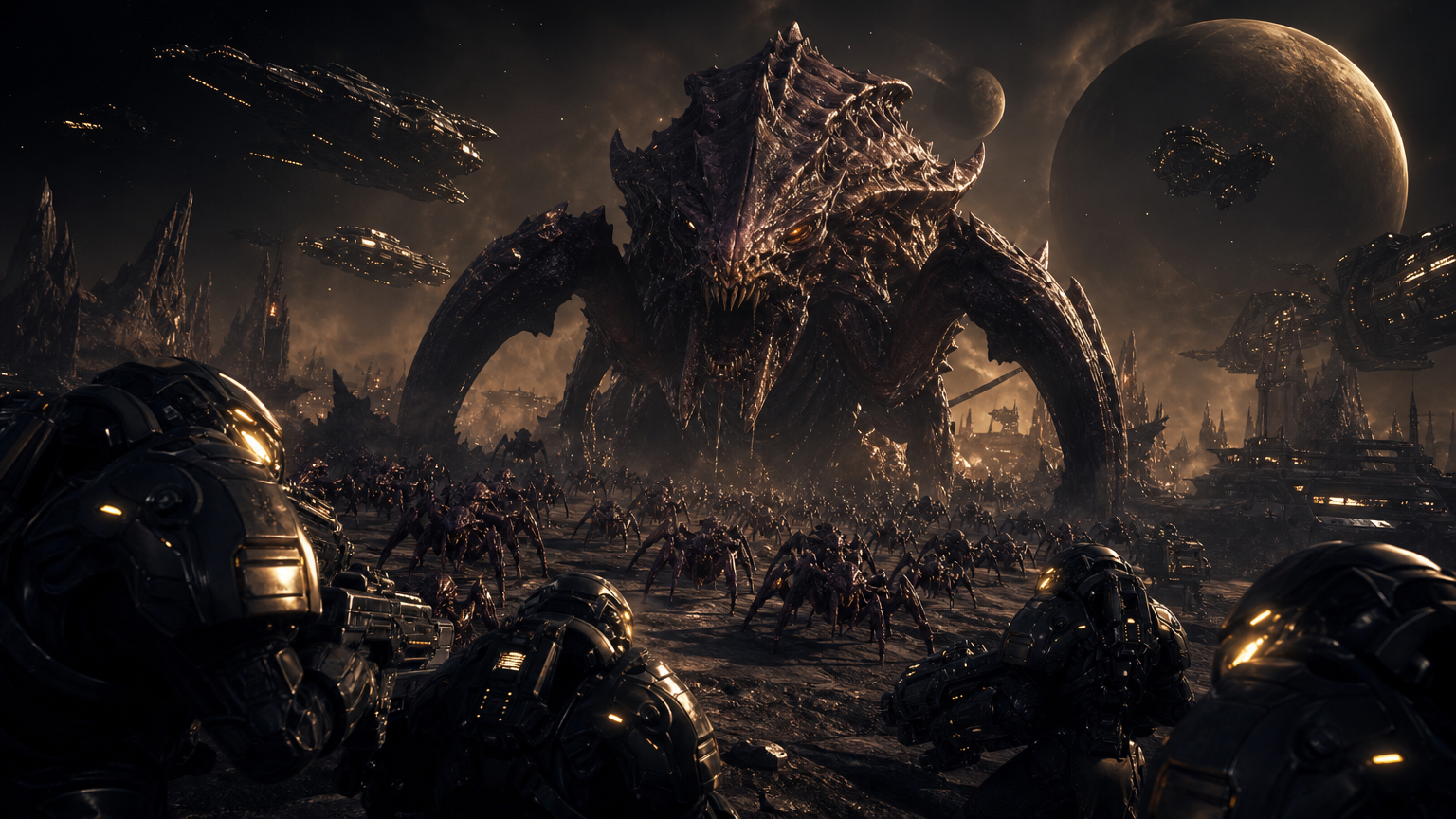
Blizzard brings StarCraft back, but changes the battlefield
Blizzard’s long-dormant sci-fi franchise is back in active public view after the BlizzCon 2026 opening ceremony, where the company announced that StarCraft will return as an original open-world shooter landing in spring 2030 . The title is officially presented simply as StarCraft, not StarCraft 3, and the announcement reframes one of PC gaming’s defining strategy universes around direct, ground-level combat rather than base-building, resource control and high-speed army management .
That genre shift is the story. Blizzard is not just reviving an old brand; it is asking the StarCraft audience to accept a new center of gravity. The series became famous through real-time strategy, esports, asymmetrical factions and the top-down command fantasy of Terran, Zerg and Protoss warfare. The 2030 project instead promises a shooter set inside the same universe, with reporting from the reveal describing it as open-world and story-driven . In practical terms, the player’s fantasy changes from orchestrating a Zerg rush or managing a Terran bio push to surviving those battles from the dirt.
The announcement was accompanied by a cinematic trailer titled “Dominion,” but Blizzard did not show gameplay during the reveal . That absence matters because “open-world shooter” can describe a wide range of designs: a single-player campaign, a co-op live-service structure, a faction war sandbox, an extraction-inflected world, or a narrative shooter with large hubs. For now, the confirmed pillars are narrower: StarCraft is back, it is an open-world shooter, it is set for spring 2030, and Blizzard is positioning it as a major future bet rather than a small spin-off .
The Dominion angle
The reveal material leans heavily on the Terran Dominion. The trailer follows the training and deployment of a Dominion Space Marine, framed by martial propaganda and sacrifice, before moving into a battlefield encounter with the Zerg . Worthplaying’s account of the announcement reproduced Blizzard’s Dominion-facing recruitment language, built around the “sons and daughters of the Dominion,” mankind’s survival and the call to carry the fight forward “no matter the cost” .
That framing is a smart first image for a StarCraft shooter. The Terrans have always been the franchise’s most accessible human perspective, and Marines are the most recognizable infantry unit in the setting. By centering the reveal on a Dominion soldier rather than on Kerrigan, Raynor, Artanis or a godlike Xel’naga storyline, Blizzard appears to be choosing scale through proximity: not the galactic map, but the person inside the armor.
GamesRadar’s early guide says the project is set in the Koprulu Sector roughly 70 years after StarCraft 2: Legacy of the Void, with the trailer suggesting a resurgent Swarm and a Dominion faction trying to regain a foothold . If that timeline holds, it gives Blizzard room to move beyond the completed arc of the original cast while still using the factions and iconography that make StarCraft instantly legible. It also lowers the burden of making a direct sequel to StarCraft 2’s campaign while keeping enough continuity for longtime players to care.
A long runway and a risky promise
A spring 2030 window is both useful and dangerous. It gives Blizzard roughly three and a half years from this announcement to define the project publicly, build confidence, and show why this is not merely a famous logo attached to a fashionable genre. But it also creates a long hype cycle around a game that currently has no public gameplay demonstration, no confirmed platforms, no final date, and no clear explanation of whether the open world is solo, cooperative, persistent, seasonal or something else .
PC Gamer captured the immediate tension around the reveal: the words “STARCRAFT RETURNS 2030” landed after the trailer, and the long wait became part of the reaction almost as quickly as the genre pivot itself . Blizzard president Johanna Faries defended the company’s habit of announcing major projects far ahead of release as a way to show confidence in its biggest bets and to signal that Blizzard intends to ship large games on time . That corporate message may reassure investors and employees, but players will judge the project by footage, systems and follow-through.
The risk is amplified because StarCraft already has history as an action-game almost. Blizzard’s cancelled StarCraft: Ghost remains one of the industry’s most famous “what if” projects, and current coverage has naturally compared the new shooter to Blizzard’s earlier attempts to move the franchise out of real-time strategy . Worthplaying also described this as Blizzard’s third attempt at a StarCraft shooter after Ghost and the reportedly cancelled Project Ares . That history does not doom the 2030 game, but it ensures skepticism will be part of the launch campaign until Blizzard shows sustained progress.
Why not an RTS?
For some fans, the central disappointment is simple: StarCraft is returning, but not in the genre that made it StarCraft. PC Gamer noted that speculation before the show included hopes for a new StarCraft RTS, but the announcement gave no sign that such a project exists . GamesRadar put the matter plainly: this is not a sequel to StarCraft 2: Wings of Liberty and not a real-time strategy game .
From Blizzard’s perspective, the decision is understandable even if it is painful for purists. Open-world shooters can support cinematic storytelling, character progression, broad console appeal, post-launch expansions and a longer commercial tail. StarCraft’s universe is already full of battlefield scale, faction identity, alien horror, military hardware and campaign spectacle; those elements can translate naturally into a shooter if the combat, mission design and world structure are strong.
But the pivot also removes the one thing no other Blizzard property can truly replace. Warcraft has action-RPG, MMO and strategy heritage. Diablo owns loot-driven action. Overwatch owns team shooting. StarCraft’s unique identity inside Blizzard has always been strategic speed, competitive clarity and three-way asymmetry. If the new game plays like a generic open-world shooter with Zerg skins, the brand name will become a liability. If it translates faction identity into weapons, enemies, traversal, squad tactics, vehicles and world control, it could justify the gamble.
What Blizzard has and has not said
The most important thing Blizzard has confirmed is broad direction, not mechanics. Multiple fresh reports agree that the new StarCraft is an open-world shooter, led by Dan Hay, the former Far Cry executive producer and creative director associated with Ubisoft’s open-world shooter experience . The reveal was cinematic rather than hands-on, and PC Gamer reported that no gameplay was shown at BlizzCon . GamesRadar also reported that platforms remain undefined, while expecting PC and Xbox as likely but not confirmed destinations .
That leaves major questions open. Will players control only Terran soldiers, or eventually Protoss and Zerg perspectives? Is “Dominion” the subtitle, a trailer label or only the factional theme of the reveal? Will the game be first-person, third-person, or support both? Will the world be a campaign space, a shared online environment, or a sequence of open combat zones? How will Blizzard preserve StarCraft’s factional asymmetry when a shooter typically centers one body, one weapon kit and one camera?
The 2030 date suggests Blizzard knows it is still early. The studio has time to answer those questions, but the expectations curve begins now. The announcement has succeeded in reviving attention. The next job is harder: proving that StarCraft can survive the jump from the commander’s overview to the Marine’s visor.
The bottom line
StarCraft’s return is not conservative nostalgia. It is a franchise reinvention aimed at a wider audience, built around a genre with broader mainstream reach than classic RTS. That makes it exciting, but also fragile. Blizzard has chosen a long runway, a famous universe, a proven open-world shooter leader and a spring 2030 target . What it has not yet shown is the game.
For now, the Zerg rush has been rescheduled for the next decade. Whether that becomes a triumphant return or another cautionary chapter in StarCraft shooter history depends on what Blizzard reveals after the cinematic glow fades.
Sources from the last 72 hours
- [1]Everything Announced at BlizzCon® 2026 Opening CeremonySep 12, 2026, 1:33 PM UTC
- [2]New StarCraft game is an open world shooter coming in 2030Sep 12, 2026, 12:00 AM UTC
- [3]StarCraft returns in 2030 with an open-world shooter, the legendary Blizzard series' first new game in almost a decadeSep 13, 2026, 12:00 AM UTC
- [4]Why is Blizzard still announcing games years ahead of release? 'We want to convey confidence in some of our biggest bets coming forward'Sep 13, 2026, 12:00 AM UTC
- [5]BlizzCon 2026: Blizzard announces new open-world StarCraft shooterSep 12, 2026, 2:00 PM UTC
- [6]'StarCraft' Open-World Shooter In Development, Scheduled For ... 2030 - TrailerSep 12, 2026, 6:10 PM UTC
- [7]StarCraft: Everything we know so far about Blizzard's new open-world, story-driven shooterSep 13, 2026, 12:00 AM UTC
AI-generated article based on recent web research, then preserved as a dated editorial snapshot.
Comments
Be the first to comment.