
Daily Podcast full article
SpaceX completes 700th Falcon mission
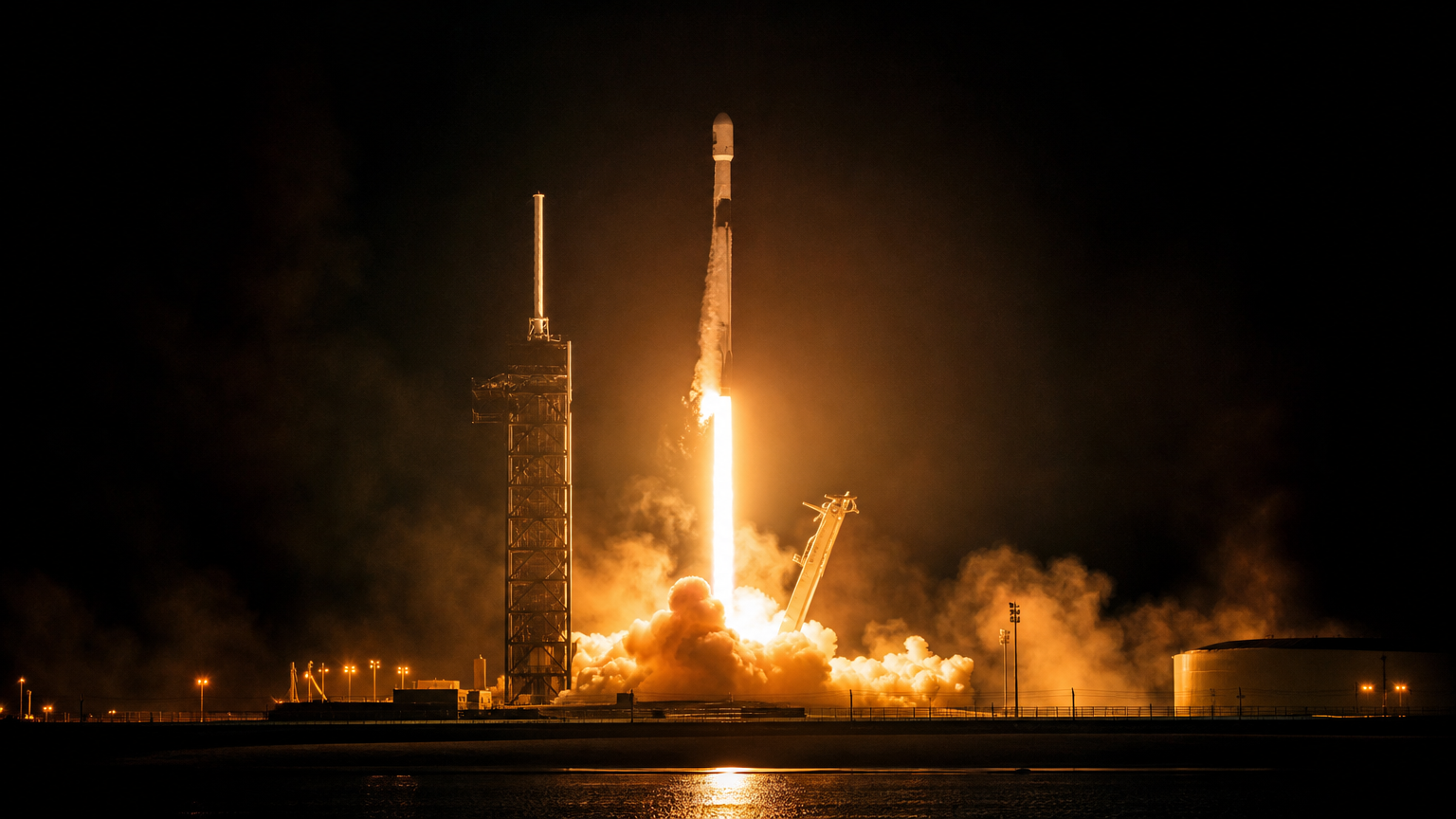
SpaceX’s Falcon fleet crossed the 700-mission line with a Cape Canaveral launch that placed the final three SES O3b mPOWER satellites on their way to medium Earth orbit. The flight was not just another tally mark for reuse; it showed Falcon 9 acting as shared launch infrastructure for a major broadband operator whose business sits outside SpaceX’s own Starlink empire.
A milestone launch with someone else’s network onboard
SpaceX completed its 700th Falcon mission on September 13, 2026, when a Falcon 9 lifted three SES O3b mPOWER communications satellites from Space Launch Complex 40 at Cape Canaveral Space Force Station in Florida at 2:49 p.m. EDT, or 18:49 UTC . The customer was SES, the Luxembourg-based satellite operator, and the payloads were the eleventh, twelfth and thirteenth spacecraft in its second-generation medium Earth orbit broadband system .
The launch mattered because the round number was tied to an external commercial customer, not to another Starlink deployment. Spaceflight Now reported that the 700 Falcon missions comprised 687 Falcon 9 launches and 13 Falcon Heavy launches, while Space.com described the same flight as the 700th mission to date for SpaceX’s Falcon rocket family . In other words, a company best known for vertically integrating its own satellite internet network marked a major fleet milestone by flying infrastructure for another global connectivity provider.
The mission was also the final deployment flight for the current O3b mPOWER constellation. SES said the three satellites would join 10 O3b mPOWER spacecraft already in operation and expand services that range from tens of megabits per second to multiple gigabits per second to a single site . SpaceX’s role was straightforward but important: deliver the last trio safely enough that SES can now move into orbit raising, checkout and eventual service expansion.
What flew, and why it counts
The payload stack consisted of O3b mPOWER satellites 11, 12 and 13, also described by Spaceflight Now as spacecraft F11, F12 and F13 . SES said the new satellites are intended to strengthen the performance, resiliency and reach of its medium Earth orbit network, with operational entry targeted for mid-2027 after commissioning . Spaceflight Now also reported that Boeing built the satellites and that the final three spacecraft complete the O3b mPOWER constellation .
O3b mPOWER is not a low Earth orbit megaconstellation like Starlink. It is a medium Earth orbit system designed for high-performance connectivity, especially for governments, enterprises, cloud providers, mobility customers and telecom operators in remote or demanding environments . That makes the September 13 launch strategically different from a routine Starlink batch: it expands a network that can compete, complement and interconnect with other satellite architectures rather than simply adding more SpaceX-owned capacity.
SES framed the flight as a defining milestone for its own roadmap. Chief executive Adel Al-Saleh said the launch completed the O3b mPOWER constellation and strengthened SES’s ability to deliver resilient, secure and scalable connectivity worldwide . SES also said the new satellites would support expanded capacity, additional flexibility across the system and progress toward next-generation sovereign and secure communications services .
Falcon 9’s industrial rhythm
For SpaceX, the defining number was 700. For the launch industry, the more important signal may be how ordinary the operation looked despite that number. The Falcon 9 used first-stage booster B1080, and Spaceflight Now reported that this was the booster’s 29th flight after earlier missions that included four trips tied to the International Space Station, ESA’s Euclid observatory, SES’s Astra 1P and 22 Starlink batches . Space.com likewise identified B1080 and reported that it landed on the drone ship A Shortfall of Gravitas less than nine minutes after liftoff .
That recovery kept the reuse cycle intact. Spaceflight Now counted the landing as the 166th on A Shortfall of Gravitas and the 661st Falcon booster landing overall . Space Launch Now’s mission page listed the flight as successful, showed B1080 with 29 flights and 29 successful landings, and noted that all spacecraft separated before SES confirmed launch success .
The numbers underline how SpaceX’s Falcon business has shifted from proving reusability to operating it at fleet scale. A 29-flight booster was once a hypothetical stress case; now it can launch the final satellites in another company’s broadband architecture on a Sunday afternoon from a heavily used pad. The milestone therefore belongs less to spectacle than to operations: launch, recover, refurbish, schedule and repeat.
The importance of SLC-40
The launch site adds another layer to the story. The mission departed from Space Launch Complex 40 at Cape Canaveral Space Force Station . Spaceflight Now reported that this was the 400th orbital launch from SLC-40 and that SpaceX was responsible for 345 of those flights . The same report noted that the pad received a crew and cargo access tower in 2023 and began supporting Dragon flights in March 2024 .
That matters because Falcon’s 700-mission milestone is not only a vehicle achievement. It is also a ground-system achievement. High-cadence rocketry depends on pad turnaround, maritime recovery, payload processing, range coordination and weather discipline. On September 13, the 45th Weather Squadron had forecast only a 60 percent chance of favorable conditions at the start of the window, deteriorating to 40 percent later, according to Spaceflight Now . The rocket still launched at the opening opportunity reported by SES and Space.com .
The result was a launch that looked routine because the supporting system has become routine. That is the quiet industrial significance of Falcon at 700 missions: SpaceX has made orbital launch cadence depend less on isolated heroics and more on integrated logistics.
A broadband market bigger than Starlink
The SES payload also complicates the standard narrative around SpaceX and satellite internet. Starlink is SpaceX’s internal demand engine, but Falcon 9 is also a transport layer for operators with different orbital strategies and customer bases. SES said O3b mPOWER targets enterprise, government, mobility and telecom customers and is designed to deliver high-performance connectivity in underserved, remote and demanding environments .
Space.com noted that SpaceX has launched all O3b mPOWER satellites across six Falcon 9 missions beginning in December 2022 . That continuity shows why rival or adjacent satellite operators still buy SpaceX launches: Falcon has become the most available commercial route to orbit even when the payload supports a network outside SpaceX’s own.
This does not erase competition. It highlights a more nuanced market. SpaceX sells broadband through Starlink, but it also sells launch capacity to broadband providers. SES, meanwhile, operates in medium Earth orbit and talks about multi-technology, multi-orbit connectivity rather than a single-layer network . The September 13 mission therefore captured the dual identity of Falcon 9: a tool of SpaceX’s own expansion and a neutral-enough logistics service for customers building independent space infrastructure.
What happens next
The satellites are not instantly in full service. SES said the three newly launched O3b mPOWER spacecraft are expected to become operational by mid-2027 . Spaceflight Now similarly reported that the satellites must complete orbit-raising, checkouts and commissioning before entering service . That means the launch completed the deployment phase, but the commercial and technical payoff will arrive after months of in-orbit work.
For SpaceX, the 700th Falcon mission is already in the rear-view mirror. Space.com reported that the flight was SpaceX’s 107th orbital mission of 2026 and Falcon 9’s 105th of the year, with Falcon Heavy accounting for the other two orbital missions . Those annual totals explain why the 700th Falcon mission is less an endpoint than a status indicator for a launch system that has become central to commercial, government and scientific spaceflight.
The memorable part is not merely that Falcon reached 700. It is that mission 700 carried three satellites for SES, completed a non-SpaceX broadband constellation deployment, reused a booster for the 29th time and ended with another drone-ship landing. Seven hundred launches later, Falcon’s achievement is not just flight; it is uptime.
Sources from the last 72 hours
- [1]SES’s Final Three O3b mPOWER Satellites Successfully LaunchedSep 13, 2026, 12:00 AM UTC
- [2]SpaceX launches 3 telecom satellites to orbit on 700th Falcon mission of all time (video)Sep 13, 2026, 12:00 AM UTC
- [3]Falcon 9 Block 5 | O3b mPower 11-13Sep 13, 2026, 11:09 PM UTC
- [4]SpaceX launches 700th Falcon rocket, carries final 3 O3b mPOWER satellites to orbit for SESSep 13, 2026, 12:00 AM UTC
AI-generated article based on recent web research, then preserved as a dated editorial snapshot.
Comments
Be the first to comment.