
Daily Podcast full article
UAE backs Boring Company with $3B: Musk’s tunnel wager moves to execution
A UAE-led $3 billion Series D has lifted The Boring Company’s valuation to $23 billion and tied Elon Musk’s tunnelling venture more tightly to Gulf infrastructure ambitions. The money is large; the harder test is whether the company can turn Dubai Loop and a proposed 150-plus kilometres of UAE tunnels into durable, permitted, heavily used transport infrastructure.
The deal: capital, confidence and a very concrete promise
The United Arab Emirates has become the lead backer of The Boring Company’s latest $3 billion Series D round, a financing that reportedly values Elon Musk’s tunnelling and transport startup at $23 billion . The round is not a generic technology bet. It is attached to a visible infrastructure ambition: expand the company’s partnership with the UAE and support more than 150 kilometres of underground transport infrastructure across the country .
That makes this deal different from many high-profile venture rounds. The UAE is not merely buying exposure to a Musk company; it is also helping underwrite a transport system it may become one of the first countries to deploy at scale . In other words, the investor and the customer are closely aligned, which can accelerate procurement and political support but also concentrates the commercial story around one geography and one state-backed vision.
The round includes other well-known investors, with reports naming Sequoia Capital, Andreessen Horowitz, Vy Capital, Valor Equity Partners and Human Capital among participants . A tech briefing on September 12 also listed Valor, Sequoia, Andreessen Horowitz and Human Capital, and said the proceeds are intended for hiring, Loop deployments and research and development around the Prufrock boring machine . For The Boring Company, the message is clear: the new money is meant to fund people, machines and projects, not just valuation optics.
Why the UAE is central
The Boring Company’s UAE push builds on the Dubai Loop, the passenger tunnel system associated with Dubai authorities and framed as the company’s first significant international construction foothold . The Stack’s September 12 briefing described the Dubai Loop pilot as a 6.4-kilometre route with four stations, with construction slated to begin in late 2026 . The Equilibrium similarly described the initial phase as about four miles and said the company expects digging to start before the end of the year .
That pilot matters because the broader 150-plus-kilometre ambition is far too large to judge by press-release momentum alone. A four-station route can test passenger flow, station operations, ventilation, emergency access, maintenance cycles, integration with roads and the tolerance of city regulators. It can also expose weaknesses before a national network becomes expensive to redesign.
The UAE’s interest fits a broader regional pattern: Gulf states have been using sovereign and affiliated capital to buy stakes in strategic technologies while also importing infrastructure concepts that support diversification, tourism and global-city branding. A tunnel network fits that agenda because it promises a premium mobility layer without taking surface space from roads, real estate or public plazas. But the same feature that makes tunnels attractive also makes them unforgiving. Once a route is bored, mistakes are literally embedded underground.
The valuation jump
The reported $23 billion valuation is striking because it represents a major rise from the company’s earlier private-market benchmark. Several recent summaries note that The Boring Company was valued at about $5.7 billion after a 2022 round, making the new valuation roughly four times higher . That increase is easier to understand if investors are pricing the company not as a small mobility operator but as a platform for repeatable tunnel construction, machine automation and government-backed urban infrastructure.
Still, a valuation is not a tunnel. The Boring Company must prove that its model can scale beyond limited systems and announced projects. The September 12 tech briefing described existing work as including the Las Vegas Convention Center Loop and an announced Nashville tunnel, while the UAE plan would dwarf the operational footprint the company has so far demonstrated . That imbalance is the heart of the story: investors are funding a future in which the company can bore faster, cheaper and more repeatedly than traditional contractors, but the public evidence still needs to catch up.
The new round also changes the company’s risk profile. A smaller venture-backed startup can survive delays as product iteration. A $23 billion infrastructure company tied to national transport ambitions faces a different standard. It has to meet civil-engineering timelines, safety codes, public expectations and contractual milestones. The software-world habit of shipping quickly and improving later does not translate easily to tunnels carrying passengers underground.
What the money is supposed to build
The stated use of proceeds matters. Reports published over the weekend point to three priorities: hiring, scaling Loop projects and developing the Prufrock tunnel-boring platform . If those priorities hold, the round is not just about Dubai. It is about whether The Boring Company can industrialize tunnelling.
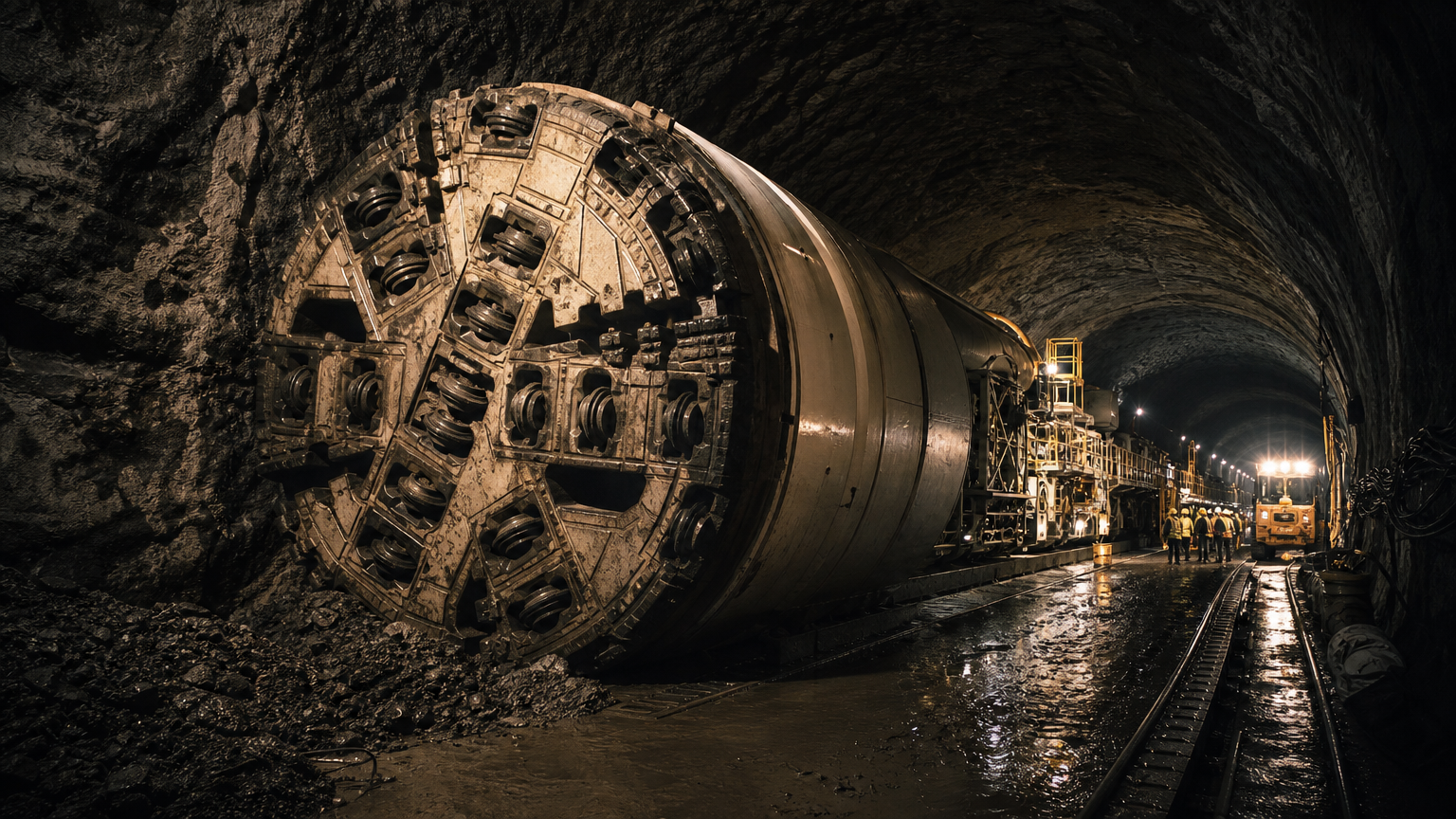
Prufrock is central to that thesis because a cheaper or faster boring machine would be the company’s real product, even if the public sees cars or pods in tunnels. The Loop system is the visible service; the machine and construction method are the potential margin engine. If The Boring Company can lower cost per kilometre, simplify launch and retrieval, automate more of the tunnelling process and reduce surface disruption, it has an argument for projects in dense cities where conventional transit is slow and expensive to build.
But if the economics do not improve, the model becomes harder to defend. Tunnels require geotechnical surveys, environmental approvals, utility coordination, fire-life-safety systems, stations, evacuation routes and long-term operations. These are not optional features. They are the difference between a demonstration and a public transport asset.
The investor-customer overlap
One of the most interesting aspects of the round is the overlap between funding and demand. The Equilibrium put the point bluntly: the biggest cheque writer is also linked to the largest order . That alignment can be powerful. Governments can clear land-use issues, coordinate agencies and commit to multi-year infrastructure plans in ways fragmented private customers cannot.
Yet it also raises a question for investors: is The Boring Company being valued on broad market demand or on a state-backed anchor project? AInvest’s September 12 analysis argued that the company’s valuation is deeply tied to the UAE project rather than to proven passenger revenue at large scale . That is a critical distinction. A company with one enormous strategic customer can look very valuable, but the durability of that value depends on execution, contract terms, utilization and the ability to replicate the model elsewhere.
For the UAE, the same overlap may be intentional. By investing, the country can share in upside if the technology becomes exportable. By commissioning tunnels, it gets early access. The strategy resembles a hybrid of industrial policy, venture capital and infrastructure procurement.
The execution test
The next year will matter more than the announcement. The market will watch whether Dubai Loop construction begins as described, whether route details and station plans become clearer, whether permitting proceeds smoothly, and whether the company discloses more about cost, capacity and operations. The 150-plus-kilometre figure is impressive, but the first kilometres will carry the credibility burden.
Utilization will be just as important as construction. A tunnel that moves few passengers is an engineering curiosity; a tunnel that moves many people reliably can become infrastructure. The Boring Company’s pitch has always been about defeating traffic by adding a third dimension beneath cities. The UAE round gives that pitch a better-funded laboratory, but not a free pass.
The company’s challenge is now to become less like a Musk concept and more like a disciplined civil-infrastructure operator. That means boring machines, yes, but also boring details: station throughput, maintenance staffing, passenger safety, emergency drills, insurance, operating costs and transparent performance data.
Bottom line
The UAE-led $3 billion round is a major endorsement of The Boring Company and one of the clearest signs yet that Gulf capital wants a front-row seat in Musk’s industrial ecosystem . It also gives the company a chance to move beyond scattered deployments and prove that Loop tunnels can become a repeatable transport product.
But the story is not solved by the cheque. The valuation assumes scale, the UAE plan assumes execution, and the Dubai Loop pilot must bridge the gap between spectacle and service. In infrastructure, confidence can open the tunnel door. Only delivery keeps traffic moving through it.
Sources from the last 72 hours
- [1]Boring Co. Raises $3B, Valued at $23B for Transit ProjectsSep 13, 2026, 12:00 AM UTC
- [2]The Stack — September 12, 2026Sep 12, 2026, 5:22 PM UTC
- [3]The Boring Company just raised $3 billion, and Abu Dhabi is buying the tunnelsSep 12, 2026, 12:00 AM UTC
- [4]The $23 Billion Tunnel Nobody Pays to RideSep 12, 2026, 5:45 AM UTC
AI-generated article based on recent web research, then preserved as a dated editorial snapshot.
Comments
Be the first to comment.