
Daily Podcast full article
Elon Stuns When Asked About Tesla & SpaceX Merger at All-In Summit
Elon Musk’s most revealing All-In Summit answer was not a formal merger announcement. It was his explanation of why Tesla and SpaceX are already acting like deeply interlocked industrial partners, especially around a new semiconductor push meant to reduce dependence on Taiwan’s advanced chip supply and give Musk’s companies more control over the hardware limits of AI, robotics and space infrastructure.
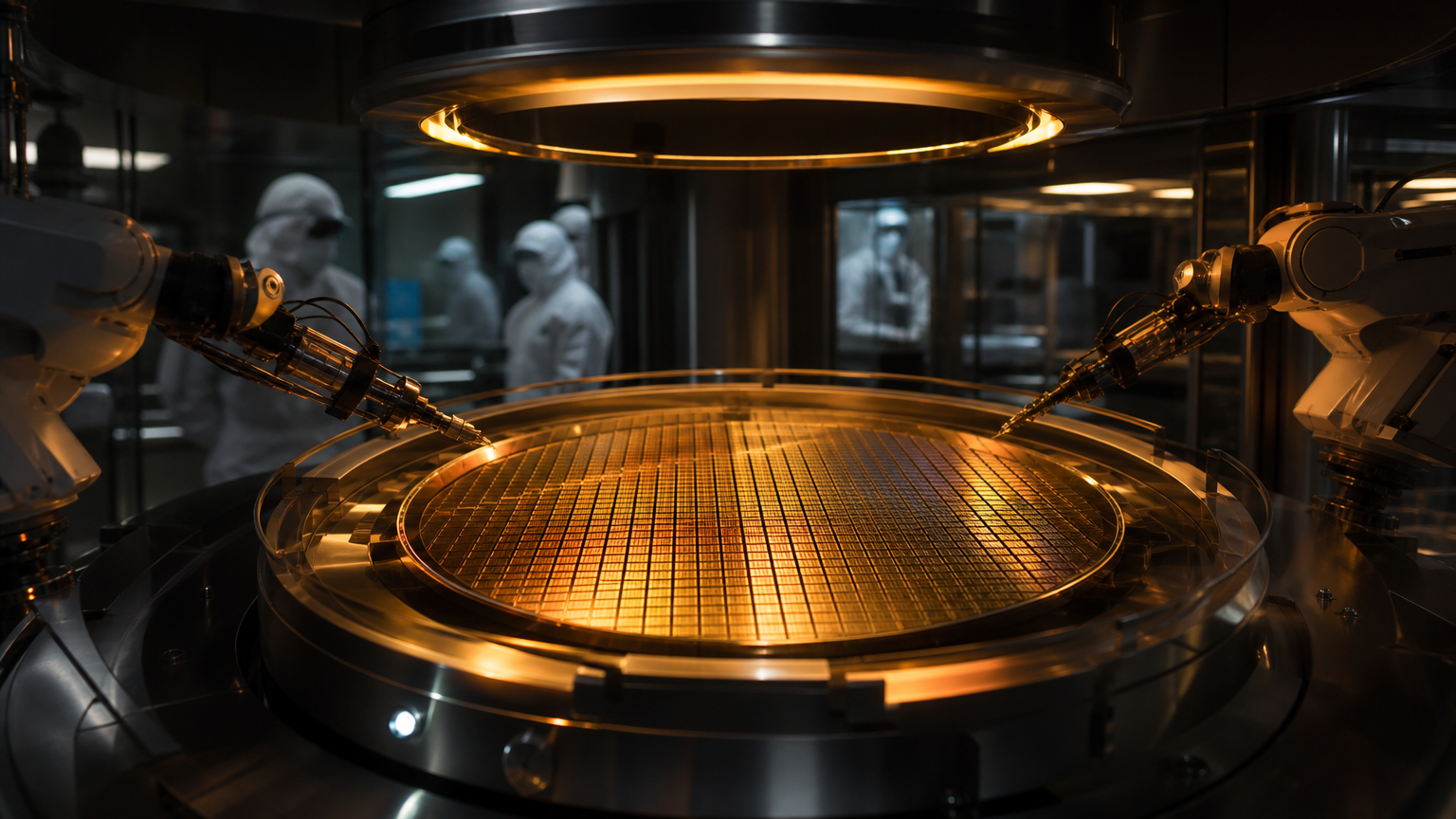
The question was about a merger. The answer was about chips.
Elon Musk did not say that Tesla and SpaceX are merging. That is the first thing to keep straight. What stunned the room at the All-In Summit was that, when asked why the two companies remain separate, Musk did not simply laugh off the idea or shut it down. Instead, he pointed to the amount of work already happening across company lines: shared engineering instincts, overlapping operational needs and, most importantly, a joint push into chip manufacturing .
That answer matters because the merger question was really a proxy for something larger. Tesla is no longer just an electric-vehicle company in Musk’s telling; it is an AI, robotics, autonomy and manufacturing platform. SpaceX is no longer just a launch company; it is Starlink, satellites, spacecraft, ground systems and potentially space-based data infrastructure. Both businesses now depend on the same scarce substrate: advanced semiconductors.
The immediate headline, then, is not that Musk announced a corporate transaction. He did not. The headline is that Tesla and SpaceX are being pulled together by the physics and geopolitics of compute. The All-In exchange turned a long-running fan and investor speculation into a concrete operational theme: if future growth depends on chips that others may not be able to supply, Musk wants the option to build more of the stack himself .
Terrafab is the strategic center of gravity
The project at the heart of Musk’s answer is Terrafab, described in the fresh HelloBro summary as a Tesla-SpaceX semiconductor effort tied to Austin and Giga Texas, with the first stage framed as a research fab rather than immediate mass production . Musk reportedly characterized this as a “crawl, walk, run” path: learn to make something useful, prove the process, and only then think about scale .
That distinction is important. A research fab is not the same thing as a mature leading-edge foundry. It is a learning machine. It lets engineers test designs, packaging approaches, process flows and manufacturing discipline before anyone can claim volume output. Musk acknowledged that Tesla and SpaceX have not previously run a fab line and that the first challenge is simply proving they can manufacture useful chips at all .
The motivation, however, is clear. Musk connected Terrafab to the risk that advanced chips from Taiwan might become unavailable, a disruption he framed as severe enough to impair operations . That is a strikingly blunt version of a concern many technology executives usually phrase more diplomatically. For Tesla, chip scarcity could slow vehicles, robotaxis and humanoid robots. For SpaceX, it could constrain satellites, ground terminals, spacecraft systems and any future data-center-like infrastructure in orbit.
The logic is classic Musk vertical integration. If a component is existential, do not merely negotiate harder with suppliers. Redesign the system around control. In software terms, it is the “sudo make it so” instinct applied to hardware: if one chip can save the roadmap, try to build the machine that builds the chip.
Austin is the crawl stage; Texas filings show the ambition is bigger
The Austin research-fab discussion should be read alongside fresh local documentation from Anderson-Shiro CISD, whose September 14, 2026 meeting materials describe TerraFab plans for a semiconductor and related device fabrication plant involving approximately 78 billion dollars in initial phases and a potential combined investment of approximately 119 billion dollars over four phases .
Those numbers should not be treated as guaranteed spend tomorrow. Public incentive, school-district and local-government materials often describe proposed or potential investment phases, not finished construction budgets. But they do show that the project being discussed around Terrafab is not a small lab curiosity. It is being contemplated as a multi-phase industrial campus with a scale far beyond an ordinary corporate R&D building .
This is where the All-In answer becomes more than theater. Musk’s comments about a Giga Texas research fab suggest the near-term practical work: order tools, learn packaging, run experiments, produce something useful by the end of next year if things go well . The local Texas materials show the outer envelope of ambition: a much larger semiconductor buildout that could become one of the most capital-intensive manufacturing bets associated with Musk’s companies .
The gap between those two realities is the story. Terrafab is simultaneously early and enormous. It is early because the team still has to learn semiconductor manufacturing at a serious level. It is enormous because the demand Musk is trying to serve spans cars, robots, satellites, AI servers and possibly space infrastructure.
Why Taiwan risk changes the corporate logic
Musk’s Taiwan point is not just a geopolitical aside. It explains why a Tesla-SpaceX chip effort can make sense even without a formal merger.
The world’s most advanced semiconductor production is concentrated in a small number of companies and regions. If the supply of frontier chips, advanced packaging or key manufacturing capacity tightens, the largest AI users do not merely pay more; they wait. Waiting is poisonous to Musk’s operating model. Tesla’s autonomy roadmap, Optimus scaling, Starlink upgrades and SpaceX’s future compute-heavy systems all depend on rapid iteration.
That is why packaging received special emphasis in the All-In summary. Musk and the executives around the project reportedly identified packaging as an early weak point in the supply chain, where even a successfully designed chip can be delayed before deployment . Starting there is pragmatic. Advanced chip fabrication is brutally hard, but packaging, testing and integration are also bottlenecks where vertical integration can produce real operational learning before full foundry-scale ambitions are reached.
A same-day AI infrastructure brief made the broader point in another way: the bottlenecks around AI are increasingly physical, with Musk also warning that gas turbines are sold out through 2030 in the context of data-center capacity constraints . Chips, packaging, power and factories are now part of the same strategic conversation. The AI race is not only about model quality; it is about who can secure enough watts and wafers to keep improving.
A merger hint, not a merger plan
So what did Musk actually signal on the Tesla-SpaceX merger question? The careful reading is this: he signaled strategic convergence, not a transaction.
A real merger would be enormously complicated. Tesla is public. SpaceX is private. Their investor bases, regulatory profiles, government-contract exposure, risk tolerances and capital structures are different. Any formal combination would require far more than Musk musing on stage. It would need boards, valuations, shareholder approvals, regulatory review and a detailed explanation of why Tesla shareholders should absorb aerospace, satellite and possibly defense-linked exposure, or why SpaceX holders should want public-market Tesla volatility.
But Musk’s refusal to dismiss the premise matters. He chose to answer by describing collaboration “in so many areas,” according to the HelloBro summary, and that answer will feed speculation precisely because it maps onto visible industrial reality . The companies already share a founder, a Texas footprint, an engineering culture and a growing dependence on AI infrastructure. Terrafab gives that overlap a physical address.
The real takeaway
The most important development from the All-In exchange is not that Tesla and SpaceX are about to become one company. It is that Musk is treating semiconductor supply as a mission-critical capability across his empire.
Terrafab is the embodiment of that view. In the short term, it is a research and learning project in Austin, with equipment on order and a goal of producing something useful before meaningful scale arrives . In the longer-term Texas planning context, it sits inside a much larger proposed semiconductor buildout measured in tens of billions of dollars . Strategically, it is Musk’s answer to a world where Taiwan risk, packaging constraints, AI power demand and full fabs running near capacity can all become brakes on growth.
The merger question got the viral moment. The chip answer was the substance. Tesla and SpaceX may remain legally separate, but Terrafab shows why they are increasingly solving the same problem: how to get enough custom compute, manufactured close enough to home, to keep the machines, robots and rockets moving.
Sources from the last 72 hours
- [1]Elon Stuns When Asked About Tesla & SpaceX Merger (at All In Summit today) · SpaceX · HelloBro.aiSep 15, 2026, 10:15 AM UTC
- [2]Anderson-Shiro CISD Public View - BoardBook PremierSep 14, 2026, 11:30 PM UTC
- [3]AI Industry Overnight Brief September 15, 2026 | Trump Calls AI Fears a 'Hoax' on Huang Call as Gas Turbines Sell Out to 2030, OpenAI Slides IPO to 2027 at $852B Mark, Kioxia Eyes $10B US ADR - Denial Meets Bottleneck · NightIndexSep 15, 2026, 12:10 AM UTC
AI-generated article based on recent web research, then preserved as a dated editorial snapshot.
Comments
Be the first to comment.