
Daily Podcast full article
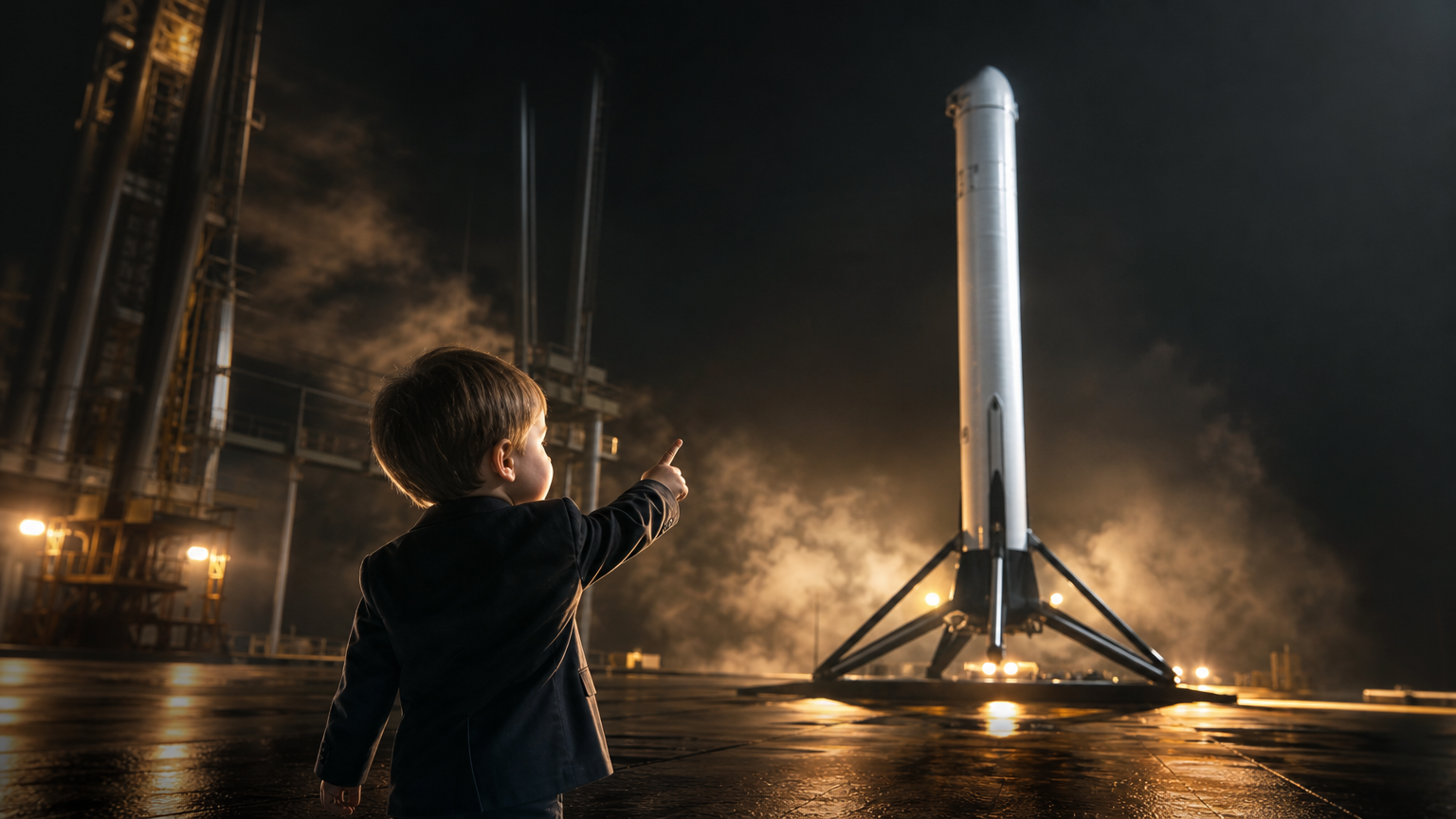
Baby Elon Explains SpaceX (2008): the reusable-rocket bet reaches its orbital exam
In 2008, SpaceX’s pitch sounded almost childishly simple: rockets should not be thrown away after one flight. Eighteen years later, Falcon 9 has made first-stage reuse routine, while Starship’s next test is framed as the moment when SpaceX tries to move the original fully reusable vision from analogy to orbital practice.
The 2008 thesis, in one line
The working headline is still the right one: Baby Elon Explains SpaceX (2008). The story is not just nostalgia about a young company or a young Elon Musk. It is about a technical claim that has aged into an operating doctrine: affordable human spaceflight depends on making orbital rockets reusable, not slightly cheaper disposable machines.
In the 2008 argument summarized by HelloBro.ai, SpaceX said launch costs had failed to improve meaningfully since the 1960s and framed full reusability as the breakthrough that could change the economics of access to orbit . The analogy was deliberately blunt: using an expendable rocket was like throwing away a car after one trip . Falcon 1 was presented as a vehicle with a reusable first stage in mind, while Falcon 9 was described as the path toward reusing both stages .
That is the key to reading the latest SpaceX news. The current question is not whether SpaceX can launch a lot. Falcon 9 has already answered that. The question is whether SpaceX can finish the harder half of the 2008 promise: recover and rapidly reuse an orbital-class upper stage.
Falcon 9 turned reuse from slogan into infrastructure
On September 13, 2026, SpaceX launched three SES O3b mPOWER satellites from Cape Canaveral on what Space.com described as the 700th mission for the Falcon rocket family . The same report said the flight was SpaceX’s 107th orbital mission of 2026 and Falcon 9’s 105th launch of the year . Those numbers are the practical consequence of the 2008 argument: once the most expensive hardware comes back, launch cadence becomes an engineering and logistics problem rather than a pure manufacturing problem.
The details of that September 13 mission make the point sharper. The Falcon 9 booster, B1080, was flying for the 29th time and landed on the droneship “A Shortfall of Gravitas” less than nine minutes after launch . That is not full rocket reuse, because the Falcon 9 second stage is still expended. But it is enough reuse to change behavior across the launch market: customers now routinely ride on flight-proven boosters, and launch operations are built around inspection, refurbishment and reflight rather than single-use disposal.
In 2008, SpaceX was arguing against the inherited personality of rockets: heroic, expensive and disposable. By 2026, Falcon 9’s first stage has become almost mundane in the best possible way. It flies, lands, gets turned around and flies again. The “car after one trip” analogy no longer sounds like marketing; it sounds like a maintenance philosophy.
Starship is where the original promise remains unfinished
Starship is the vehicle that keeps the 2008 thesis alive because it targets the part Falcon 9 did not solve: full and rapid reusability of both the booster and the spacecraft. Space.com reported on September 15, 2026 that SpaceX is targeting September 22 for Starship Flight 14, described as the first attempt to send Starship into orbit . The planned launch window opens at 8:15 a.m. EDT, or 12:15 GMT, from Starbase in South Texas .
That planned flight is more than a symbolic orbit. SpaceX intends Flight 14 to deploy 26 Starlink V3 satellites, complete about six orbits at roughly 275 kilometers altitude and splash down in the Pacific west of Chile after about 10 hours . Aviation Week also reported that the mission is targeting nearly 10 hours in duration, that Federal Aviation Administration mission licensing remains pending, and that the spacecraft is expected to carry the first batch of 26 Starlink V3 satellites for SpaceX’s operational network .
This matters because previous Starship tests were not sustained orbital missions. Space.com noted that Starship’s first 13 flights were suborbital, while Flight 14 is designed to begin the phase in which SpaceX can develop Starship as a fully and rapidly reusable system . In other words, orbit is not the finish line. It is the entrance exam.
Reuse now depends on heat shields, relights and boring reliability
The newest development is not simply “bigger rocket goes farther.” It is a checklist of the unglamorous systems that decide whether reusability is real. Ars Technica reported that SpaceX has made changes to the Super Heavy booster after Flight 13, when the booster experienced engine-relight problems during its return sequence and made a hard splashdown in the Gulf . According to Ars, the next booster will target an offshore Gulf landing rather than a tower catch, while hardware and software changes are intended to improve engine filtering and relight reliability .
The upper stage has its own reuse exam. Ars reported that SpaceX is using Flight 14 to gather more heat-shield data and that the company has added tile-retention mechanisms, addressed plasma flow paths behind tiles and will test curved tile designs . It also reported that two tiles recovered from Ship 40 are planned to fly again on Ship 41, marking the first tile reuse for Starship . That small detail is philosophically huge: full reuse begins not with speeches about Mars, but with whether a heat-shield tile can survive, be inspected and fly again.
Space.com reported that SpaceX will not attempt to catch either the Starship upper stage or the Super Heavy booster on Flight 14 . That restraint is important. A system meant to be routine cannot be proven by rushing the riskiest recovery maneuver before the ascent, orbital operations, payload deployment, deorbit and reentry chain is understood. Reusability is not one trick; it is a stack of reliable events.
The business case is now riding inside the test vehicle
The 2008 SpaceX pitch connected reusable rockets to affordable human spaceflight and a multiplanetary future . In 2026, the immediate payload is not a crewed Mars ship but Starlink capacity. TechCrunch reported that Flight 14 is expected to deploy the first orbital batch of 26 V3 Starlink satellites and described this as potentially the first Starship launch to generate launch-division revenue, even if the customer is another SpaceX division .
That internal-customer structure is classic SpaceX. Falcon 9’s cadence was reinforced by Starlink demand; Starship’s early operational purpose is likewise tied to satellites too large or too numerous for the older architecture. Space.com reported that Starlink V3 satellites are designed to launch on Starship and that Flight 14’s Starlink payload is meant to expand network speed and reliability . Avid Spaceflight reported that each V3 satellite is designed for about 1 terabit per second of downlink capacity, implying about 26 terabits per second of potential added downlink capacity from the Flight 14 batch if the satellites become operational .
This brings the old cost argument into the present. Reusability is not an abstract virtue. It is what allows SpaceX to imagine moving from dozens of tons per launch to very large recurring payload flows, then using those flows to support broadband, lunar logistics, orbital refueling and eventually human deep-space transport.
So did “baby Elon” get it right?
Mostly, yes, but with an asterisk. The 2008 thesis was right that the core cost problem was not merely engines, factories or procurement. It was disposability. Falcon 9’s 2026 launch rate and booster reflight history show that partial reuse can reshape the orbital launch market . The company that once argued rockets should behave more like aircraft has built a Falcon operation that, while not airline-like, is unmistakably reuse-centered.
The asterisk is that full reuse remains harder than the analogy suggests. Falcon 9 did not make its second stage reusable. Starship is now trying to close that gap, and Flight 14 is designed to test orbit, payload deployment, long-duration flight, reentry learning and recovery data without attempting the tower catches that would eventually enable faster reuse . That is progress, but it is not yet routine operations.
The current state of the subject is therefore a neat historical loop. In 2008, SpaceX argued that throwing away orbital rockets was the central absurdity holding spaceflight back . In September 2026, Falcon 9 shows how much changes when part of the rocket comes home, while Starship is preparing to test whether the whole architecture can finally grow out of its single-use personality disorder.
Sources from the last 72 hours
- [1]Baby Elon Explains SpaceX (2008) · SpaceX · HelloBro.aiSep 16, 2026, 6:00 AM UTC
- [2]SpaceX's next Starship launch will lift off on Sept. 22 and aim to reach orbit for 1st timeSep 15, 2026, 12:00 AM UTC
- [3]SpaceX declares Starship ready for orbit, sets launch date next weekSep 15, 2026, 2:48 PM UTC
- [4]SpaceX Sets Sept. 22 For Next Starship Flight TestSep 15, 2026, 12:00 AM UTC
- [5]SpaceX launches 3 telecom satellites to orbit on 700th Falcon mission of all time (video)Sep 13, 2026, 9:41 PM UTC
- [6]SpaceX will try to put Starship in orbit for the first time on September 22Sep 15, 2026, 6:16 PM UTC
- [7]Starship Flight 14: SpaceX Prepares for First Orbital Flight and Starlink V3 DeploymentSep 15, 2026, 12:00 AM UTC
AI-generated article based on recent web research, then preserved as a dated editorial snapshot.
Comments
Be the first to comment.