Daily Podcast full article
Boring Company raises $3B
The UAE-led Series D gives Elon Musk’s tunnel venture a $23 billion valuation and a mandate to turn Loop projects from demonstrations into repeatable infrastructure, with more than 150 kilometers of planned UAE tunnels now at the center of the story.
A $3 billion tunnel bet, led from the Gulf
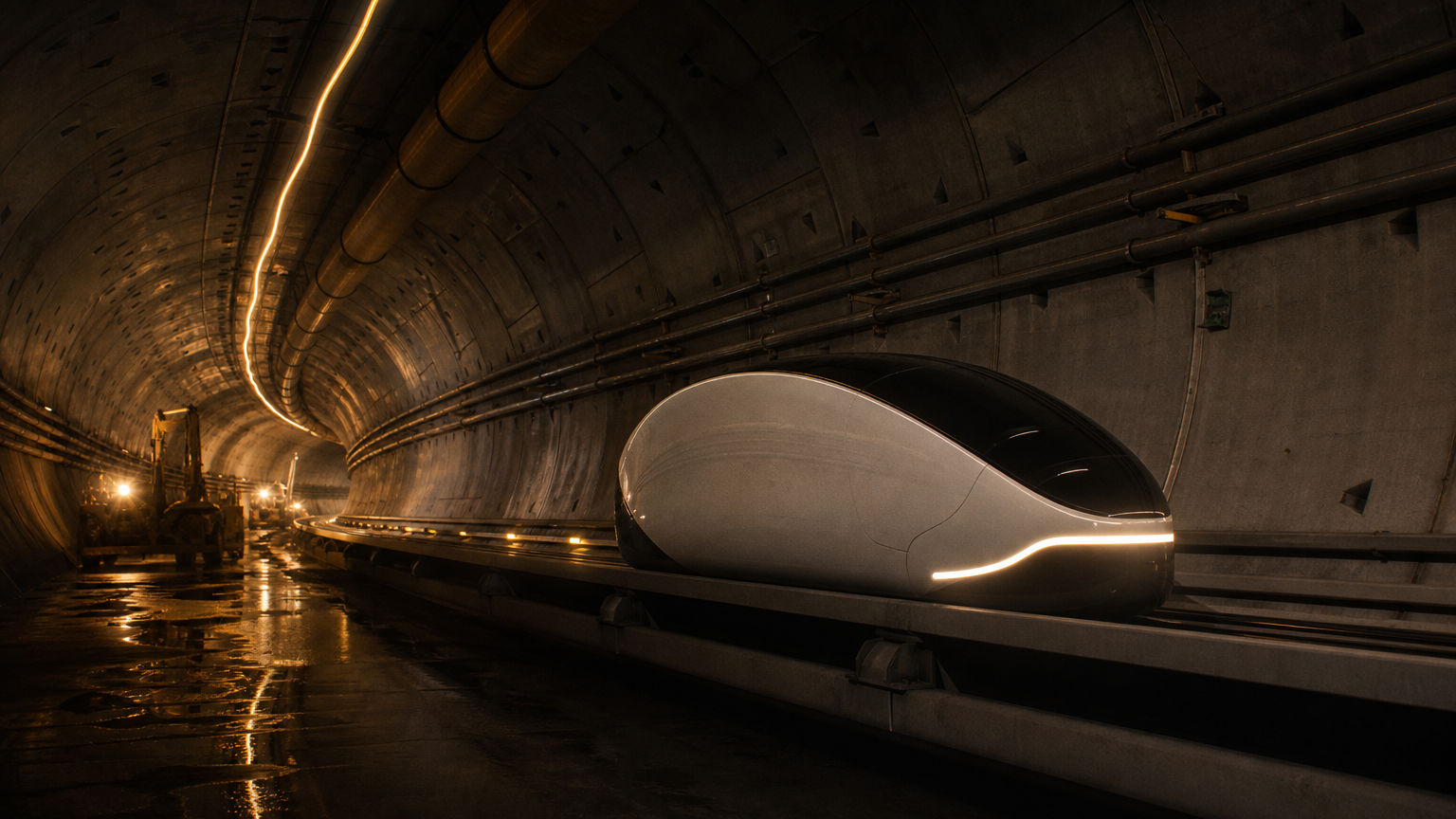
The Boring Company has raised $3 billion in a Series D round led by the United Arab Emirates and affiliated investment entities, lifting Elon Musk’s tunneling venture to a reported $23 billion valuation . The new capital is not just a balance-sheet event: it is tied to a plan to deploy more than 150 kilometers, or about 93 miles, of underground infrastructure across the UAE, separate from the previously awarded Dubai Loop project .
That distinction matters. Dubai Loop has already been described as a pilot-scale project, while the new UAE commitment points to a much larger national infrastructure ambition . The Boring Company’s challenge is therefore no longer only whether it can excite investors. It is whether it can convert sovereign-backed capital, permitting, tunneling machines, station construction, operations and passenger demand into a functioning transport network.
The investor list also signals how the company is being framed. Beyond the UAE and affiliated entities, the round included Human Capital, Vy Capital, Valor Equity Partners, Sequoia Capital, Andreessen Horowitz, Temasek, Shamal Holding and Baron Capital . For a company whose public identity remains closely linked to Musk, the mix of venture capital, sovereign-adjacent capital and regional investors shows that the UAE is treating tunnel infrastructure as a strategic mobility and development bet, not simply as a financial trade.
Why the UAE is the center of gravity
The Boring Company’s original public narrative was simple: move cars underground to reduce traffic. The current financing makes the UAE the most important test of that thesis. Fresh reporting says the company has agreed to build more than 150 kilometers of tunnels in the country, while the Dubai Loop pilot separately calls for a 6.4-kilometer tunnel with four stations and construction expected to begin late this year .
In practical terms, this means the UAE is both investor and potential anchor customer. That alignment can reduce one of the biggest frictions in urban infrastructure: the gap between a technology provider that wants to build quickly and public authorities that control rights-of-way, safety rules, environmental approvals and passenger systems. But it also concentrates the risk. If the UAE program slips, The Boring Company’s new valuation will be judged against a very visible international benchmark.
The timing is important because Dubai Loop is still pre-service. Recent coverage notes that Las Vegas remains the only place where The Boring Company is currently moving passengers . That makes the UAE expansion less a proven replication of an operating model and more a high-stakes attempt to scale a model that has so far been commercially visible in one market.
The Las Vegas proof point — and its limits
The strongest proof point for The Boring Company remains Las Vegas. The company says Vegas Loop has carried more than four million riders, and Clark County has approved 19 additional stations, bringing the planned network to 123 stations . The same reporting says the company has begun its 14th tunnel in Las Vegas and its 25th tunnel overall, giving investors evidence that the venture has moved beyond a single showpiece tunnel .
Still, Las Vegas is not a full subway system, commuter rail network or urban mass-transit substitute. The current Loop model moves passengers in electric vehicles through narrow tunnels, and current projects use modified Teslas at lower speeds rather than fully autonomous high-capacity pods . That design can be attractive for point-to-point trips in tourism and convention districts, where predictable flows and relatively short distances may suit a premium, controlled network. It is less clear whether the same model can address everyday urban congestion at metro scale.
That is why the $3 billion round intensifies, rather than resolves, the central debate. If the company can dig faster and cheaper than conventional projects, a smaller-diameter tunnel system may become attractive to cities that cannot wait a decade for rail megaprojects. If it cannot show higher throughput, better cost discipline and reliable public operations, the round may look like capital chasing a charismatic founder rather than an infrastructure breakthrough.
Prufrock, hiring and the physical bottleneck
The stated use of proceeds shows where The Boring Company thinks the bottlenecks are. The new money is meant to support Loop expansion, continued work on Prufrock tunnel-boring machines and hiring across engineering, operations and production . That is a revealing list because tunneling is not software. It scales through machines, crews, geology, concrete segments, site logistics, safety protocols and government approvals.
Prufrock is therefore central to the investment case. Built In describes The Boring Company as developing its own tunnel-boring machines, with Prufrock designed to tunnel at a speed of one mile per week . The company’s broader argument is that vertical integration and smaller tunnel diameters can lower the time and cost of urban tunneling . Investors are effectively underwriting that engineering claim.
Nashville adds another layer to the test. Tunneling Online reports that The Boring Company’s Music City Loop began tunneling on February 25, 2026, after receiving a Tennessee Department of Transportation permit, and that the project is the company’s first in hard rock . By August, two machines were reportedly mining simultaneously, while a third was in final assembly in Bastrop for shipment to Nashville . That matters because a system that works in one type of ground must prove it can work across different geology if it is to become a repeatable infrastructure platform.
A valuation built on execution risk
At $23 billion, The Boring Company is being valued as more than a niche contractor. The latest valuation is roughly four times the company’s 2022 valuation of about $5.7 billion, according to recent coverage . That step-up reflects the size of the UAE opportunity, but it also raises the burden of proof.
The company has announced or pursued projects in multiple cities, but fresh summaries still point out that Las Vegas is the only location where it currently carries passengers . DigitalToday’s updated coverage framed the fundraising as a deal that places greater weight on future UAE tunnel plans than on current operating performance . That is a fair reading: the money prices in a future in which The Boring Company becomes a multi-city infrastructure operator, not merely a builder of demonstration tunnels.
There are reasons investors may accept that risk. A sovereign-backed UAE program can offer a clearer path from financing to deployment than fragmented municipal negotiations. The Gulf’s appetite for high-profile infrastructure and technology projects also gives The Boring Company a venue where ambition, capital and urban development planning can move together. But infrastructure has a way of enforcing discipline. Route maps, utility relocation, fire safety, ventilation, emergency access, passenger capacity and maintenance regimes are harder to accelerate than fundraising.
What to watch next
The first watch item is whether Dubai Loop construction begins on schedule and whether the 6.4-kilometer, four-station pilot moves from precast production to visible tunneling and station works . The second is whether The Boring Company or UAE authorities disclose more detail on the separate 150-plus-kilometer program: routes, phasing, budget, passenger model, regulatory structure and delivery timetable.
The third is whether Las Vegas continues to expand from a convention-oriented proof point into a broader urban network. The fourth is Nashville, where hard-rock performance could either strengthen or weaken the argument that Prufrock machines can generalize across markets .
For now, the headline is clear: Boring Company raises $3B, and the UAE has become the company’s most important proving ground. The financing gives Musk’s tunneling venture unusual firepower. It also gives investors, cities and skeptics a much larger scoreboard. The next story will not be about whether capital arrived at ludicrous speed. It will be about whether the tunnels do.
Sources from the last 72 hours
- [1]The Boring Company Announces Series D FundingSep 15, 2026, 12:00 AM UTC
- [2]UAE leads $3 billion investment into Elon Musk's Boring Company, valuing it at $23BSep 15, 2026, 1:43 PM UTC
- [3]With The Boring Company, Elon Musk Is Taking City Traffic UndergroundSep 15, 2026, 12:00 AM UTC
- [4]Musk's Boring Company raises $3 billion in UAE-led round, valued at $23 billionSep 15, 2026, 8:00 PM UTC
AI-generated article based on recent web research, then preserved as a dated editorial snapshot.
Comments
Be the first to comment.