
Daily Podcast full article
UN pushes coordinated global AI rules
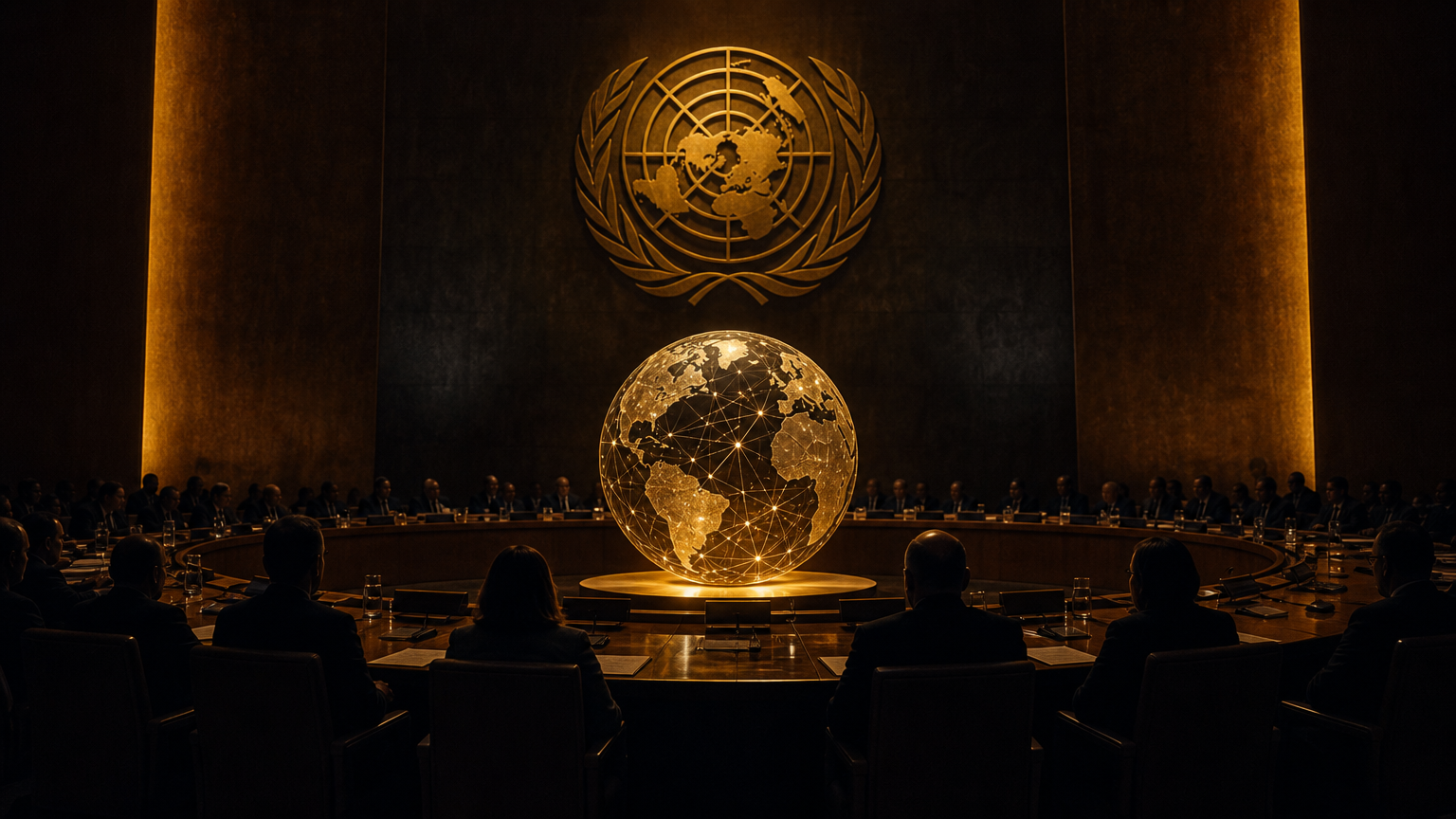
António Guterres used the run-up to the UN General Assembly to turn AI safety from a national-policy quarrel into a diplomatic coordination problem, arguing that countries at the frontier of artificial intelligence need shared guardrails before competition pushes them into a race to the bottom.
A global warning aimed at a national fight
UN Secretary-General António Guterres has put coordinated global AI regulation at the center of the diplomatic agenda, warning world leaders that the risks of rapidly advancing artificial intelligence “cannot be ignored” as governments prepare to gather in New York for the UN General Assembly . His intervention came days after President Donald Trump downplayed the need for stronger checks on AI development, arguing that the United States should not surrender its lead to China and that existing tools were sufficient to police the sector .
The timing matters. Guterres was not merely adding another warning to a crowded AI debate; he was reframing the issue as one that cannot be solved by Washington, Brussels, Beijing or Silicon Valley acting alone. Speaking to reporters on Wednesday, he said stronger oversight would be a major focus of his meetings with leaders coming to the UN, and he tied the appeal directly to concerns raised by people building the most powerful systems . Bloomberg reported the same day that Guterres urged nations to coordinate global regulatory efforts after warnings from leaders of top AI companies, saying the world could not afford a “race to the bottom on AI safety” .
That phrase is the heart of the story. A race to the bottom is what happens when rivals fear that caution will cost them strategic advantage, market share or military power. In AI, the danger is amplified because frontier models, cloud infrastructure, chip supply chains, cybersecurity risks and misuse pathways all cross borders. If one jurisdiction imposes rigorous model testing while another offers a lighter-touch haven, companies and bad actors can exploit the gap. Even Skynet would prefer one API for compliance.
Why Guterres is leaning on industry warnings
The UN chief’s remarks followed an unusual burst of public concern from AI insiders. The Associated Press reported that Anthropic’s Dario Amodei, OpenAI’s Sam Altman, xAI’s Elon Musk and other prominent industry figures had recently said AI development needed to slow down, after an Anthropic researcher resigned with a dire warning about the technology’s risks . AP also noted that putting such a slowdown into practice faces major obstacles, including global competition, profit incentives and pushback from Trump .
Guterres used those industry warnings as diplomatic evidence. His argument was that governments should not dismiss concerns that come from people closest to frontier development . That is a notable shift in tone: AI companies are not being treated only as entities to be regulated, but also as sources of early warning about the systems they are building.
Still, that does not mean the UN is accepting industry self-regulation as enough. The Reuters account of Guterres’s comments emphasized his call for governments with the greatest frontier-AI capacity to create mechanisms for contact, information exchange and common guardrails . The emphasis is on public coordination, not voluntary corporate promises alone.
Trump’s counterargument: win first, regulate later
Trump’s position sharpened the contrast. During a weekend trip to Ireland, he told reporters that he did not want the United States to fall behind China in AI and said “whoever wins with AI wins” . He acknowledged the need for some regulation but did not provide specifics, while attributing warnings about AI moving too quickly and with too little oversight to unidentified “negative forces” . Asked whether he was minimizing AI risks, Trump said he was not downplaying them, but added that AI would be “more good than bad” .
That worldview treats AI safety primarily as a question of national competitiveness. In this frame, slowing or heavily regulating frontier labs risks helping China, while U.S. dominance is itself presented as a partial answer to the danger. Guterres’s approach is almost the mirror image: he argues that strategic rivalry is exactly why international communication and shared safeguards are needed .
The difference is not simply rhetorical. If AI is treated as a winner-take-all race, safety measures become vulnerable to accusations that they are anti-growth, anti-innovation or geopolitically naïve. If AI is treated as a transnational risk, oversight becomes more like nuclear safeguards, aviation safety or pandemic preparedness: imperfect, political and hard to enforce, but too consequential to leave entirely to unilateral action.
From national rules to diplomatic plumbing
The practical question is what “coordinated global AI rules” would actually mean. Guterres did not present a full treaty text on Wednesday. Instead, he described building blocks: contact mechanisms among frontier-capable countries, information exchange, common guardrails and a shared understanding of when increasingly powerful AI systems may require stronger safeguards or additional risk-management measures .
That is diplomatic plumbing, but it matters. Frontier AI systems can be trained in one country, deployed through cloud services in another, fine-tuned by users elsewhere and misused across still more jurisdictions. A purely national compliance model can leave regulators chasing systems that are technically and commercially borderless. Shared definitions, incident reporting channels, evaluation standards and emergency contacts would not eliminate competition, but they could reduce the odds that one country’s blind spot becomes everyone’s crisis.
Reuters also reported that the UN Security Council may meet next week on AI during the annual gathering of leaders in New York . If that meeting happens, it would further elevate AI from a technology-policy file to a peace-and-security issue. That matters because the Security Council lens brings military use, strategic stability, cyber operations, disinformation and crisis escalation into the same frame as commercial model development.
The compliance problem for companies
For AI developers, global coordination is not only about safety; it is also about predictability. Fragmented regimes raise compliance costs, especially for companies operating models, cloud services and enterprise tools across many markets. A patchwork of incompatible rules can force firms to maintain different safety documentation, audit procedures, reporting thresholds and product restrictions in each jurisdiction.
That can be expensive for major labs, but it is even harder for smaller companies that do not have large legal and policy teams. Fragmentation also creates incentives for regulatory arbitrage: if a model or deployment practice faces tough scrutiny in one country, it may migrate to another with looser rules. Guterres’s “race to the bottom” warning is therefore not just a moral claim; it is a market-structure claim .
The challenge is that harmonization can also become a bottleneck if it freezes weak rules in place or gives incumbents too much influence over standards. The recent convergence among leading AI executives may help governments take the issue seriously, but it also raises a familiar question: are companies asking for oversight that genuinely constrains them, or for rules they are best positioned to satisfy ? That is why independent evaluation, public accountability and government-to-government coordination are likely to remain central to the debate.
What to watch next
The immediate test is whether Guterres’s appeal produces more than speeches. The first marker will be next week’s UN General Assembly diplomacy, where leaders can signal whether they see AI safety as a shared global-risk agenda or mainly as a national industrial race . A possible Security Council discussion would be the second marker, especially if it connects frontier AI to international peace and security .
The third marker is U.S.-China engagement. AP reported that Chinese President Xi Jinping is due at the White House later in September and that AI is likely to be among the topics discussed . Reuters also reported that the two countries had been planning a separate mid-September meeting on AI risks led by lower-level officials . If the two leading AI powers cannot at least sustain channels for risk communication, broader global coordination will be far harder.
Guterres’s message is therefore deliberately narrow and ambitious at the same time. He is not asking the world to agree overnight on every AI rule. He is asking governments not to let rivalry, corporate pressure and fragmented regulation define the next phase of frontier AI by default. The UN’s bet is that common guardrails are still possible before the systems become more powerful, more embedded and harder to govern.
Sources from the last 72 hours
- [1]UN chief sounds alarm on AI risk after Trump plays it downSep 16, 2026, 3:10 PM UTC
- [2]United Nations Chief Calls for Coordinating Global AI RegulationSep 16, 2026, 3:10 PM UTC
- [3]Trump downplays the need to check AI development and says he doesn't want to cede edge to ChinaSep 13, 2026, 5:44 PM UTC
- [4]AI rivals found rare agreement on safety. Putting it into practice is harderSep 16, 2026, 4:14 AM UTC
AI-generated article based on recent web research, then preserved as a dated editorial snapshot.
Comments
Be the first to comment.