
Daily Podcast full article
US confirms orbital weapon deployment
The United States has publicly acknowledged that it has “on-orbit space control weapons,” a first-of-its-kind confirmation that shifts military space from strategic ambiguity into declared operational reality. The disclosure, made by Air Force Secretary Troy Meink and followed by limited Space Force clarification, leaves the hardware unidentified but sharpens questions about deterrence, satellite vulnerability, commercial infrastructure and escalation in Earth orbit.
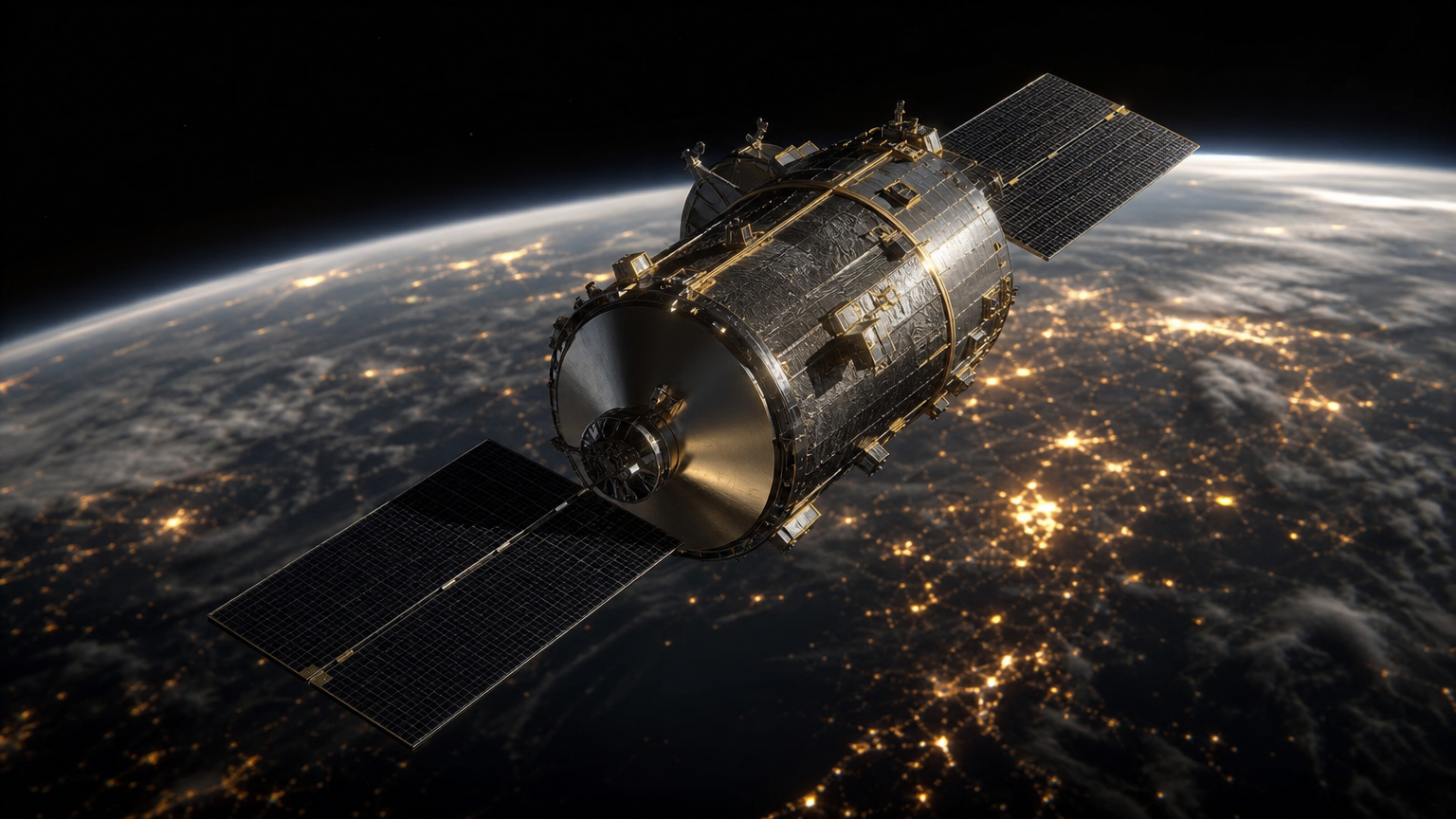
A threshold crossed in orbit
The United States has confirmed, for the first time in public, that it has deployed weapons in Earth orbit. Air Force Secretary Troy Meink told the Air, Space & Cyber Conference in Maryland on September 14, 2026, that the United States now has “on-orbit space control weapons capable of defending the Joint Force against hostile adversary action” . The official Air Force account of the speech described the statement as a first acknowledgement that the Space Force has deployed weapons in space .
That single sentence matters because it moves the debate from suspicion to confirmation. For years, analysts assumed major powers were developing ways to disrupt, disable or threaten satellites, but Washington generally avoided saying it had actual weapons already circling the planet. Meink’s formulation was not accidental: he later said the phrase was “very well thought out” and declined to explain the type of weapon, whether it had been tested or how many systems were involved .
The current public record therefore establishes three facts and leaves many more unanswered. The United States says the capability exists, says it is already on orbit, and frames it as a way to defend the joint force . It has not disclosed whether the systems are kinetic or non-kinetic, whether they are designed to affect satellites directly, or whether they are attached to known military spacecraft or hidden inside classified payloads .
“Space control” is the key phrase
The most important phrase in the announcement is not simply “weapon,” but “space control.” In military language, space control refers to the ability to assure one’s own use of space while limiting or denying an adversary’s use of it. A Space Force spokesperson told The War Zone that space control includes kinetic and non-kinetic means to affect adversary capabilities and that such capabilities can be used for offensive and defensive purposes .
That definition keeps the door open to several possibilities. A kinetic system could physically strike or damage another object, but such use would risk dangerous debris. A non-kinetic system could involve jamming, dazzling, cyber effects or other ways to interfere with sensors, communications or command links without necessarily creating fragments. Meink refused to identify which category applies to the systems now acknowledged by the United States .
This ambiguity is deliberate. Meink said public acknowledgement can support deterrence, but details would not help that deterrence . In other words, Washington wants rivals to know that it can respond from orbit, but it does not want them to know exactly how, where or with what. That approach mirrors older forms of military signaling: reveal enough to alter an opponent’s risk calculation, conceal enough to preserve uncertainty.
Why the disclosure came now
The immediate setting was the annual Air, Space & Cyber Conference, but the strategic backdrop is broader. The official Air Force summary of Meink’s remarks described a military environment shaped by AI-enabled threats, rapidly scaling drone warfare and adversaries moving aggressively to employ new technologies . In that same speech, Meink argued that the Air Force and Space Force must increase combat power and innovate faster while remaining affordable .
The orbit announcement also fits a wider shift in how U.S. defense leaders talk about space. Air & Space Forces Magazine reported that Meink’s comments followed years of increasingly open discussion about counter-space capabilities, “space fires” and space-based interceptors for missile defense . The same report said Meink linked the space-control acknowledgement to the need for the United States to operate freely in space .
That matters because modern militaries do not treat satellites as optional support systems. Communications, missile warning, positioning, navigation, targeting, weather data and intelligence all depend on space-based infrastructure. AP reported that longstanding concerns about Russia and China reflect how much U.S. infrastructure depends on satellite communications . The new acknowledgement therefore concerns not just exotic orbital combat, but the foundation of everyday military operations.
The China and Russia reaction
The announcement drew quick criticism from Beijing and Moscow. Deutsche Welle reported on September 15 that China urged Washington to “stop expanding its military capabilities and preparing for war in outer space,” while warning against an arms race in space . DW also reported that Kremlin spokesperson Dmitry Peskov said Russia believed space should be free of weapons and called for work toward complete demilitarization of space .
Those responses are politically predictable, but they also show why the disclosure is consequential. If one major power formally admits to orbital weapons, rivals can cite that admission as justification for their own programs. The Irish Times, citing analysts, warned that the U.S. confirmation could accelerate a high-risk arms race with Russia and China in Earth orbit .
Washington’s argument is the reverse: U.S. officials say the capability is needed because rivals already threaten American and allied space systems. DW reported that the Space Force justified the deployment by citing Russia and China, saying China develops and operates space and counterspace capabilities and Russia views space as a warfighting domain . The result is a classic security dilemma: each side frames its own deployments as defensive and the other side’s deployments as destabilizing.
What is still unknown
The largest unknown is the nature of the weapon itself. Meink did not say whether the systems can destroy, disable, blind, jam, spoof or cyber-disrupt another satellite . He also declined to discuss testing, numbers or basing concepts . That leaves analysts to infer from the phrase “space control,” but inference is not confirmation.
The second unknown is the operating orbit. “On-orbit” could refer to low Earth orbit, medium Earth orbit, geosynchronous orbit or a classified trajectory. Low Earth orbit is crowded with commercial and government satellites; geosynchronous orbit hosts high-value communications, missile-warning and surveillance assets. Each orbital regime brings different escalation and debris risks.
The third unknown is command authority. A weapon in orbit is not just a machine; it is part of a decision chain. Who authorizes its use, under what rules of engagement, and how the United States would distinguish defensive action from offensive escalation are now urgent policy questions. The public acknowledgement makes those questions harder to defer.
The debris problem
The most dangerous scenario would involve physical destruction in orbit. The Irish Times noted that Russia’s 2021 ground-based anti-satellite test created thousands of pieces of orbital debris . Even small fragments can threaten satellites because objects in orbit travel at extreme speeds. A kinetic engagement in a crowded orbital shell could endanger unrelated spacecraft, including U.S. military assets, allied systems and commercial satellites.
That is why non-kinetic interpretations matter. If the U.S. system is primarily designed to jam or interfere rather than collide, it may reduce debris risk. But non-kinetic does not mean non-escalatory. Interference with communications, navigation or reconnaissance can still be treated as an attack, especially during a crisis. Space warfare may not produce visible explosions, yet it can blind or confuse forces on Earth.
Commercial space is now even more entangled
The announcement also affects private satellite operators. Commercial constellations provide communications, imagery, data relay and broadband services that increasingly support governments and militaries. Once the United States confirms weapons in orbit, the boundary between military satellites, dual-use infrastructure and private systems becomes harder to police.
Meink himself emphasized that space is important not only militarily but also economically and for civilian life . That is the core commercial risk. A contested orbit is not a separate battlefield sealed off from business. It is the operating environment for telecom networks, remote sensing companies, launch providers, insurers and customers who rely on uninterrupted satellite services.
Commercial operators may now face more pressure to harden spacecraft, diversify orbits, improve maneuverability, share tracking data and plan for interference. They may also face more questions from governments about resilience, cyber protection and crisis coordination. The confirmation does not mean a space war is imminent, but it does mean the insurance, compliance and operational assumptions around satellite business have changed.
A new difficulty setting for low Earth orbit
The legal backdrop is complicated. Fresh reporting this week noted that the 1967 Outer Space Treaty bans weapons of mass destruction in orbit, but does not impose a blanket prohibition on conventional weapons in Earth orbit . That gap has always mattered; now it matters more.
The United States has chosen controlled disclosure over silence. It has confirmed a capability, framed it as defensive deterrence and withheld nearly every operational detail. That may strengthen deterrence if rivals become more cautious about attacking U.S. space assets. It may also normalize orbital weapons and push rivals to make their own deployments more explicit.
The immediate story is not that space suddenly became militarized. It has been militarily important for decades. The change is that Washington has now said, plainly enough, that it has weapons already deployed there. Earth orbit remains a place of communications, navigation, science and commerce. But after September 14, 2026, it is also an acknowledged weapons domain, and every satellite operator now has to plan for that reality.
Sources from the last 72 hours
- [1]Meink offers blueprint for modernizing Air, Space Forces 'affordably'Sep 14, 2026, 12:00 AM UTC
- [2]U.S. Admits It Has Weapons In OrbitSep 14, 2026, 11:40 PM UTC
- [3]Meink Reveals Space Force Has ‘On-Orbit Space Control Weapons’Sep 14, 2026, 12:00 AM UTC
- [4]US confirms it has weapons in spaceSep 15, 2026, 12:00 AM UTC
- [5]China warns of new arms race after US confirms deployment of space weaponsSep 15, 2026, 2:03 PM UTC
- [6]US acknowledges it has sent weapons to spaceSep 15, 2026, 12:16 PM UTC
AI-generated article based on recent web research, then preserved as a dated editorial snapshot.
Comments
Be the first to comment.