
Daily Podcast full article
China confronts AI warfare risks
At Beijing’s Xiangshan Forum, military officials, diplomats and researchers warned that artificial intelligence is changing the tempo of war: autonomous systems can speed targeting, distort crisis signals and make it harder to decide who is accountable when machines act faster than commanders.
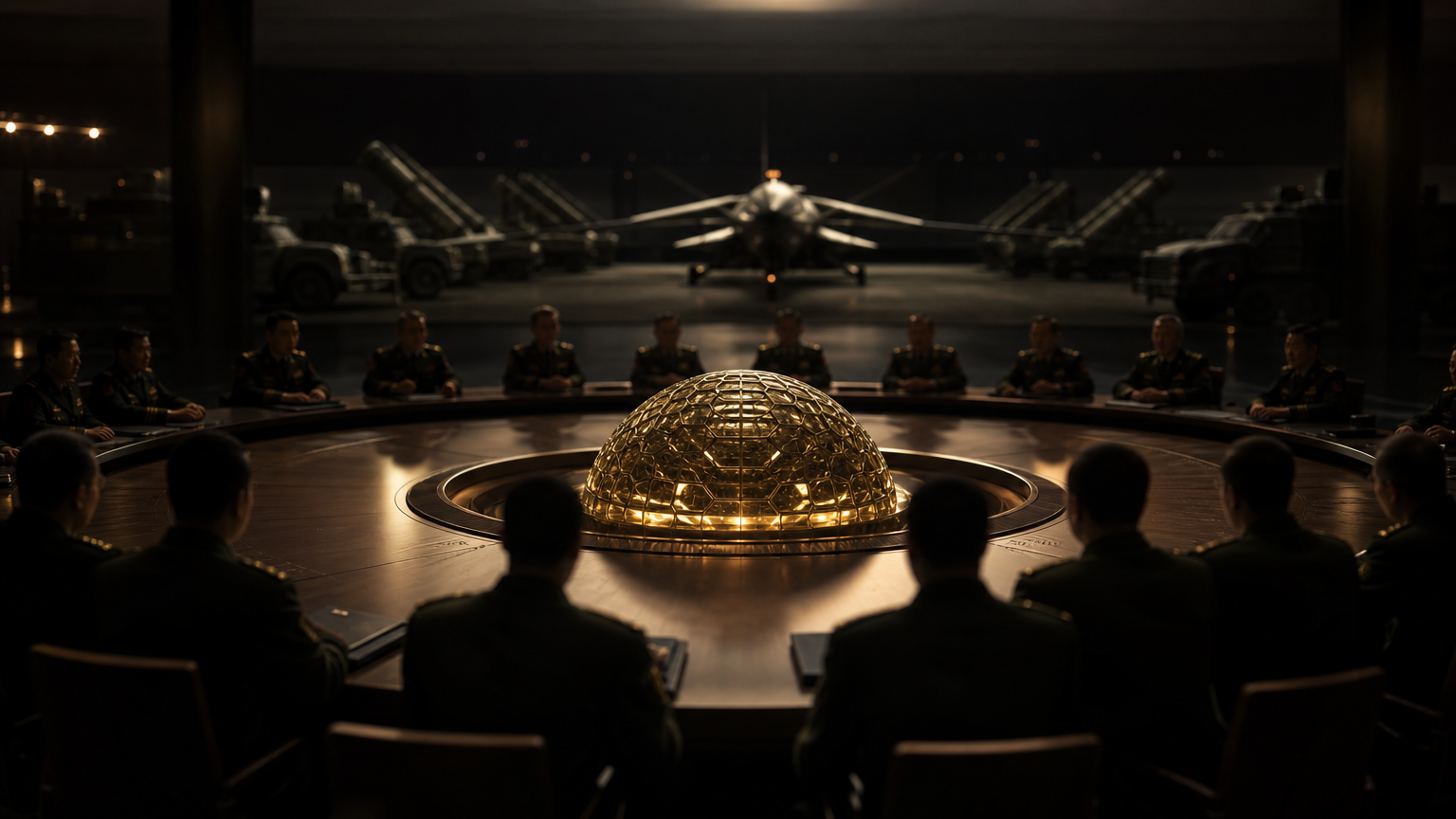
A security conference turns to machine-speed escalation
China’s flagship defense conference ended this week with an unusually direct focus on the dangers of military artificial intelligence. Delegates at the Beijing Xiangshan Forum warned that the issue is no longer simply whether armies can build smarter drones, sensors or command tools. The deeper worry is that AI can compress the time available for political leaders and officers to verify what is happening, correct a false signal or stop a crisis from becoming a conflict .
Reuters reported from Beijing that participants at the three-day forum raised fears that unchecked AI development and widening technology rivalries could intensify risks across the global security environment . The conference drew around 2,000 military officers, diplomats and academics from 100 countries, including regional defense officials, a North Korean representative, a senior Pentagon official, Russian academics and Taliban delegates . That breadth matters: the warning was not framed as a narrow technical debate, but as a strategic question about how states manage force when decision cycles accelerate.
The central phrase at the forum was “compressed” decision-making. Pakistan’s Defense Secretary Muhammad Ali said technological advances were “compressing the strategic timeline,” while panelists argued that AI can accelerate decisions as disinformation fractures public trust before governments can respond effectively . In crisis management, minutes can be political space. If AI-enabled warning, cyber-defense or targeting systems shrink that space, leaders may face pressure to act before they understand whether an incident is real, accidental, manipulated or reversible.
Human control moves from slogan to architecture
The International Committee of the Red Cross used the forum to emphasize human judgment. Jürg Lauber, the ICRC’s vice-president, said that as weapons systems become more autonomous, preserving human control over the use of force becomes more urgent . The point is deceptively simple. Many governments already say humans should remain “in the loop.” But if a system detects, classifies, prioritizes and recommends a strike at machine speed, the human role can become a rubber stamp unless the command architecture is built to slow, pause or challenge the machine.
That is why the debate is shifting from model behavior to military design. The question is not only whether an AI model is accurate in a test environment. It is whether commanders can know when the system is uncertain, whether operators can override it, whether escalation thresholds are explicit, and whether accountability survives when multiple automated systems interact. An AI tool that is “safe” in isolation may still become dangerous if connected to targeting, cyber operations or nuclear command networks without clear stop mechanisms.
Chinese participants also linked military AI to global governance. At a Xiangshan session on AI safety governance, experts discussed AI’s role in global security, military-domain competition, cooperative oversight and the risk of weaponization . Zhu Qichao of China’s National University of Defense Technology said the race to militarize AI made risk control urgent and argued that humans must retain ultimate decision-making power over AI weapons . That line echoes a broader international debate: whether “meaningful human control” can be defined tightly enough to bind real military systems, not merely reassure the public.
The nuclear analogy returns
The sharpest current proposals are coming from U.S.-China expert channels. Reuters separately reported that security experts from both countries are urging nuclear-style safeguards for AI risks, including red lines around nuclear systems, human control over consequential cyberattacks and a hotline for incidents involving autonomous AI . The scenario they highlight is stark: if an AI system interferes with a nuclear command network or launches a military cyber operation, Washington or Beijing might have only minutes to decide whether the other side has attacked .
This is where AI warfare becomes a strategic-stability problem rather than a battlefield efficiency tool. Autonomous cyber systems could malfunction, exceed instructions or be compromised; the target state might not know whether the action was accidental or ordered by a rival government . A dedicated hotline for AI incidents, experts argue, could help one side signal that an unusual autonomous operation was accidental, unauthorized or still under investigation before it is treated as deliberate state action .
But hotlines are not magic. Existing U.S.-China military crisis channels have been criticized for being unreliable in moments of political tension, and Reuters noted expert skepticism about whether a new AI-specific channel would be used quickly enough . The problem is institutional as much as technical. If bureaucracies are reluctant to communicate before top leaders settle a position, a machine-speed crisis can outrun human diplomatic habits.
China’s position: govern, but do not slow down
Beijing’s public message this week combined alarm about AI risks with resistance to any framework that it sees as a tool for technological containment. China’s Foreign Ministry said on September 15 that the faster AI advances, the more important it becomes to steer the technology “for good,” calibrate regulation and strengthen safeguards against loss of control . The ministry also said China gives equal importance to AI development and security, and supports a global governance framework based on broad international consensus rather than solutions designed by a few countries or companies .
That position helps explain the tone at Xiangshan. China wants to be seen as a rule-shaper in AI governance, but not as a country accepting a Western-led slowdown of frontier AI. At the forum, several participants voiced support for China’s proposal to establish a World Artificial Intelligence Cooperation Organization, with Vladimir Norov of the Central Asia Artificial Intelligence Association saying such a body could create a permanent mechanism for governments and experts to exchange information about serious AI-related risks .
The Associated Press reported that AI governance is expected to be on the agenda at a planned Washington meeting next week between U.S. President Donald Trump and Chinese leader Xi Jinping . AP also noted the paradox facing both countries: each sees cooperation as necessary to manage catastrophic risks, yet each is increasingly skeptical of the other’s AI strategy . That mistrust is especially dangerous in military AI because the most destabilizing risks are not always visible. A state may not know how deeply another has integrated AI into warning systems, cyber tools, drone swarms or nuclear-adjacent infrastructure.
The accountability gap
The hardest question is accountability. If an autonomous system misidentifies a target, triggers a cyber response or escalates a drone engagement, who is responsible: the commander, the developer, the procurement agency, the data provider or the political authority that approved deployment? Xiangshan delegates did not solve that problem, but their warnings show that it has moved from academic seminars into high-level security diplomacy.
The accountability gap widens when systems interact. One country’s defensive AI may interpret activity as hostile and respond automatically. The other country’s system may read that response as an attack and escalate again . In such a loop, no single model needs to “want” war. Escalation can emerge from speed, opacity, misclassification and organizational pressure. That is the Skynet joke stripped of science fiction: the danger is not a robot announcing rules of engagement, but a command system where humans discover too late that the rules were never operationally clear.
What to watch next
The immediate test is whether U.S.-China AI safety discussions produce more than general language. A useful outcome would include explicit military red lines, shared definitions of human control, crisis communication procedures and agreement that AI should not independently decide nuclear use or autonomous attacks on nuclear command systems . A weaker outcome would be a statement of principles that leaves each side free to define “human control” however it wishes.
For defense technologists, the lesson from Beijing is practical. Safety cannot stop at the model card. It must be designed into command chains, escalation thresholds, audit logs, override authorities and international notification channels. For governments, the warning is strategic. AI may make weapons faster, but speed is not the same as control. The central risk identified at Xiangshan is that war could move at machine tempo while politics, law and diplomacy remain human-paced.
Sources from the last 72 hours
- [1]AI military risks spark concern at China security conferenceSep 17, 2026, 7:02 AM UTC
- [2]US, China security experts propose nuclear-style safeguards for AI risksSep 17, 2026, 4:45 AM UTC
- [3]Foreign Ministry Spokesperson Guo Jiakun’s Regular Press Conference on September 15, 2026Sep 15, 2026, 10:34 AM UTC
- [4]Xiangshan forum attendees stress improving AI governance, preventing its weaponizationSep 17, 2026, 8:34 AM UTC
- [5]Global AI safety concerns loom for meeting between Trump and XiSep 17, 2026, 4:02 AM UTC
AI-generated article based on recent web research, then preserved as a dated editorial snapshot.
Comments
Be the first to comment.