
Daily Podcast full article
SpaceX reaches orbit and targets global coverage
SpaceX has not yet flown Starship Flight 14 as of September 17, but the company has set September 22 for the vehicle’s first orbital attempt: a mission designed to move Starship from suborbital testing into a revenue-linked Starlink deployment profile and to test the path toward global broadband expansion.
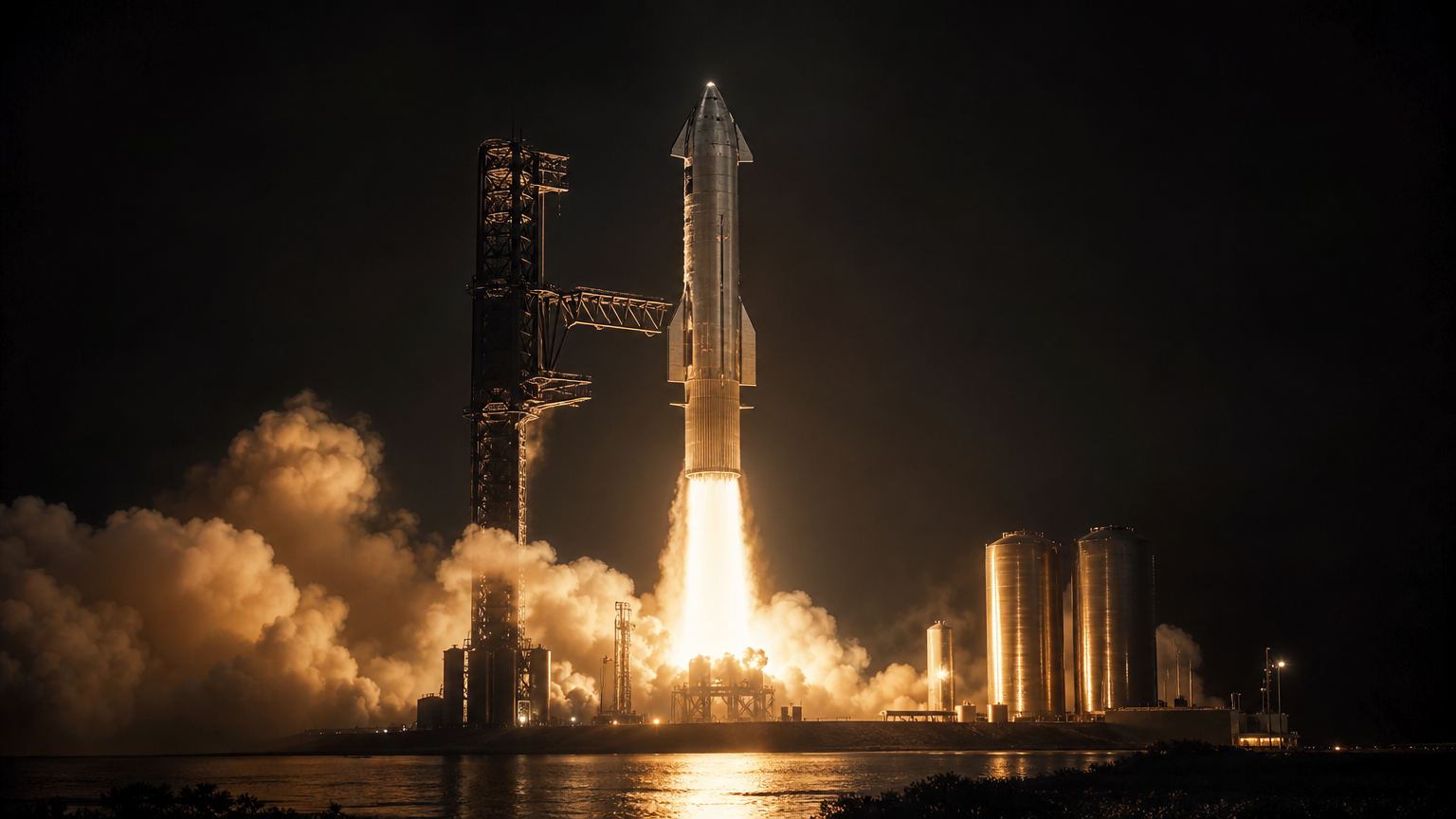
A milestone still waiting for launch day
The working headline for this story is “SpaceX reaches orbit and targets global coverage,” but the freshest reporting available before the 72-hour cutoff shows a mission still ahead, not yet completed. SpaceX is targeting Tuesday, September 22, 2026, for Starship Flight 14, with the goal of sending the upper stage into Earth orbit for the first time and deploying Starlink V3 satellites . That distinction matters: every previous Starship test reached space on a suborbital trajectory, while Flight 14 is designed to attempt orbital insertion and then return through a controlled end-of-mission sequence .
The planned launch window opens at 7:15 a.m. Central time, or 12:15 UTC, from SpaceX’s Starbase facility in South Texas, subject to regulatory approval . Reuters described the flight as the 14th Starship test and a major step beyond the July test, which followed a suborbital path and returned to Earth without completing an orbit . TechCrunch similarly reported that SpaceX is now preparing to put Starship’s upper stage into orbit for the first time, framing the attempt as the program’s clearest shift yet from spectacular testing toward operational use .
What Flight 14 is designed to prove
Flight 14 is not merely about crossing the orbital threshold. The current mission profile combines several tests into one flight: launch and ascent, stage separation, orbital insertion, Starlink V3 deployment, a deorbit burn, controlled reentry and splashdown . Space.com reported that, if the mission proceeds nominally, the Starship upper stage is expected to complete about six orbits at roughly 275 kilometers altitude over nearly 10 hours before splashing down in the Pacific Ocean west of Chile .
That is a very different profile from the earlier Starship flights, whose upper stages remained aloft for roughly an hour and returned to the Indian Ocean without circling Earth . Aviation Week reported that Flight 14 is intended to deliver Starship into orbit for the first time while carrying the first batch of 26 Starlink V3 satellites for SpaceX’s operational low-Earth-orbit network . The mission therefore tests both transportation and payload utility: whether Starship can reach orbit, and whether it can begin to serve as the heavy carrier for SpaceX’s next-generation communications business.
The mission also includes a deliberate safety gate. Current reports citing SpaceX’s mission description say Starship will proceed with the orbital burn only if flight controllers determine that hardware needed for the later deorbit burn has sufficient redundancy . That condition is central to the mission’s risk posture. SpaceX is not simply trying to get to orbit; it is trying to ensure that reaching orbit does not create an uncontrolled reentry problem.
Starlink V3 turns the flight into a coverage story
The global-coverage angle comes from the payload. SpaceX plans to carry 26 Starlink V3 satellites on Flight 14, marking the first operational deployment attempt for the larger next-generation spacecraft . Space.com reported that Starlink already has more than 11,000 active satellites in low Earth orbit, but none are the larger V3 model that Starship is designed to launch at scale .
The V3 payload is the reason this mission is commercially different from a pure engineering test. SpaceX says the satellites are intended to expand connectivity speeds and reliability around the world . Aviation Week reported that the 26-satellite batch is meant for a Starlink network already above 11,100 operational spacecraft, underscoring that Flight 14 is tied directly to capacity expansion rather than only to Starship qualification .
The number of satellites is also important. Falcon 9 has built Starlink’s current constellation with high cadence, but Starship’s promise is mass and volume. If it can routinely deploy large V3 satellites, the economics of network expansion could change: fewer launches per unit of capacity, larger spacecraft, and a clearer route to higher-throughput global broadband. Flight 14 will not deliver “global coverage” by itself, but it is designed to test the launch architecture that could make denser and faster global Starlink service possible.
No tower catch this time
Despite the orbital ambition, SpaceX is keeping recovery objectives conservative. Space.com reported that Flight 14 will not include a tower catch for either the Super Heavy booster or the Starship upper stage . Instead, Super Heavy is expected to splash down in the Gulf of Mexico roughly seven minutes after liftoff, while the Ship upper stage is planned to deorbit and splash down in the Pacific after its orbital phase .
That choice shows where SpaceX is placing the emphasis. The company has already demonstrated Super Heavy tower catches on earlier flights, but Flight 14 prioritizes orbit, payload deployment and safe return over the more dramatic reuse choreography . Future milestones, including catching Ship and performing in-orbit refueling, remain essential for lunar and Mars missions, but they are not the central test on September 22 .
The mission will still gather reentry data. Space.com reported that three of the Starlink V3 satellites on the flight have been fitted with cameras to photograph Starship’s heat shield after deployment . That detail matters because orbital Starship reentry is one of the hardest parts of the reusable system: thermal protection, guidance, flap control and structural margins all have to work together before rapid reuse becomes more than an aspiration.
Investors price the attempt, not the achievement
Market coverage treated the launch date as a catalyst. Foreign Policy Journal reported that SpaceX shares, trading under the SPCX ticker, rose about 5% after the Flight 14 target emerged, with the move linked to the prospect of Starship’s first stable-orbit attempt and future revenue payload flights . 24/7 Wall St. likewise reported that SpaceX stock climbed on the Starship date while Rocket Lab and AST SpaceMobile were comparatively flat, suggesting that the reaction was specific to SpaceX rather than a broad space-sector rally .
That market reaction should be read carefully. Investors are not buying proof of success; they are repricing the probability that Starship can become an operational transport system. A successful Flight 14 would strengthen the commercial case for launching large Starlink V3 batches, NASA lunar hardware, future refueling infrastructure and eventually Mars-related missions. A failure, delay or shortened mission would not end the program, but it would reinforce that Starship’s development remains experimental.
The line between prototype and transport
Starship’s public image has long been defined by fire, scale and iteration. Flight 14 is different because the target is not just another spectacular data point. If Starship reaches orbit, deploys the V3 satellites, performs its deorbit burn and completes controlled reentry, SpaceX will have demonstrated the basic loop required for orbital transport: launch, deliver, return.
That would not make Starship fully operational overnight. It would still need repeatability, regulatory confidence, rapid refurbishment, higher launch cadence, in-orbit propellant transfer and more mature recovery operations. But an orbital Flight 14 would move the program from proving that Starship can survive pieces of a test campaign to proving that it can perform a mission shaped like a commercial service.
As of September 17, the correct current state is therefore conditional: SpaceX has set the date, published the orbital objective, tied the flight to Starlink V3 capacity and triggered an investor response. The achievement itself still depends on what happens on September 22. If the flight succeeds, the headline will stop being an ambition and become the program’s new baseline.
Sources from the last 72 hours
- [1]SpaceX targets first Starship orbital test on September 22Sep 15, 2026, 12:00 AM UTC
- [2]SpaceX's next Starship launch will lift off on Sept. 22 and aim to reach orbit for 1st timeSep 15, 2026, 12:00 AM UTC
- [3]SpaceX will try to put Starship in orbit for the first time on September 22Sep 15, 2026, 6:16 PM UTC
- [4]SpaceX Sets Sept. 22 For Next Starship Flight TestSep 15, 2026, 12:00 AM UTC
- [5]SpaceX declares Starship ready for orbit, sets launch date next weekSep 15, 2026, 7:48 PM UTC
- [6]SpaceX (NASDAQ: SPCX) Stock Price Jumps 5% As Starship Targets First Orbital Flight On September 22Sep 16, 2026, 12:00 AM UTC
- [7]SpaceX Rises 5% as Starship’s First Orbital Attempt Gets Launch Date; Rocket Lab and AST SpaceMobile Hold FlatSep 16, 2026, 2:36 PM UTC
AI-generated article based on recent web research, then preserved as a dated editorial snapshot.
Comments
Be the first to comment.