
Daily Podcast full article
Anthropic targets twice the compute
Anthropic and OpenAI are looking beyond giant AI campuses and into smaller 20–30 megawatt data-center blocks that can be switched on faster, especially in the U.K., the Nordics and possibly the U.S. The move does not replace gigawatt-scale ambitions; it shows that usable power, delivery timing and inference demand are now as strategic as model design itself [1].
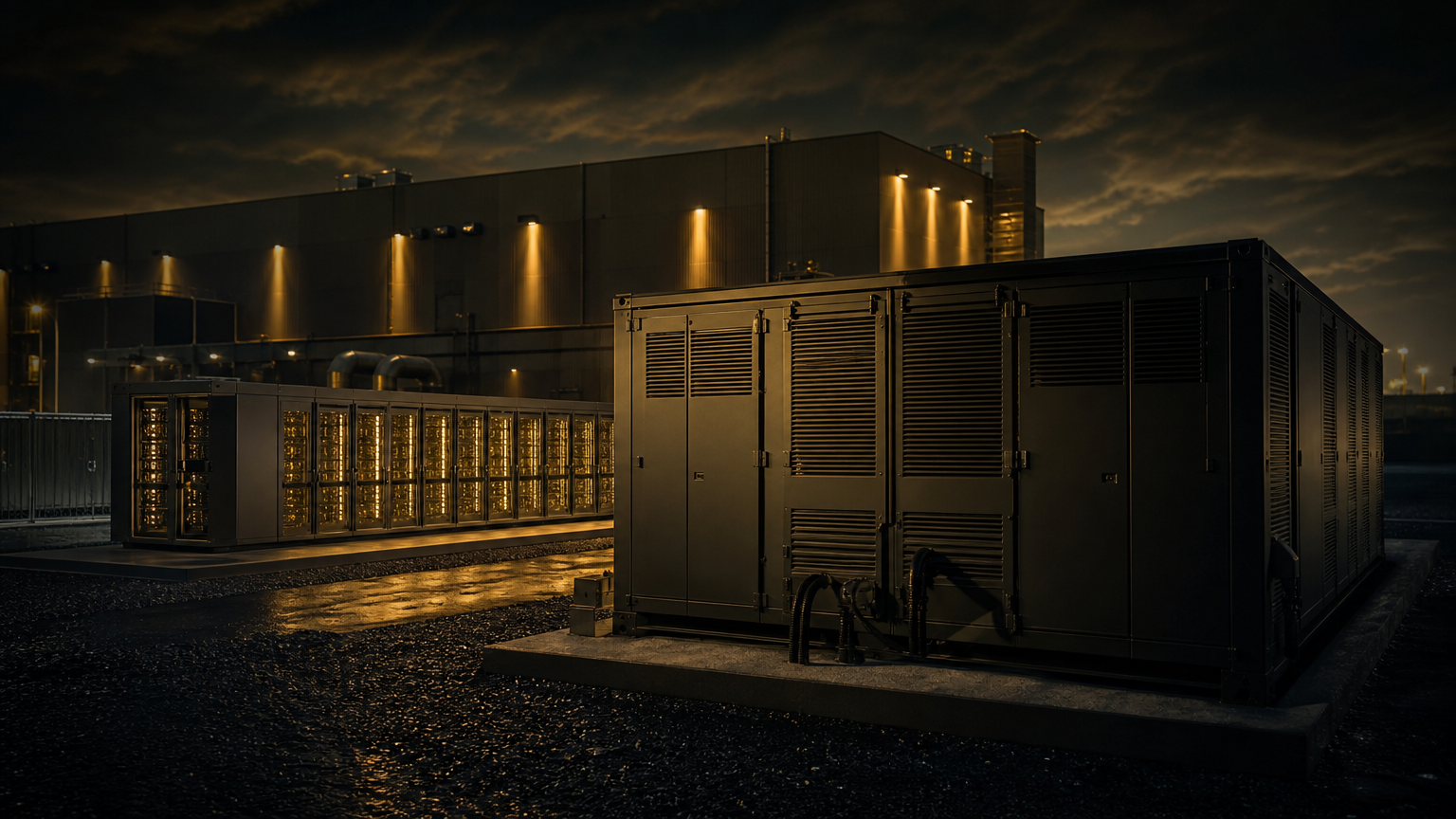
The story: smaller sites, same compute race
Anthropic and OpenAI are reportedly seeking smaller AI data-center agreements in the range of 20 to 30 megawatts, even as both companies continue to pursue much larger infrastructure commitments measured in hundreds of megawatts or gigawatts . The talks described in the latest reporting are not about abandoning mega-campuses. They are about adding faster, more flexible capacity while enormous projects work through power, permitting, construction and local-approval bottlenecks .
According to CNBC reporting republished by aVenture, Anthropic has sounded out 20–30 MW agreements across the U.K. and the Nordics, based on four people familiar with the discussions . The same report says OpenAI has explored smaller-capacity opportunities in the Nordics, and one source described discussions involving both companies around U.S. deployments of similar size . Quartz’s follow-up also framed the effort as a European and Nordic search for smaller data-center deals, with potential U.S. discussions in the background .
The important detail is the size. A 20–30 MW data center is small compared with the AI infrastructure announcements that have dominated headlines, but it is not minor in operational terms. For inference-heavy workloads, where models already trained are serving user requests, several smaller clusters can be useful if they are available sooner and can be distributed across regions . That is why the phrase “twice the compute” should be read less as one single site doubling in size and more as a procurement strategy: collect enough powered fragments, and the aggregate starts to matter.
Why 20–30 MW is suddenly attractive
The core reason is time to usable capacity. Jabez Tan, head of research at Structure Research, told CNBC that smaller capacity deals are attractive because companies can sometimes secure powered, existing or nearer-term sites faster than waiting for one very large block in a single location . Blockspace summarized the same point sharply: the reported 20–30 MW deployments are about faster access to AI compute capacity, not a retreat from larger long-term commitments .
That distinction matters. Training frontier models often benefits from very large, tightly networked clusters in one place because many chips must coordinate closely . Inference is different. Once a model is deployed, many user requests can be handled across separate clusters, making smaller sites more practical . If a company can serve part of its demand from a Nordic site, another part from a U.K. site, and later another part from a U.S. site, it can improve capacity before a gigawatt campus is complete.
The shift also reflects a harder infrastructure reality. Very large data-center projects face local pushback in the U.S., while European markets are constrained by scarce land and limited power availability . Quartz reported that both companies’ smaller-site search comes after a year of much larger agreements and against a backdrop where mega-projects are harder to execute quickly . In other words, the race is no longer only about who can buy the most GPUs. It is about who can bring enough electricity, cooling, land, networking and construction together soon enough to support paying customers.
This is a supplement, not a retreat
The smaller-site push sits alongside major infrastructure commitments. CNBC’s report says Anthropic reached a roughly $45 billion cloud agreement with Nscale for around 460 MW of compute capacity at a West Virginia data-center development . Blockspace adds that Anthropic also has a separate 20-year lease with TeraWulf for about 401 MW of critical IT load in Kentucky, while OpenAI’s disclosed pipeline includes long-term Ohio leases tied to roughly 8 GW of IT load and about 10 GW of gross power .
OpenAI has also said it surpassed the original 10 GW commitment of the Stargate AI infrastructure project in April and has since committed to another 3 GW in Georgia and 8 GW in Ohio, according to the CNBC report carried by aVenture . Those figures underline the point: 20–30 MW sites are not replacing the giant buildout. They are a parallel lane.
Newsquawk’s market note treated the report as a signal about sizing rather than named counterparties, warning that deals in the tens of megawatts could represent either phased procurement or caution around power, financing and demand certainty . That is the right nuance. The available reporting does not identify counterparties, prices, delivery schedules or signed contracts for the smaller deployments . For now, the story is about active exploration and infrastructure strategy, not completed deals.
The inference angle
The strongest strategic explanation is inference. CNBC’s report says training requires large amounts of computing power to process data, while day-to-day deployment can run on smaller chip clusters . The same report cites JLL projections that inference’s share of global data-center workloads will overtake training in 2027, rising from 9% in 2025 to 37% by 2030, while training moves from 14% to 13% over the same period .
Blockspace repeated that JLL projection and connected it to the logic of distributed deployment . If inference demand is rising quickly, then smaller sites can become more valuable because they fit the workload. A model used by millions of people does not need every request to pass through one giant campus. It needs enough reliable capacity in enough places, with latency, cost and resiliency managed well.
This is also why the U.K. and Nordics matter. The regions can offer access to different grids, climates, energy mixes and connectivity routes. They may not solve every constraint, but they can diversify risk. OpenAI’s quoted comment to CNBC described the company as building a “diversified compute portfolio” and evaluating infrastructure by requirements, performance, reliability, timing and cost . That is the language of portfolio management, not one-off site shopping.
What to watch next
The next developments to watch are concrete counterparties, signed leases, utility interconnection filings, and whether the 20–30 MW figures refer to gross site power or critical IT load . That distinction is crucial because gross power includes facility overhead, while IT load is closer to the power available to servers. A headline number can look similar while the actual compute delivered differs meaningfully.
Investors and competitors will also watch whether these smaller deals cluster around inference, regional redundancy, or stopgap capacity before larger campuses come online. Newsquawk noted that the market impact runs through utilities, power suppliers, data-center REITs and infrastructure names whose valuations already assume multi-year AI demand . If Anthropic and OpenAI sign many small deals, it could broaden the set of winners beyond the developers able to assemble huge single-site campuses.
The key takeaway is practical: frontier AI is becoming an energy-and-construction business as much as a software business. Algorithms still matter, but near-term advantage may come from getting 20 MW here, 30 MW there, and stitching those blocks into a working global compute fabric. The fastest path to hyperscale may start with a side quest.
Sources from the last 72 hours
- [1]Anthropic and OpenAI hunt for smaller data center deals, sources tell CNBC, in race to deploy AI capacitySep 18, 2026, 12:00 AM UTC
- [2]Anthropic and OpenAI are pursuing smaller data center deals in the U.K. and NordicsSep 18, 2026, 12:00 AM UTC
- [3]Anthropic and OpenAI seek 20–30 MW data center deals: CNBCSep 18, 2026, 12:00 AM UTC
- [4]Anthropic and OpenAI are reportedly looking for smaller AI data centre deals of between 20-30 MW, CNBC reports citing sourcesSep 18, 2026, 10:01 AM UTC
AI-generated article based on recent web research, then preserved as a dated editorial snapshot.
Comments
Be the first to comment.