
Daily Podcast full article
Full Tesla Cybercab Robotaxi New Update Is Here
Tesla’s Cybercab is no longer just a futuristic two-seat pod from a launch stage: it is now part of Tesla’s paid Robotaxi experiment in Austin, where a stripped-down vehicle with no steering wheel, pedals or side mirrors is testing whether low-cost autonomy can survive real passengers, real streets and real regulation.
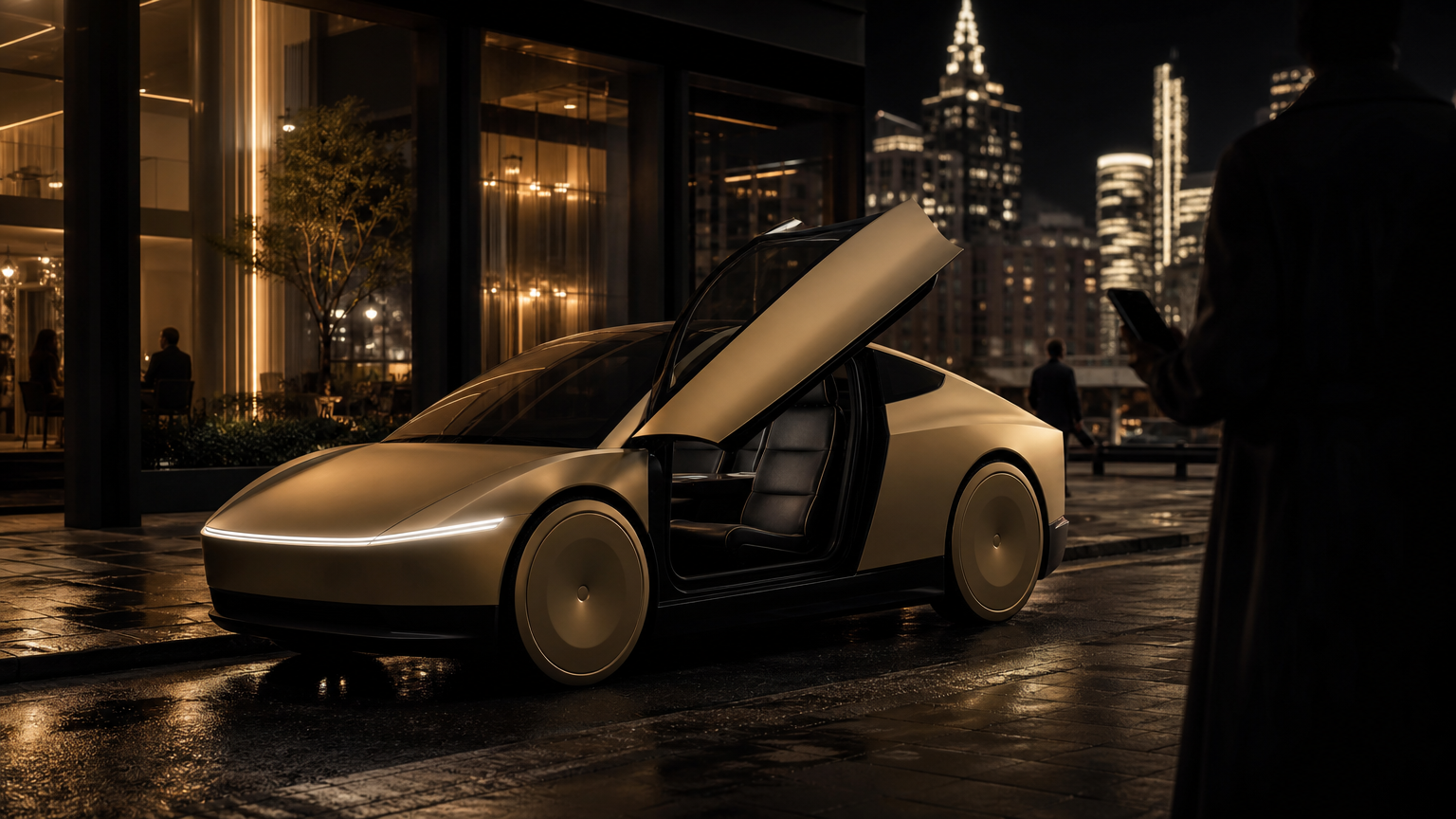
From showcase vehicle to paid Austin service
Tesla’s Cybercab update is important because the vehicle has crossed the line from concept theater into operating reality. The latest picture is not simply that Tesla has a new autonomous car; it is that the company is trying to prove a complete business model in Austin with a vehicle designed from the beginning for robotaxi economics rather than private ownership . Public operations remain limited, but the shift is meaningful: riders can now encounter the gold, two-seat Cybercab inside Tesla’s Robotaxi service alongside the company’s more conventional Model Y robotaxis .
That makes Austin the proving ground for two overlapping bets. The first is technical: whether Tesla’s camera-led autonomy stack can deliver a reliable driverless ride without a human safety driver in a purpose-built car. The second is industrial: whether a simplified vehicle can reduce cost per mile enough to challenge Uber, Lyft, taxis and rival autonomous fleets. Cybercab is therefore not just another Tesla model; it is a rolling test of whether the company can turn autonomy into a transportation utility.
The design says “fleet machine,” not “driver’s car”
The Cybercab’s most revealing feature is what it removes. It has no steering wheel, no pedals and no conventional driver position, which immediately separates it from Model Y robotaxis that still preserve the architecture of a normal car . Axios described the Austin Cybercab as a gold-colored vehicle without steering wheel, pedals or side mirrors, currently operating only in limited parts of Austin .
Under the skin, the vehicle follows the same logic. HelloBro’s current subject briefing lists a single front motor at about 219 horsepower, a curb weight of roughly 3,113 pounds and a front-wheel-drive layout that emphasizes fewer parts, lower manufacturing complexity and fleet reliability over performance . For a robotaxi, that is the point. Acceleration figures and enthusiast handling matter far less than uptime, predictable maintenance, efficient energy use and fast production.
Tesla’s broader Cybercab case also rests on efficiency. The same briefing cites an approximately 48 kWh battery, a target range near 293 miles and energy use of about 165 Wh per mile, which would be central to keeping paid passenger miles cheap if real-world duty cycles match the claim . The implication is clear: Tesla is not trying to make the most luxurious taxi in Austin. It is trying to make a high-utilization autonomous appliance.
A small fleet, with Model Y still doing most of the work
The most useful reality check is fleet composition. A current Texas roster tracker counted 439 Tesla vehicles registered for autonomous operation in the state as of its September 18 check: 390 Model Y vehicles and 49 Cybercabs . That means Cybercab is visible and real, but still a minority of Tesla’s Texas robotaxi presence.
That balance matters. Model Y gives Tesla scale because it is already produced in volume and retains standard controls. Cybercab gives Tesla the purpose-built economics story, but the registered count suggests the company is still in an early deployment phase rather than a mass-service phase . In practical terms, the Austin rollout is less a full replacement of conventional ride-hailing than a controlled live trial with paying passengers.
The public experience also reflects that early-stage status. Axios’ Austin dispatch, republished in the Dallas newsletter, described a Cybercab ride from near the University of Texas campus toward a hamburger spot, with the vehicle ending at a nearby Whataburger rather than the intended destination across the way . That is not catastrophic, but it is exactly the sort of edge case that separates a slick demo from a dependable transport service.
The first rider reports show the business problem
The core tension is that robotaxis are judged by riders, not by engineering presentations. If the car arrives, drives safely and charges a competitive fare, the missing steering wheel may quickly feel normal. If it takes the wrong route, avoids major roads or stops short of the destination, passengers will compare it with a human-driven ride-hail car that simply gets them there.
One widely discussed Austin trip showed the current limitation clearly. A Cybercab journey that would normally take around 10 minutes by highway reportedly took about 70 minutes because the vehicle stayed off highways and used surface streets through Austin instead . The same report said the Cybercab did not use at-grade railroad crossings, forcing a longer route to cross tracks by bridge . For Tesla, this is not merely a navigation annoyance. It affects utilization, fare competitiveness and passenger trust.
Another fresh report described a Cybercab that struggled to leave a hotel parking lot because of construction in one lane, moved back and forth several times, and then told the rider he had arrived where he started . Incidents like that do not prove the system is unsafe, but they show how fragile the customer experience can be when there is no driver to improvise.
Regulation is now the central obstacle
Tesla’s boldest design choice is also its largest regulatory question. A vehicle without a steering wheel, pedals or mirrors challenges safety standards that were written around a human driver sitting behind physical controls. A September 18 regulatory report said NHTSA’s current work is moving toward performance-based standards for automated driving systems, while existing Federal Motor Vehicle Safety Standards still contain assumptions about manual controls .
The same report said NHTSA opened an Audit Query into Tesla’s Cybercab self-certification when paid Cybercab rides began in Austin and later escalated to a Special Order, with Tesla’s response due by September 30 . Crucially, the agency had not issued a defect finding or ordered the service to stop, but it was asking how Tesla justified compliance for a vehicle that removes the hardware many rules still reference .
That creates a narrow path for Tesla. If Cybercab works well, it becomes evidence that rules should evolve toward measurable safety performance rather than legacy hardware. If it stumbles, critics will argue that the absence of controls makes every failure harder to manage.
Emergency response becomes part of the product
The latest operational update also shows Tesla trying to close that gap. Tesla shared footage of first responders training around Cybercab and Model Y robotaxis, and Tesla Oracle reported that first-responder feedback is being incorporated into Cybercab design and safe operation . That is more than public relations. For a car without ordinary controls, emergency access, vehicle shutdown, door operation and post-crash handling become part of the safety case.
Tesla Oracle reported that Cybercab’s butterfly doors and lack of conventional door handles require specific training for police, fire and rescue personnel . Another report described Tesla’s emergency approach as combining local controls, remote support and specialized training, including procedures for stopping autonomous operation and handling the vehicle when conventional controls are absent .
The real update: Cybercab is entering the messy phase
The headline update is not that Tesla has solved robotaxis. It is that Cybercab has entered the phase where promises meet operational friction. The vehicle’s low weight, single-motor layout, simplified cabin and autonomy-first design support a persuasive cost story . The Texas registration count shows a real but still limited Cybercab footprint . Rider reports show both novelty and rough edges , , . Regulators and first responders are now testing the implications of removing the steering wheel as much as Tesla is testing the AI , .
That is why Cybercab matters. If Tesla can make this small, simplified, driverless vehicle dependable at scale, it could reset the economics of urban mobility. If not, the Cybercab will remain a striking demonstration of how hard it is to turn autonomy from a technology claim into a public service.
Sources from the last 72 hours
- [1]Full Tesla Cybercab Robotaxi New Update Is HereSep 18, 2026, 11:23 AM UTC
- [2]👀 Cybercab test rideSep 17, 2026, 12:00 AM UTC
- [3]TSLA robotaxi fleet sizeSep 18, 2026, 12:00 AM UTC
- [4]First responder training and feedback enhance Tesla Cybercab crash and fire safetySep 18, 2026, 12:00 AM UTC
- [5]NHTSA Signs SAE Deal to Write First Federal Robotaxi StandardSep 18, 2026, 1:54 PM UTC
- [6]Tesla Cybercab kjører ikke motorvei: 10-minutters tur ble 70 minutter i AustinSep 17, 2026, 12:00 PM UTC
- [7]Tesla Cybercab Gets Trapped in Hotel Parking Lot, Tells Passenger He’s Arrived at His DestinationSep 18, 2026, 5:33 PM UTC
AI-generated article based on recent web research, then preserved as a dated editorial snapshot.
Comments
Be the first to comment.