
Daily Podcast full article
Inside $119B Terafab: World's Largest Building SHOCKED!
Tesla’s Terafab story is no longer only about the size of a proposed Texas chip complex. The latest 72-hour picture shows a more complicated reality: a $119 billion industrial ambition, a fresh trademark fight in federal court, Intel-linked foundry expectations, deeper Tesla-SpaceX integration signals, and a Cybercab motor claim that could matter almost as much as the fab itself.
The headline still belongs to Terafab
The working headline is unchanged: Inside $119B Terafab: World's Largest Building SHOCKED! The story is still Tesla’s bid to pull critical hardware closer to home: semiconductors for autonomy, robotics and space systems on one side, and a rare-earth-free Cybercab drive unit on the other.
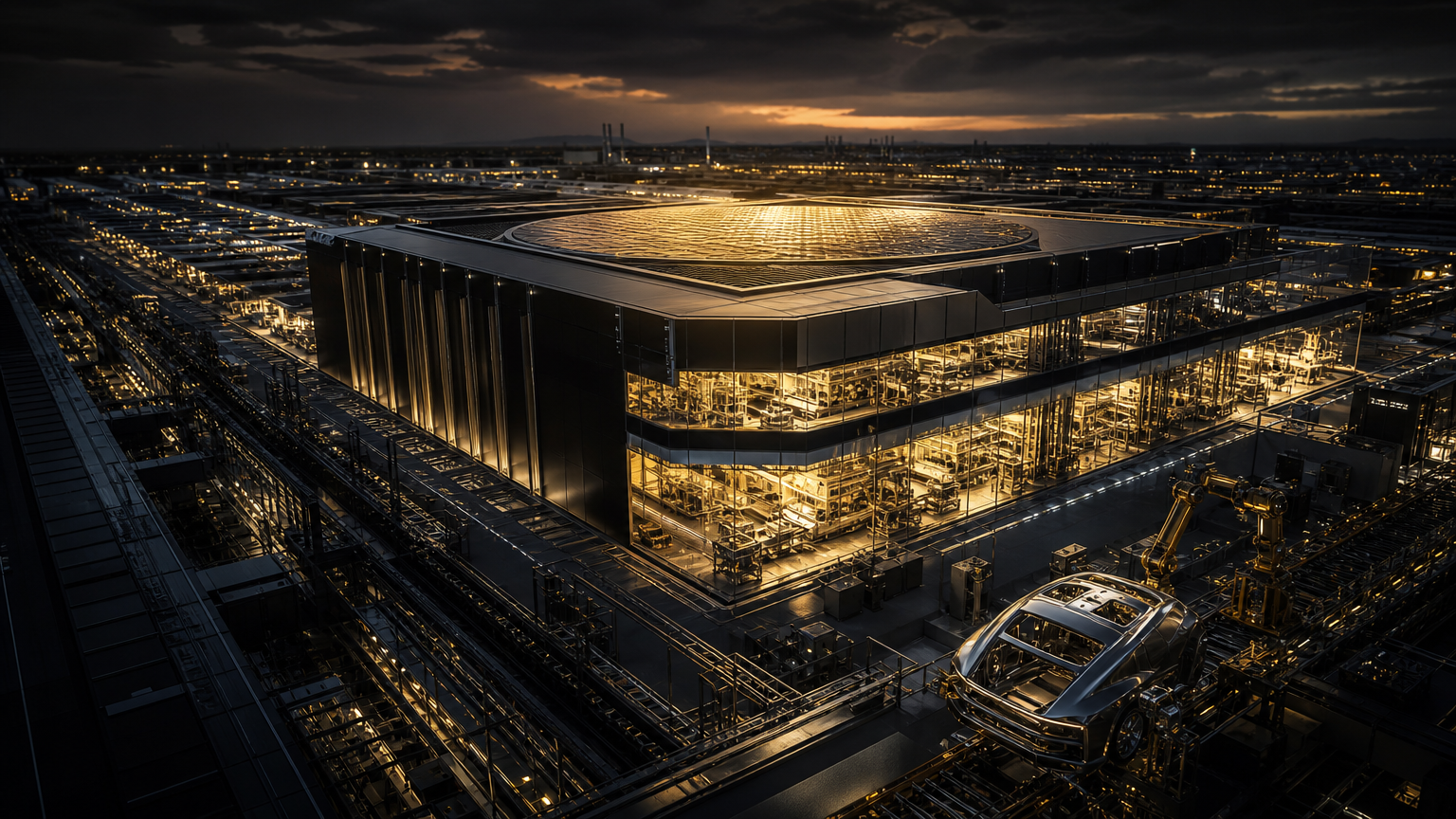
As of September 19, 2026, the clearest framing is that Terafab is a proposed Texas semiconductor complex intended to vertically integrate AI chip production for Tesla and SpaceX, with the total multi-phase investment discussed around $119 billion and the physical footprint described at roughly 100 million square feet . That number is the shock value. The deeper story is control: control of chips, control of process knowledge, control of power and water infrastructure, and control of bottlenecks that could otherwise sit in Taiwan, advanced packaging suppliers, memory vendors or lithography tool queues.
HelloBro’s current subject brief describes Terafab as more than a conventional fab. The project is presented as an integrated complex that could combine logic, memory, advanced packaging, testing and assembly, aiming to reduce the risk that one external supplier or geography slows the whole AI hardware pipeline . That is why the “world’s largest building” label matters less than the architecture of dependence it is meant to replace.
A megafab with a courtroom problem
The newest hard development is not a crane, a wafer line or a power turbine. It is a trademark case.
Tesla, SpaceX and SpaceXAI have taken the Terafab name dispute to federal court, asking a Texas judge to declare that their use of “Terafab” for the planned semiconductor operation does not infringe rights claimed by TERA-print LLC . The action was filed in the U.S. District Court for the Western District of Texas as Tesla, Inc. et al. v. TERA-print, LLC, Case No. 1:26-cv-02543 .
That matters because branding is not cosmetic when a project becomes a political, financial and supply-chain symbol. According to the September 18 report, TERA-print holds a registered TERA-FAB mark, while Tesla filed three U.S. trademark applications on May 18, 2026, connected to Terafab and Tesla Terafab for semiconductor-related activities . The conflict therefore sits directly on the project’s public identity.
The legal fight does not prove the fab will or will not be built. But it does show that Terafab has moved from concept video and industrial rumor into the formal machinery of courts, trademarks and corporate risk management. A project this large can be slowed by land, water, electricity, EUV tools, tax structures, community opposition, export controls or litigation. The name dispute is one more reminder that the bottlenecks are not only technical.
Tesla and SpaceX keep moving closer
A separate September 18 market note reported that Elon Musk had signaled closer operational ties between Tesla and SpaceX, including possible corporate integration, while highlighting a joint Terafab semiconductor manufacturing effort for custom chips used in Tesla vehicles and energy products . That is a crucial distinction. Terafab is not being framed as a Tesla-only factory. It is being framed as a shared infrastructure layer for Musk-controlled demand.
For Tesla, the immediate logic is autonomous driving, Cybercab, Optimus and energy systems. For SpaceX, the logic points toward satellites, orbital compute and radiation-hardened systems. HelloBro’s current Terafab brief says the chip roadmap is expected to include AI5 and AI6 inference chips for Tesla autonomy and Optimus, plus D3 radiation-hardened chips for SpaceX satellites and orbital computing .
That combination explains the project’s extreme scale. A normal automaker can buy chips. A normal aerospace company can contract specialized silicon. But a company cluster trying to run robotaxi fleets, humanoid robots, AI inference and space-based compute may decide that chip supply is not a procurement line item. It becomes existential infrastructure.
Intel’s role is now part of the market story
Intel’s name has also become part of the current Terafab conversation. A September 19 Yahoo Finance article, republishing Insider Monkey analysis, described Intel as targeting a significant opportunity through a strategic Terafab partnership with Musk-affiliated companies, including SpaceX, Tesla and xAI . The same report said Tigress Financial reiterated a Buy rating on Intel and raised its price target to $145 from $118, citing long-term growth opportunity and the Terafab partnership’s potential to support Intel’s AI-driven foundry turnaround .
That does not mean Terafab is financially de-risked. The same analysis warned that the commercial terms, production volumes and potential revenue contribution have not been fully disclosed, and that near-term financial impact may be difficult to quantify . In other words, Intel may gain credibility and optionality before it gains revenue.
Still, the Intel angle is important because money cannot instantly buy process expertise. Advanced semiconductor manufacturing depends on yield learning, process control, packaging integration, equipment availability and engineering culture. If Terafab is intended to compete near the leading edge, execution knowledge could matter as much as capital.
The building may be enormous, but the bottleneck may be tiny
The popular version of the Terafab story focuses on floor area. The operational version focuses on constraints.
HelloBro’s current brief says Terafab has been described at about 100 million square feet, about ten times Gigafactory Texas, with a first phase discussed near $16.3 billion and a full multi-phase estimate around $119 billion . It also notes that if the fab uses leading-edge nodes, EUV lithography systems could become a key bottleneck because ASML remains the only commercial supplier of advanced EUV scanners .
This is where the “world’s largest building” framing can mislead. Semiconductor output is not determined by concrete alone. It is determined by lithography throughput, cleanroom yield, metrology, chemicals, gases, ultrapure water, power stability, packaging capacity and talent. A huge shell without enough tools is not a fab. A fab without yield is not a business. A business without reliable demand is not a strategy.
Terafab’s demand story is unusually strong on paper because Tesla and SpaceX could be internal anchor customers. But that also creates concentration risk. If Cybercab ramps slower than expected, if Optimus adoption takes longer, or if SpaceX’s orbital compute roadmap shifts, the utilization math changes.
Cybercab is the smaller factory story
The Terafab narrative also connects to Tesla’s rare-earth-free Cybercab drive unit. On September 19, SINGULISM examined Tesla’s claim that the Cybercab motor maintains range without rare earths, while the electric drive unit is reported to be 18% smaller and 25% lighter . The report emphasized that these remain company claims without independent comparative testing, and that Tesla has not disclosed the motor type, material composition, efficiency maps or comparison conditions .
That caution is necessary. A rare-earth-free motor is only a breakthrough if it works across cost, efficiency, thermal behavior, noise, durability and mass production. Still, the strategic logic is clear. Rare earths, especially magnet materials used in high-performance EV motors, have become a supply-chain vulnerability. If Tesla can remove that dependency in a robotaxi designed for high utilization, the gain is not just environmental. It is economic and geopolitical.
In that sense, Cybercab and Terafab are two versions of the same idea. One rewrites the vehicle around fewer scarce materials. The other rewrites the chip supply chain around fewer external choke points. Sometimes the real upgrade is not a patch; it is new firmware for the whole industrial stack.
What to watch next
The next Terafab milestones are not only ceremonial. Watch for court filings in the TERA-print dispute, clearer disclosure of Tesla-SpaceX ownership or operating structure, public incentives or tax-abatement documents, power and water permits, named equipment suppliers, Intel’s technical role, and any independent evidence of Cybercab motor performance.
For now, the current state is this: Terafab remains one of the most ambitious industrial projects attached to Tesla, but its story has become more grounded. It is now a legal matter, a foundry-market catalyst, a Tesla-SpaceX integration signal and a supply-chain independence thesis all at once. The shock is not just the $119 billion number. The shock is that Tesla’s next factory story may be less about making cars, and more about owning the silicon, magnets, energy and process stack behind them.
Sources from the last 72 hours
- [1]Inside $119B Terafab: World's Largest Building SHOCKED!Sep 19, 2026, 11:53 AM UTC
- [2]Tesla and SpaceX take “Terafab” trademark dispute to federal courtSep 18, 2026, 12:00 AM UTC
- [3]Tesla (TSLA) Teases Deeper Integration And Roadster Reveal With New Chip PushSep 18, 2026, 8:11 AM UTC
- [4]Intel Corporation (INTC)’s Terafab Partnership Could Give Its AI Foundry Ambitions a Major BoostSep 19, 2026, 8:13 AM UTC
- [5]Examining Tesla's Rare-Earth-Free Motor Claim: Supply Chain Holds FirmSep 19, 2026, 12:00 AM UTC
AI-generated article based on recent web research, then preserved as a dated editorial snapshot.
Comments
Be the first to comment.