
Daily Podcast full article
Einstein’s spooky action survives stress test
A new collider-era test of quantum entanglement has pushed Einstein’s “spooky action” into one of the most violent laboratory settings available: Higgs-boson decays at CERN’s Large Hadron Collider. The result is not a gadget launch, but it strengthens the case that quantum correlations remain robust where intuition says they should be easiest to destroy.
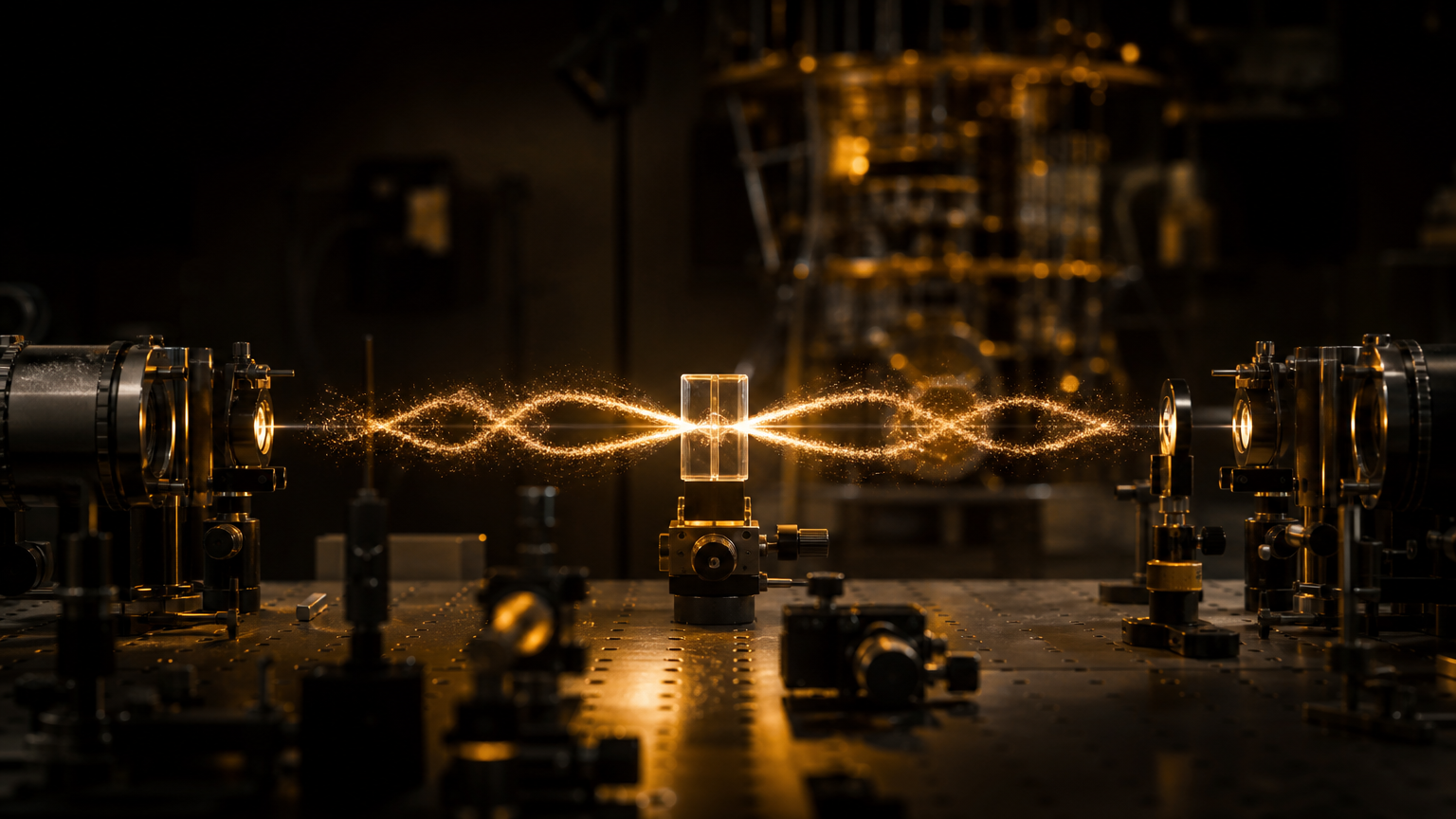
The story: entanglement in the blast zone
Einstein’s “spooky action at a distance” has just passed a demanding stress test. Researchers working with CERN’s Large Hadron Collider have reported strong evidence that pairs of Z bosons can be quantum-entangled when they emerge from Higgs-boson decays, placing one of quantum theory’s strangest effects inside some of the highest-energy conditions created in a laboratory .
That matters because entanglement is often introduced as a fragile laboratory effect, the sort of thing coaxed out of photons, electrons or trapped ions in highly controlled settings. This latest report moves the phenomenon into a harsher arena: proton collisions, Higgs production, and the almost instantaneous decay of massive weak-force carriers. ScienceDaily, summarizing the Oxford-linked work, describes the result as evidence that entanglement “survives” in one of physics’ most extreme tests .
CERN’s own account frames the finding as the first evidence of quantum entanglement between two Z bosons produced by Higgs decay, with both ATLAS and CMS contributing recent studies of the effect . A separate EuropaWire science brief likewise summarized the development as strong evidence for entanglement between Z-boson pairs produced in Higgs-boson decays at the LHC .
What was actually tested
The experiment is not a test of spooky action across everyday distances. It is a test of whether the mathematical correlations that define entanglement can still be inferred from particles born and destroyed in a violent high-energy process.
The chain begins with protons accelerated around the LHC and smashed together at enormous energies. In some rare collisions, a Higgs boson is produced. That Higgs can decay into two Z bosons, which themselves vanish almost immediately, leaving behind pairs of electrons or muons that can be measured in the detector .
Because the Z bosons are gone before anyone can measure them directly, the physicists do detective work. They track the outgoing electrons and muons, reconstruct the angles at which those particles emerged, and use those angular patterns to infer the spin properties of the parent Z bosons . If those reconstructed spin correlations match the entangled pattern better than a separable, non-entangled pattern, the data support entanglement.
CERN’s explanation emphasizes why the Z boson is an especially interesting target. Unlike top quarks, which have two possible spin states in this context, Z bosons can occupy three spin states: -1, 0 and +1 . When two Z bosons are produced from a spin-zero Higgs boson, their spin information is constrained by the origin they share . That shared origin gives researchers a way to look for correlations that cannot be reduced to two independent particles merely flying away from the same event.
Why the result feels counterintuitive
Entanglement is unsettling because it resists a common-sense picture of particles as tiny independent objects carrying prewritten instruction cards. Einstein objected to the idea that quantum theory allowed correlations that seemed to transcend ordinary local description. The shorthand “spooky action” stuck because it captured the discomfort: measure one part of an entangled system and the other part is described differently, even when separated.
Modern experiments have repeatedly confirmed that the quantum account is not just philosophical decoration. Entangled systems behave as quantum mechanics predicts, and local hidden-variable patches have not restored the classical picture. What is new here is the environment. Most demonstrations of entanglement involve relatively low-energy systems, whereas the LHC produces short-lived particles in intense collisions .
That makes the Z-boson result less a surprise ending than a range extension. Quantum mechanics was expected to apply, but the measurement still matters because expectation is not observation. The LHC setting lets researchers ask whether quantum information ideas survive when translated into the language of particle physics, spin reconstruction and collider statistics.
What it means for quantum technology
This result should not be read as a near-term product announcement. No one is about to build a consumer quantum computer out of decaying Z bosons. The bosons vanish too quickly, the events are too rare, and the LHC is not a prototype communications network.
The significance is more fundamental. Entanglement is a resource behind quantum communication, quantum sensing and quantum computing. If entanglement continues to appear, in measurable form, across very different physical regimes, scientists gain confidence that the rules used to describe engineered quantum systems are not delicate special cases but expressions of a deeper structure in nature .
That confidence matters indirectly. Technologies usually grow from reliable principles. Early electromagnetism was once fundamental science; later it became radio, electronics and modern computing. Collider entanglement will not follow the same path in any simple way, but it adds evidence that quantum correlations are not confined to pristine tabletop systems.
The Higgs becomes a quantum laboratory
The Higgs boson is best known for its link to mass, but this result highlights another role: it can act as a starting point for controlled questions about quantum correlations at high energy. CERN notes that entanglement at such energies may provide an additional probe of the Higgs boson and its interactions with elementary particles .
That is an important shift in framing. The LHC is often discussed as a machine for finding new particles. It is also a machine for testing known physics under extreme conditions. Even when no new particle appears, a rare decay channel can become a microscope for the rules connecting quantum theory, spin and the Standard Model.
The High-Luminosity LHC, the planned upgrade intended to increase the number of collisions available to experiments, could sharpen this program. CERN says the dramatic increase in collisions should expand opportunities to study quantum entanglement and other quantum phenomena at extremely high energies .
What not to overclaim
The correct headline is not “Einstein was wrong again” in a simplistic sense. Einstein helped build quantum theory, and his objections clarified the very questions later experiments learned how to test. The point is narrower and stronger: the nonlocal correlations that so troubled him continue to show up, now in a collider setting that is far removed from the clean optical experiments usually associated with entanglement.
Nor does this prove that quantum computers are about to become easy, that faster-than-light messaging is possible, or that all mysteries of measurement have been solved. Entanglement does not let users send controllable information instantaneously, and collider evidence does not remove the engineering difficulties facing practical quantum devices.
What it does show is that reality has once again declined to install the local-variables patch. The same quantum weirdness that powers the theoretical promise of quantum information appears to persist among heavy, fleeting particles created in some of the most violent collisions humans can produce. That is a stress test worth taking seriously.
The bottom line
Einstein’s “spooky action” has survived another escalation. From photons and ions to top quarks and now Z bosons born in Higgs decays, entanglement keeps turning up where quantum mechanics says it should. The latest LHC result is not a product launch, but it is a powerful reinforcement of the foundations beneath future quantum communication, sensing and computing.
For fundamental physics, that is the real news: even in the debris of high-energy collisions, the universe still behaves as though its parts can be linked more deeply than classical intuition allows .
Sources from the last 72 hours
- [1]Einstein’s “spooky action” just survived one of physics’ most extreme testsSep 20, 2026, 12:00 AM UTC
- [2]Strong evidence for quantum entanglement between Z bosons found by ATLAS and CMSSep 17, 2026, 5:00 PM UTC
- [3]CERN’s ATLAS and CMS Experiments Find Strong Evidence of Quantum Entanglement Between Z Bosons Produced in Higgs Boson DecaysSep 17, 2026, 5:00 PM UTC
AI-generated article based on recent web research, then preserved as a dated editorial snapshot.
Comments
Be the first to comment.