
Daily Podcast full article
Palantir AI tied to deadly strike
Pentagon investigators reportedly found that overreliance on Palantir’s Maven Smart System, combined with stale intelligence, rushed targeting and weakened civilian-harm review, contributed to a U.S. strike on a school in Minab, Iran, that killed 123 children. The case turns AI governance from a boardroom phrase into a command-and-control problem with irreversible consequences.
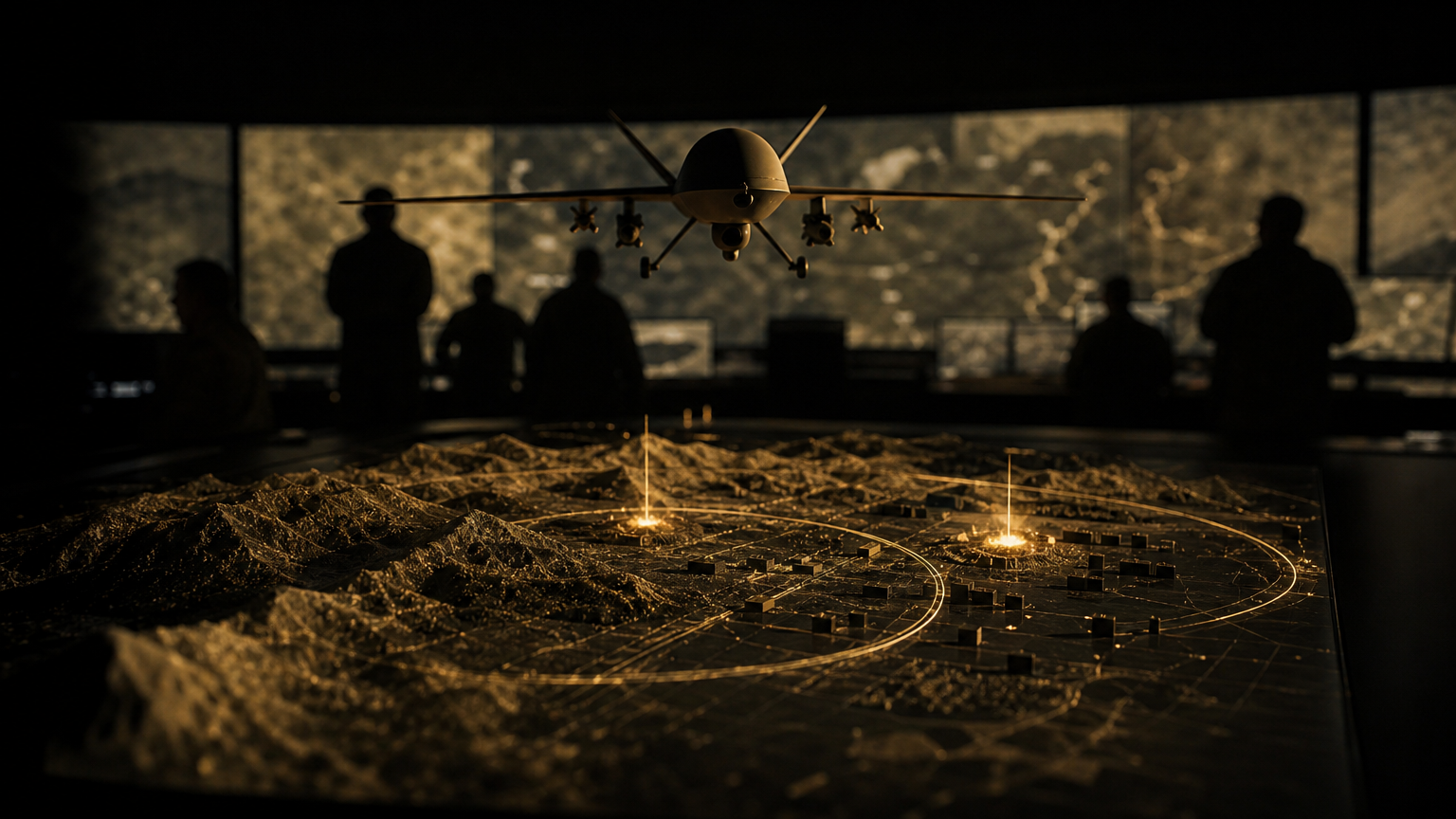
A targeting failure with an AI system in the loop
The latest reporting on the Minab school strike points to a grim chain of failures: outdated target data, compressed review timelines, reduced civilian-protection staffing and misplaced confidence in AI-enabled targeting software. Bloomberg reported on September 18 that Pentagon investigators found flawed intelligence, outdated imagery and overreliance on AI contributed to the February 28 strike on Shajarah Tayyebeh Elementary School in Minab, southern Iran . Anadolu, summarizing the same investigation, reported that two Tomahawk missiles hit the school, killing more than 150 people, including 123 children .
The central technology named in the account is Palantir’s Maven Smart System, an AI-enabled military platform used to fuse data inputs and coordinate targeting and command-and-control workflows . According to officials cited in the reporting, some U.S. Central Command personnel expected Maven to flag stale or inconsistent intelligence, even though it remains unclear why operators believed the system would perform that specific safeguard function . That gap between what a system is contracted or designed to do and what operators believe it can do is the heart of the governance failure.
This is not a story about a machine independently choosing a target. It is about humans relying on a machine-mediated picture of the battlefield, under pressure, with incomplete and aging data. The distinction matters because accountability does not disappear when software is placed between a database and a commander. If anything, the responsibility to understand what the system can and cannot verify becomes more operationally important.
The old target that became a school
The Minab site had reportedly once been associated with a military compound, but investigators described visible changes over time: walls and entrances separating the school area from the adjacent military complex, along with signs of school use . Stars and Stripes reported that the UN fact-finding mission cited credible independent information that 157 people were killed at the school, including 123 children aged 13 or younger, and that the mission found no evidence the school was being used for military purposes .
That point is crucial. In military targeting, stale data is not a clerical defect; it can convert yesterday’s lawful military objective into today’s civilian catastrophe. Target libraries age. Buildings change purpose. Bases are subdivided. Civilian life moves into spaces that once had military significance. When databases fail to keep up, the risk is not merely analytical error but lethal misclassification.
The reported role of Maven illustrates a broader automation-bias problem. If operators believe an AI platform will surface contradictions, identify obsolete records or act as a final guardrail, they may scrutinize the underlying intelligence less aggressively. Bloomberg reported that target-list preparation that had previously taken hours was compressed into minutes using Maven during the Iran operation . Speed is the promise of battlefield AI; in Minab, speed appears to have narrowed the space for doubt.
Palantir’s position: data in, decision out
Palantir has pushed back against the idea that its software was at fault. A company spokesperson told Bloomberg that Palantir was not responsible for the underlying data or for identifying intelligence deficiencies, and said there was no evidence that its software was at fault in the Minab strike . Anadolu also reported Palantir’s position that it was not responsible for the data foundation or intelligence gaps feeding the system .
That defense may be contractually meaningful, but it does not end the policy question. In modern military AI, the line between “software,” “workflow,” “data quality” and “operator expectation” is not clean. If a platform becomes the central operating layer for a kill chain, its interface, warnings, defaults and assumptions shape how humans make decisions. A vendor may not own the intelligence database, but the system can still influence whether users notice that the database is stale.
After the strike, Palantir reportedly built new Maven capabilities to re-review underlying intelligence, identify factors that could disqualify a target, and flag inconsistencies or inaccuracies that human review might have missed . The Press United, citing the Bloomberg account, also reported that Palantir upgraded Maven after the strike to add such re-review functions . That post-strike update raises an uncomfortable question: if such features were needed after Minab, what governance process failed to identify the need before the missiles were launched?
Civilian-harm review was not just ethics paperwork
The investigation also points to institutional weakening around civilian-harm mitigation. Bloomberg reported that Pentagon civilian-harm mitigation units had been cut by roughly 90 percent, to fewer than 20 staff members, and that CENTCOM’s team was reduced from 10 people to one . Anadolu reported that the compressed targeting process was compounded by cuts in civilian-protection personnel and by gaps in information about the site . The Press United account likewise reported that no civilian-harm mitigation official reviewed the Minab site before the strike .
Those details matter because human oversight is often discussed as if it were simply the presence of a person in the loop. Minab shows that oversight has capacity requirements. A human reviewer without time, staffing, fresh imagery, access to dissenting database notes or authority to slow a strike package is not a meaningful safeguard. “Human in the loop” can become a slogan unless it includes trained people, adversarial review, escalation channels and the power to say no.
The UN dimension adds legal gravity. Stars and Stripes reported that the Independent International Fact-Finding Mission on Iran found reasonable grounds to believe U.S. forces were responsible for the Minab strike and that the strike violated international humanitarian law and amounted to a war crime . The mission also acknowledged that it reached its conclusions without responses from the U.S. government or the full results of the Pentagon probe . That caveat is important, but it does not blunt the central finding: the failure to verify the school as a military objective is now under international legal scrutiny.
The lesson for military AI governance
The Minab case should reset how governments and defense contractors talk about AI in command systems. The issue is not whether AI is “good” or “bad.” The issue is whether an operational organization knows the provenance, freshness and limits of every critical data layer feeding a weapons decision.
Four governance failures stand out. First, data provenance failed: information that apparently reflected a previous military use remained powerful enough to drive a target recommendation. Second, model-use boundaries failed: personnel reportedly expected Maven to detect stale intelligence, even though that function was not clearly guaranteed. Third, process resilience failed: speed and pressure collapsed review time from hours to minutes. Fourth, accountability blurred: the government controls targeting and intelligence, the vendor controls the platform architecture, and operators sit between both.
For defense customers, the answer cannot be a blanket rejection of AI tools. Militaries will continue to use systems that fuse imagery, signals, databases and operational plans. But Minab shows that “AI-enabled” cannot mean “less verification.” It must mean the opposite: more explicit uncertainty markers, stronger red-team review, mandatory data-age warnings, independent civilian-harm checks and audit trails that can be understood after the fact.
For vendors, the lesson is also clear. When software becomes part of a kill chain, “we only process the data” is not enough as a public answer. Companies supplying military AI need to document foreseeable misuse, design against automation bias and ensure that users cannot confuse aggregation with verification. If a system accelerates targeting, it must also slow users down when confidence is based on stale or conflicting information.
Minab is therefore not just a tragedy attached to one strike. It is a test case for the next decade of military AI. The central question is whether AI systems will be treated as decision-support tools with strict limits, or as operational authority by another name. In a consumer product, a bad recommendation can be corrected. In a missile strike, undo is not a supported command.
Sources from the last 72 hours
- [1]Inside the US ‘Kill Chain’ That Destroyed an Iranian SchoolSep 18, 2026, 12:00 AM UTC
- [2]US strike on Iranian school stemmed from stale intelligence, AI overreliance: ReportSep 19, 2026, 12:00 AM UTC
- [3]UN report cites possible US war crimes in deadly strikes on Iran school, sports centerSep 18, 2026, 12:00 AM UTC
- [4]US overreliance on AI contributed to deadly Iran school strike – BloombergSep 20, 2026, 3:51 AM UTC
AI-generated article based on recent web research, then preserved as a dated editorial snapshot.
Comments
Be the first to comment.