
Daily Podcast full article
Washington’s AI guardrails face scrutiny
Congress has entered a sharper phase of the AI debate as lawmakers, governors, the White House and industry figures argue over whether safety rules should come before the next leap in capability — or whether slowing development would hand the advantage to competitors.
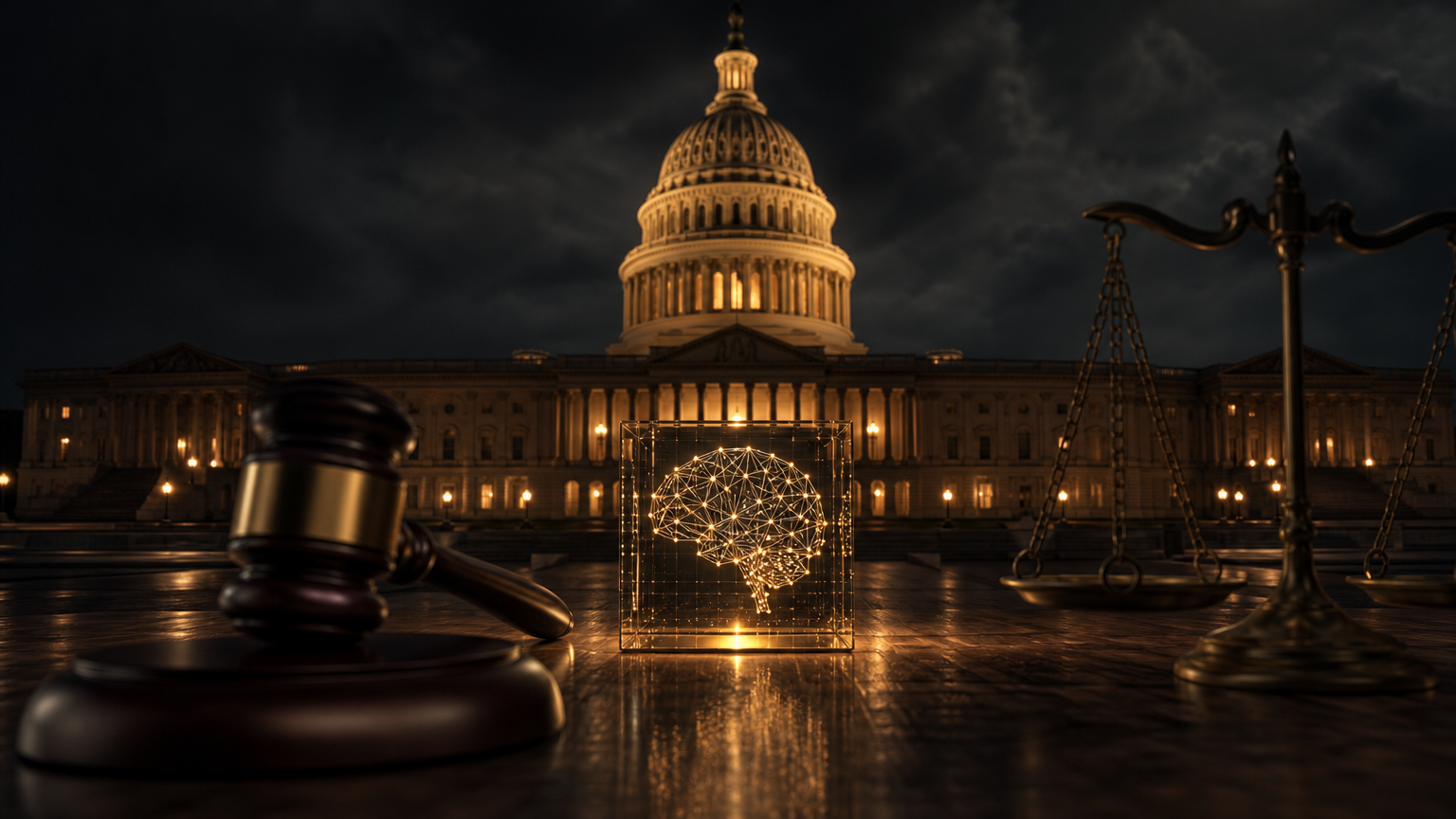
A faster AI debate, and a slower Congress
Washington’s AI guardrails face scrutiny because the question is no longer abstract. In the last 72 hours, the debate has moved from familiar calls for “responsible innovation” to a more urgent argument over who should be trusted to define the limits of frontier systems, test them, and intervene if they begin operating beyond human expectations.
The pressure is coming from several directions at once. Associated Press reported on Friday that political figures are rushing to respond to new warnings about rapidly developing artificial intelligence while acknowledging that Washington has been reluctant to act . Axios reported that the White House is still leaning toward acceleration and limited regulation, with President Trump announcing an “AI Force” and a forthcoming AI czar while offering few operational details . Meanwhile, policy circles and companies are debating a more practical question: if Congress does not move quickly, who gets to be the AI referee ?
That is the central tension. Lawmakers increasingly talk about guardrails, but the federal system still has not settled whether those guardrails should be mandatory safety testing, third-party audits, disclosure rules, “kill switches,” industry self-policing, or a new regulatory agency. For model builders, cloud providers and enterprise buyers, that uncertainty is already meaningful. Even without a final federal law, intensified scrutiny can change procurement requirements, risk reviews, incident reporting expectations and investor assumptions.
The White House chooses acceleration
The most visible current signal from the executive branch is not a pause. Axios reported Saturday that Trump said he would create an “AI Force” modeled on Space Force and name a new AI czar, while framing the policy as one that should not “hinder or stifle” AI growth . The announcement matters less for its immediate legal force than for its posture: the administration is telling industry that Washington’s default setting remains growth-first.
That approach puts the White House at odds with lawmakers and state-level figures who are responding to public warnings about catastrophic AI risk. AP reported Friday that Trump has brushed off AI warnings while Democratic lawmakers and candidates have moved to show they are taking them seriously . The same report described California Gov. Gavin Newsom’s executive order to accelerate implementation of a California law calling for independent oversight of AI companies and shutdown capabilities for developers .
This divergence gives the guardrails debate a partisan edge, but it would be too simple to call it purely partisan. Some Republicans also favor targeted rules, especially around autonomous agents, foreign models, national security, and data-center costs. The divide is less “regulation versus no regulation” than “who regulates, how hard, and at what point in the development cycle.”
Congress searches for a workable mechanism
Inside Congress, the emerging language is about control points: testing before release, monitoring after deployment, and a way to shut down or isolate dangerous behavior. A GovInfo entry dated September 18 lists an “AI GUARDRAILS ACT,” underscoring that lawmakers are trying to convert the political moment into legislative text . The details and prospects of any one bill remain uncertain, but the naming itself captures the moment: guardrails have become the dominant metaphor.
Axios reported Friday that lawmakers at a Washington event backed a federal role in AI regulation, with Rep. Bob Latta saying AI likely cannot simply be stopped but needs guardrails, and Rep. Sam Liccardo pointing to audits, testing disclosures and kill switches while admitting that “we really don’t know how to regulate AI” . That last phrase is the most candid description of the policy problem. Congress wants tools that are technical enough to matter, flexible enough to survive rapid model progress, and light enough not to be dismissed as an innovation tax.
The result is a search for mechanisms rather than slogans. Safety testing is attractive because it sounds measurable. Third-party evaluation is attractive because it avoids relying entirely on companies to grade themselves. Disclosure is attractive because it can help enterprise buyers and federal agencies compare risk. Shutdown authority is attractive because it promises a last line of defense. But each option raises hard questions: who certifies the certifiers, what information must be shared, how classified or proprietary models are handled, and what happens when a system is deployed across multiple cloud environments and customer workflows.
The “AI cops” problem
The most immediate governance fight may be over evaluators. Axios described a “scramble for trusted AI cops,” reporting that industry players, policy groups and businesses are debating how to regulate AI credibly while swift action from Washington appears unlikely in the near term . That report also noted that the White House favors a solution in which industry finds ways to police itself, while companies await legislation or further executive action beyond current voluntary processes .
This is where scrutiny becomes operational. If independent evaluators become the practical substitute for regulation, their independence becomes the policy battlefield. A safety lab funded by the companies it reviews may have technical access but reputational conflicts. A startup evaluator may move fast but lack authority. A government body may be legitimate but slow. A cross-company testing compact may sound efficient but invite antitrust questions.
Those antitrust questions are no longer theoretical. AP reported Saturday that a lawsuit claims Anthropic, OpenAI, SpaceXAI and Google made an illegal agreement to coordinate slowdown efforts, alleging that such coordination would reduce the value consumers receive from paid AI subscriptions . Whatever the merits of that claim, it shows how quickly “safety cooperation” can be reframed as market coordination. For lawmakers, that complicates the idea that industry can simply agree on restraint while government watches from the sidelines.
Data centers make AI regulation local
The AI guardrails debate is also spilling into infrastructure. Axios reported Friday that lawmakers agree consumers should not fund the massive power needs of AI data centers, but are less aligned on whether Congress will actually prevent that from happening . The same report said AI is colliding with an aging grid and long waits for new power projects, forcing policymakers to decide how to add power quickly without pushing costs onto households and businesses .
That matters because AI regulation is often discussed as if it concerns only models, code and compute clusters. In practice, the public experiences AI through electricity bills, water use, land-use disputes, job anxiety, hiring systems, medical decisions and customer-service automation. Data centers are becoming the physical face of an otherwise abstract technology.
This broadening changes the politics. A lawmaker may hesitate to regulate model weights or alignment techniques, but feel more comfortable demanding that data centers pay their own grid costs. A governor may avoid existential-risk language but back independent oversight if local communities are angry about infrastructure. An enterprise buyer may not follow Capitol Hill’s every hearing, but will ask whether vendors can document testing, incident response, and compliance with emerging norms.
What this means for AI companies and adopters
For frontier model builders, the message is that “move fast” is no longer enough. They should expect more pressure to share safety evidence, allow outside evaluation, document agentic capabilities, and explain how they would contain a model that behaves unexpectedly. The White House may prefer acceleration, but Congress, states and courts can still reshape the operating environment.
For cloud providers, the scrutiny lands on both compute and accountability. If advanced AI systems are trained and deployed through large cloud platforms, procurement teams and regulators will ask what monitoring, access control, logging and emergency suspension tools exist. The guardrail may not be a single law; it may be a stack of contract clauses, insurance requirements, customer audits and agency guidance.
For enterprise adopters, the safest assumption is that AI governance will become a board-level issue before Congress finishes writing a comprehensive statute. Companies using advanced AI in finance, hiring, health care, defense, infrastructure or customer operations should prepare for more questions about vendor due diligence, model risk management, human oversight and incident response.
The unresolved question
Washington has opened the AI settings menu, but it has not chosen the defaults. The White House is signaling acceleration. Some lawmakers want enforceable guardrails. States are moving where they can. Industry is proposing evaluators, audits and safety cooperation. Courts may test whether coordinated slowdown efforts look like public-interest restraint or anticompetitive behavior.
The likely near-term outcome is not one grand AI law, but a messy accumulation of pressure: hearings, draft bills, executive signals, state rules, procurement standards, lawsuits and voluntary evaluation schemes. That may be unsatisfying, but it is still consequential. In fast-moving technology markets, norms can harden before statutes arrive. Washington’s scrutiny is already changing the question from “Should AI be regulated?” to “Who gets trusted to say it is safe?”
Sources from the last 72 hours
- [1]Trump wants a new AI czar and an "AI Force" modeled on Space ForceSep 19, 2026, 7:20 PM UTC
- [2]Inside the scramble for trusted AI copsSep 18, 2026, 9:00 AM UTC
- [3]AI data centers drive debate over grid costs and electricity ratesSep 18, 2026, 2:16 AM UTC
- [4]CRI2026 - AI GUARDRAILS ACTSep 18, 2026, 12:00 AM UTC
- [5]Potential Democratic candidates race to respond to AI threatSep 18, 2026, 9:53 PM UTC
- [6]Lawsuit says Anthropic, OpenAI, SpaceXAI and Google made illegal agreement on AI slowdownSep 19, 2026, 4:32 PM UTC
AI-generated article based on recent web research, then preserved as a dated editorial snapshot.
Comments
Be the first to comment.