
Daily Podcast full article
New Tesla Semi Mass Production Line LEAKED Changes Everything!
Tesla’s newest Semi factory reveal shows why the truck is not just another electric tractor, but a manufacturing bet: a 1.7 million-square-foot Nevada line designed around 50,000 Class 8 trucks a year, fewer legacy assembly steps, powder-coated bodies, integrated battery architecture and a production flow that could redefine how heavy trucks are built.
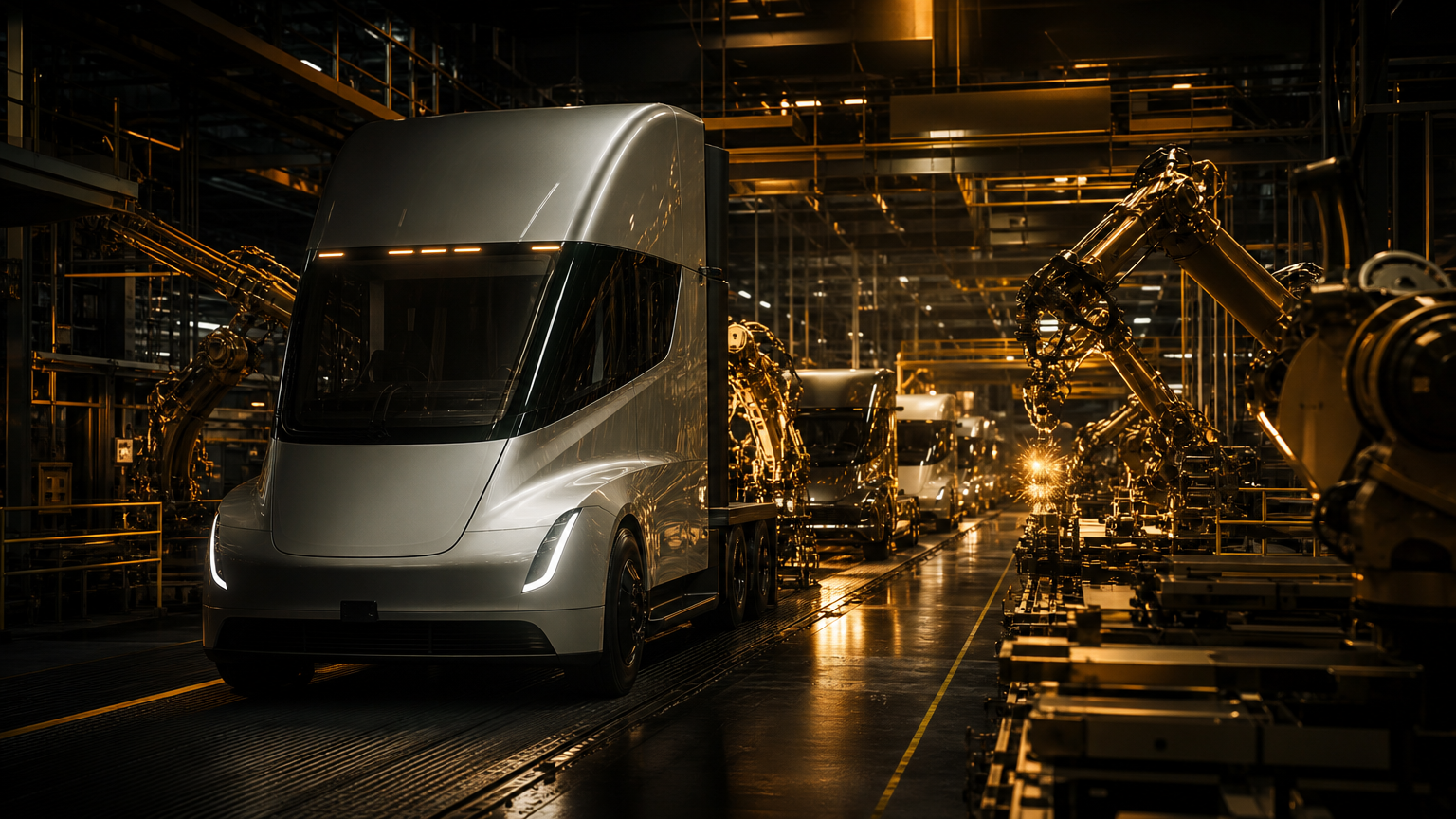
The leak is the factory, not just the truck
The latest Tesla Semi “leak” is less about a secret specification sheet and more about the public surfacing of details that were previously hidden inside the new Nevada production system. In fresh factory-tour coverage published inside the required 72-hour window, multiple outlets described a purpose-built Tesla Semi plant in Sparks, Nevada, adjacent to Giga Nevada, sized at roughly 1.7 million square feet and aimed at an eventual 50,000 trucks per year, or about 1,000 units per week at full rate .
That number matters because it reframes the Semi from a long-running pilot program into a manufacturing architecture. Tesla has already shown low-volume Semis in fleet work since the first customer deployments, but the new line is presented as a factory created for repeatable Class 8 output rather than hand-built demonstration vehicles . The key claim is not simply that Tesla can build an electric truck. It is that Tesla has tried to remove entire legacy truck-building assumptions before the truck reaches the line.
Designed together: truck and factory as one product
The most important detail from the new coverage is that Tesla appears to have designed the Semi and the plant as a single system. Reports from the Top Gear Tech walkthrough say the line was built around speed, cost, reliability and simplified assembly, rather than around adapting a diesel-style chassis to an electric powertrain . That is the part that changes the competitive frame.
Traditional heavy-truck factories are often optimized around frame rails, supplier modules, drivetrain installation, paint operations and high variation. Tesla’s approach, as described in the tour summaries, is closer to the company’s “machine that builds the machine” playbook: simplify the product so the line can move faster, then simplify the line so the product can be built with fewer bottlenecks .
One example is the cab assembly strategy. Coverage of the walkthrough says Tesla keeps the rear of the cab open late in the process, allowing large interior components such as the seat and instrument panel to be installed from behind . That sounds like a small packaging detail, but in production it can matter: easier access means fewer awkward operations, less rework and a better chance of consistent takt time.
Another example is wheel installation. EVwire and Tesla Space both highlighted a machine shown in the tour that installs all 10 wheel lug nuts at once . In a passenger-car plant, that kind of automation is expected. In heavy trucks, where scale, weight and customization can slow the line, it signals that Tesla wants Semi manufacturing to look less like traditional vocational assembly and more like high-volume vehicle production.
No paint shop is a manufacturing statement
The most attention-grabbing detail is the absence of a conventional paint shop. Fresh reports say the production Tesla Semi is powder-coated rather than painted, and that the factory therefore avoids a traditional liquid-paint operation . Tesla reportedly leans on experience from products such as Megapack to justify the approach, with the claimed advantages including lower capital requirements, less floor space and a durable finish suited to commercial use .
This matters because paint shops are among the most expensive, space-intensive and environmentally complex parts of vehicle manufacturing. If Tesla can make powder coating work at Class 8 scale while satisfying fleet durability requirements, it removes a major factory burden. The decision also fits the Semi’s use case: fleet operators care more about uptime, repairability and lifecycle cost than about luxury paint depth.
The production body changes follow the same logic. The latest coverage describes a new front end with a light bar, a three-piece front fascia that can be repaired in sections after minor damage, and aerodynamic updates that make the production truck more slippery than earlier prototypes . For freight companies, that combination is practical: less downtime after yard bumps, lower energy consumption on route and fewer parts replaced unnecessarily.
The numbers Tesla wants fleets to notice
The fresh tour reporting repeats a set of production Semi figures that explain why Tesla is pushing the truck as a business tool. TeslaNorth summarized the truck with two battery configurations, a standard pack of about 548 kWh and a longer-range setup described as adding another half again; range targets are roughly 325 miles and 500 miles, with claimed efficiency around 1.7 kWh per mile .
Performance numbers are unusually strong for a Class 8 tractor: about 12.5 seconds from 0 to 60 mph empty and about 24 seconds with a loaded trailer, according to the tour summary . Tesla also claims the Semi can hold about 65 mph on a 3 percent grade where a diesel comparison may drop closer to 50 mph . Acceleration is not the real business case, but grade speed, predictable merging and reduced driveline fatigue can matter on repeated freight routes.
The cost discussion is more important. In the California example cited from the tour, energy consumption of 1.7 kWh per mile at about 20 cents per kWh translates to roughly 34 cents per mile for electricity, compared with about one dollar per mile for diesel under the diesel-price assumptions used in the segment . That is not a universal guarantee; power prices, demand charges, depot infrastructure and route weight will decide the real payback. But it is exactly the kind of calculation that fleet managers use.
Fleet data still limits the hype
The strongest caution is that factory capacity is not the same as sustained production. A plant designed for 50,000 trucks per year does not mean Tesla is already delivering at that run rate. Current coverage of fleet data still frames the Semi as moving from low-volume reality into volume-production ambition .
Tesorb’s September 21 analysis argues that PepsiCo remains the longest-running commercial operator, with typical loads reportedly reaching about 425 miles while very heavy soda shipments at maximum gross combination weight can cut range to around 100 miles . That spread is a useful reminder: the Semi’s best early home is likely regional distribution, port drayage, depot-to-depot lanes and predictable high-utilization routes, not every cross-country freight mission on day one.
The efficiency data is more encouraging. The same analysis lists real-world fleet efficiency figures from ArcBest, NFI and DHL around the 1.55 to 1.72 kWh-per-mile range, close to Tesla’s rated 1.70 kWh-per-mile figure . If those numbers hold as the truck scales, the Semi’s economic pitch becomes more credible.
Why this changes heavy-truck competition
The leaked factory details put pressure on incumbent truckmakers because Tesla is not merely presenting an electric drivetrain. It is presenting a manufacturing thesis: fewer legacy steps, fewer paint-shop constraints, integrated battery structure, high automation and a line designed from scratch around one electric Class 8 platform.
That does not instantly defeat Volvo, Daimler Truck, Scania, Freightliner, Kenworth or other incumbents. Those companies have deep service networks, long fleet relationships and decades of reliability knowledge. Tesla still has to prove service coverage, parts availability, charging uptime, winter performance and sustained weekly production.
But the Nevada line changes the question. Until now, skeptics could ask whether the Semi was a boutique product. After the latest factory view, the sharper question is whether Tesla can ramp a factory explicitly designed not to be boutique. The answer will not come from one tour, one launch event or one glossy ride-along. It will come from weekly output, fleet uptime and whether the 50,000-unit design target turns into dependable deliveries.
For now, the leak changes everything because it shows Tesla’s real bet: the Semi is not just a truck. It is a factory strategy on wheels.
Sources from the last 72 hours
- [1]50,000 Trucks a Year, 1.7 million sq ft: Top Gear Tech Goes Inside the Tesla Semi FactorySep 19, 2026, 12:00 AM UTC
- [2]Top Gear Tech Tours Production Tesla Semi and Nevada FactorySep 20, 2026, 12:00 AM UTC
- [3]VIDEO: Detailed Tesla Semi Factory tour with a closer look at the production, 4680 battery cells, powder-coated body panels and other highlightsSep 18, 2026, 6:00 PM UTC
- [4]Tesla Space #141: I took a ride in the Tesla SemiSep 18, 2026, 6:00 PM UTC
- [5]Tesla Semi enters volume production: what PepsiCo’s fleet data reveals after three years on the roadSep 21, 2026, 12:00 AM UTC
AI-generated article based on recent web research, then preserved as a dated editorial snapshot.
Comments
Be the first to comment.