
Daily Podcast full article
US and Jura Harden the Quantum Stack
Washington is shifting quantum funding from splashy qubit counts to verified, fault-tolerant systems, while Switzerland’s Canton of Jura is positioning itself as a post-quantum semiconductor security node. Together, the moves show the quantum race becoming less about laboratory spectacle and more about hardened infrastructure.
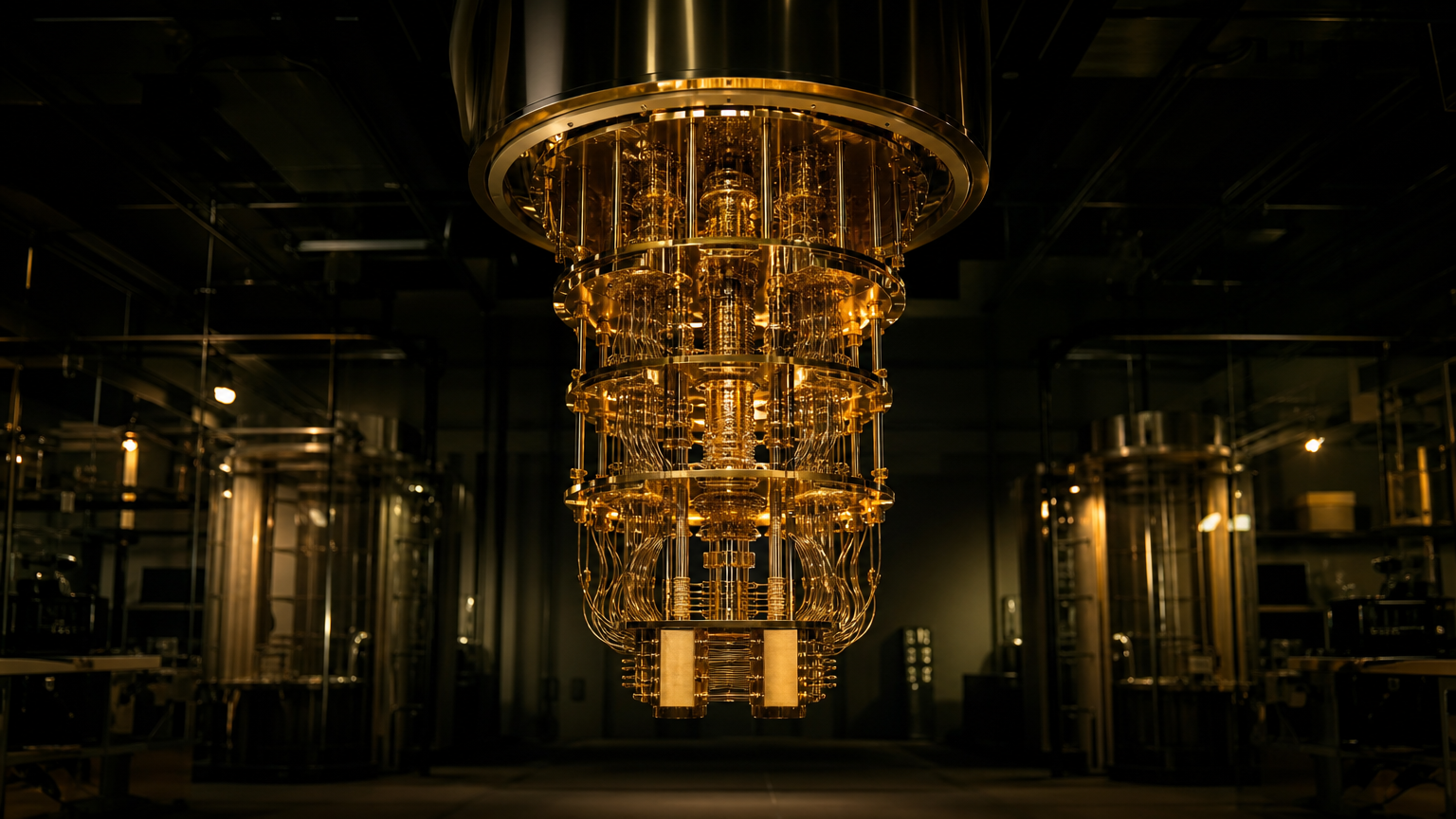
A new phase in the quantum race
The working headline is the story: US and Jura harden quantum stack. In the United States, the Department of Energy’s new Quantum Genesis Q Competition puts up to 215 million dollars behind a concrete systems target: fault-tolerant, scientifically relevant quantum computers built around logical qubits, not just larger collections of fragile physical qubits . In Switzerland, WISeKey, SEALSQ and the Republic and Canton of Jura have signed a memorandum of understanding for a post-quantum semiconductor and cybersecurity center intended to localize design, personalization, testing and secure provisioning capabilities .
The two announcements are not the same project, and they sit on different sides of the quantum transition. The U.S. competition is about building machines that can compute through errors; the Jura Center is about hardening chips and cryptographic trust anchors for a world in which quantum computing becomes strategically relevant . Read together, however, they point to the same maturation: quantum is becoming a stack problem, from error-corrected hardware and validation testbeds to secure silicon, firmware personalization and post-quantum cryptography.
Washington stops paying for vibes
The U.S. program is notable because its bar is not a marketing metric. Quantum Genesis Q is seeking private-sector proposals for systems with at least 100 logical qubits capable of performing hundreds of millions of fault-tolerant operations, with applications in chemistry, materials science, physics and applied mathematics . Innovation News Network reported that the program is led by the DOE’s Office of Advanced Scientific Computing Research and is designed to move the field toward scientifically relevant, fault-tolerant machines rather than isolated demonstrations .
That distinction matters. Physical qubits are notoriously sensitive to noise, control errors and environmental disturbances; useful quantum computing depends on encoding information across many physical qubits to form more reliable logical qubits and then correcting errors quickly enough to sustain a calculation . In other words, the prize is not “more qubits” in the abstract. It is an engineered system that can keep a computation alive long enough to matter.
The funding structure reinforces that systems discipline. Phase I offers fixed awards of up to 1.5 million dollars per awardee for early development milestones, while Phase II creates a 100 million dollar incentive pool for systems demonstrating a first-generation scientifically relevant quantum computer with at least 100 logical qubits . Two further 50 million dollar bonus pools are attached to 150-logical-qubit and 200-logical-qubit demonstrations, bringing the planned competition funding to 215 million dollars .
The schedule is also designed to force movement. Applications are open to private companies, final submissions are due on October 19, 2026, and DOE plans an informational webinar for potential applicants on September 25, 2026 . The current funding includes only 2.5 million dollars in fiscal 2026, with later-year money contingent on congressional appropriations, so the headline number is real but not automatically guaranteed .
Validation becomes part of the product
The most important part of the U.S. announcement may be the less glamorous one: the separate 45 million dollar call for a Quantum High-Performance Computing Validation and Verification Testbed at DOE National Laboratories . The purpose is to give the government independent tools to characterize the whole quantum stack, from physical hardware and gates to logical architectures, algorithms, applications and classical control systems .
That is a crucial signal. Quantum computing has suffered from a gap between vendor claims and comparable, application-relevant performance. A federal validation testbed says that winning the next phase will require more than a polished roadmap or a spectacular benchmark under narrow conditions. It will require a machine whose claims can be checked by national-lab expertise.
Defense Signals framed the competition in strategic terms, tying fault-tolerant quantum computing to U.S. leadership in next-generation computing, materials science and cryptographic resilience . That framing helps explain why the DOE is emphasizing deployable performance. If quantum machines are to affect national security, energy research or scientific discovery, the government needs confidence in the full chain: hardware reliability, error correction, software, controls and workload execution.
Jura’s answer: secure the chips before the machines arrive
While Washington is pushing the compute layer, Jura is aiming at the security and semiconductor layer. WISeKey, SEALSQ and the Canton of Jura announced an MoU to collaborate on a Swiss Post-Quantum Semiconductor and Cybersecurity Center in the canton . The proposed center carries an indicative investment of 40 million to 60 million Swiss francs over six years and is intended to establish sovereign Swiss capability for design, personalization, testing and secure provisioning of next-generation post-quantum semiconductor technologies .
The center is expected to revolve around SEALSQ’s QS7001 Quantum Shield, a secure semiconductor designed to implement post-quantum cryptographic algorithms standardized by the U.S. National Institute of Standards and Technology, including ML-KEM and ML-DSA . Its planned capabilities include cryptographic root-of-trust injection, secure firmware personalization, testing, certification and, over time, ASIC design .
This is not a quantum computer factory. It is a trust-infrastructure play. If fault-tolerant quantum computers eventually threaten legacy public-key cryptography, organizations will need hardware roots of trust, secure provisioning and certified post-quantum implementations that can be deployed in connected devices, industrial systems, defense platforms and identity infrastructure. Jura’s project addresses that migration from the semiconductor side.
The local industrial logic is also explicit. The partners say the center would combine WISeKey and SEALSQ’s cybersecurity and semiconductor technologies with Jura’s expertise in precision manufacturing, microtechnology, quality control and traceability . The jobs plan is staged: roughly 40 direct jobs within two years, 150 by year five and more than 250 by year eight, with at least 60 percent expected to be filled by residents of the canton .
Why the two moves belong in one story
The U.S. and Jura announcements are best understood as two hardening moves around the same technological inflection point. The U.S. is hardening the compute stack by demanding logical qubits, long fault-tolerant operation sequences and independent validation. Jura is hardening the security stack by trying to anchor post-quantum cryptography in sovereign semiconductor personalization and certification.
That combination is important because the quantum transition will not arrive as a single machine on a single day. It will arrive as a messy systems shift: labs racing to reduce error rates, governments setting benchmarks, vendors competing for validation, chipmakers implementing new cryptographic standards, and public-sector buyers asking where their roots of trust actually live.
The DOE competition also shifts incentives. Instead of rewarding attention-grabbing physical-qubit counts, it rewards logical-qubit performance and scientifically meaningful demonstrations . The Jura project similarly shifts the conversation from abstract “quantum readiness” to concrete facilities, skills, secure chips and supply-chain geography .
The bottom line
Quantum debugging just received a very expensive extra life, but the larger message is more sober. The field is moving from promise to audit. Machines must prove fault tolerance. Vendors must survive validation. Cryptography must migrate into hardware. Regions that want a role in the quantum era are trying to own specific layers of the stack.
For the United States, the bet is that a milestone-based federal competition can pull fault-tolerant quantum computers toward useful scientific work. For Jura, the bet is that post-quantum security will need trusted semiconductor infrastructure rooted in local industrial capability. Together, they show a quantum race that is less about headlines and more about hardened, inspectable systems.
Sources from the last 72 hours
- [1]WISeKey, SEALSQ and Canton of Jura Sign MoU to Establish a Swiss Post-Quantum Semiconductor and Cybersecurity CenterSep 21, 2026, 12:00 AM UTC
- [2]US sets $215 million challenge for the next-gen fault-tolerant quantum computersSep 18, 2026, 3:41 PM UTC
- [3]US launches $215m competition for fault-tolerant quantum computersSep 21, 2026, 12:00 AM UTC
- [4]DOE Unveils $215M Quantum Genesis Q Contest for Fault-Tolerant SystemsSep 20, 2026, 10:04 AM UTC
AI-generated article based on recent web research, then preserved as a dated editorial snapshot.
Comments
Be the first to comment.