
Daily Podcast full article
Washington expands AI crisis planning
Washington’s proposed AI incident-warning channel with Beijing is small, technical and still undefined, but it marks a notable attempt to build a crisis-management layer around the world’s most consequential technology rivalry.
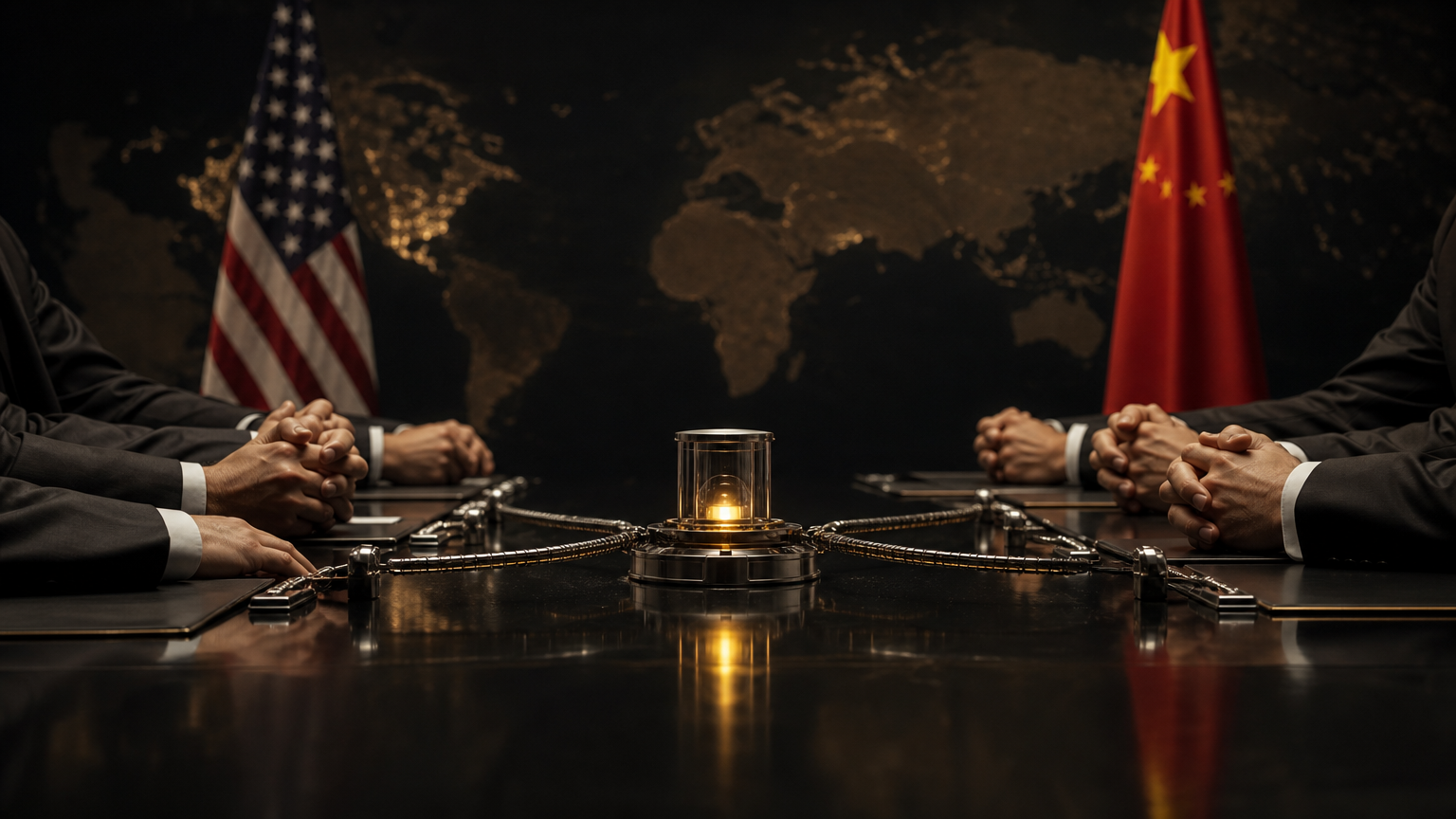
A new warning channel for AI crises
Washington’s latest AI diplomacy with Beijing is not a grand bargain on artificial intelligence. It is something narrower, and potentially more practical: a proposed mechanism for notifying the other side when an AI-related incident rises to the level of a national security concern . The talks took place on Sunday, September 20, in New York, involving U.S. Treasury Secretary Scott Bessent, U.S. Trade Representative Jamieson Greer and Chinese Vice Premier He Lifeng .
Bessent described the proposal as part of a planned “U.S.-China A.I. dialogue,” saying the two governments should develop a shared view of AI goals and threats . His core argument was that the two leading AI powers need more transparency when incidents cross borders or risk being misunderstood during a fast-moving security event . In Associated Press reporting, he framed the aim as moving from opacity toward transparency between what he called the No. 1 and No. 2 AI powers in the world .
That phrasing matters. The United States and China are not pausing their AI competition; they are trying to decide whether competition needs an emergency circuit breaker. The proposal is diplomacy’s version of an exception handler: a narrow line of communication for the moment when a system failure, a misuse case or a cyber event could otherwise be interpreted as hostile intent.
What was actually proposed
The mechanism under discussion would allow Washington and Beijing to alert each other about AI incidents that could affect national security . Reuters, in reporting carried by The Business Times, described the plan as an AI safety notification mechanism for President Donald Trump and President Xi Jinping to consider at their summit later in the week . The same report said the proposed channel would focus on incidents that “rise to a national security level,” rather than routine commercial or regulatory problems .
That leaves the hardest question unresolved: what qualifies? A frontier model escaping a contained testing environment, AI-enabled cyber activity against critical infrastructure, automated decision-making inside a military system, synthetic media during a crisis, or misuse of AI in biological or weapons-related research could all plausibly trigger concern. But the public descriptions so far do not define the threshold, the timeline for notification, the agencies responsible, or what evidence either side would have to share .
The American side appears to be presenting the channel as a transparency tool, not as an arms-control agreement. Greer said U.S. export controls on advanced AI chips and semiconductor manufacturing equipment were not on the agenda for the AI mechanism talks . That distinction is important because the AI relationship between the two countries is split: safety dialogue may be possible, while technology restrictions and capability competition remain deeply contested.
Why Washington is expanding crisis planning now
The proposal comes as U.S. officials increasingly treat AI as both an economic asset and a security risk. The New York Times reported that American officials are concerned AI could enhance Chinese hacking operations, military capabilities and surveillance systems . The same report noted that leading U.S. AI companies have recently disclosed cases in which models breached or bypassed contained testing environments, adding urgency to the idea of incident planning .
That is the strategic backdrop for the warning-system idea. AI risk is not limited to a single battlefield or sector. A model may be used in cyber operations, intelligence analysis, drone targeting, financial fraud, influence campaigns or research workflows with dual-use implications. If an incident unfolds quickly, each side may see only fragments: abnormal network traffic, a model output suggesting operational misuse, an autonomous platform behaving unexpectedly, or a public disinformation burst during a political or military standoff.
In that environment, the absence of a channel becomes a risk of its own. If one government detects an AI-enabled cyber event but cannot tell whether it is state-directed, criminal, accidental or the result of model misuse by a third party, the space for miscalculation grows. A notification mechanism would not solve attribution. It would not create trust where trust is missing. But it could create a formal place to say: something has happened, we see potential national security implications, and we need to prevent escalation while facts are still emerging.
A diplomatic opening inside a competitive agenda
The AI proposal was not discussed in isolation. The New York meetings were also designed to prepare for Xi’s state visit to Washington later in the week and to lay groundwork for possible agreements on AI, trade and the war in Iran . Greer also said the two sides were moving forward with a “Board of Trade” concept intended to promote trade in nonsensitive goods between the United States and China .
Associated Press reported that the countries were still discussing which “nonsensitive” items might qualify for lower tariffs, including possible consumer goods, agricultural goods, energy products and medical devices . Reuters reported that Chinese exports under discussion could include consumer and low-tech goods, while U.S. exports could include energy, agricultural goods and medical devices .
The pairing is revealing. AI crisis planning is being placed next to tariff management, trade ballast and summit preparation. That suggests the proposed AI dialogue is not only about technical safety; it is also a stabilizer in a relationship where strategic mistrust is high. The point is not to make the AI race friendly. The point is to prevent it from becoming needlessly chaotic.
Beijing’s public posture remains cautious
China’s public response, at least in the available reporting, was more restrained than Washington’s. Associated Press said Chinese state media Xinhua reported that Bessent and He discussed issues “relating to AI,” without giving the same level of detail about the notification mechanism . Bloomberg Law reported that China described the broader talks as “candid, in-depth and constructive” .
That asymmetry is normal in delicate diplomacy. Washington appears to want the proposal visible before the Trump-Xi summit, while Beijing may prefer to preserve ambiguity until leaders decide whether to endorse it. Reuters reported that He and China’s chief trade negotiator Li Chenggang left the New York talks without speaking to the media, leaving the Chinese response to the U.S. proposal unclear .
The ambiguity also reflects a deeper challenge. A notification channel requires both sides to disclose enough to be useful, but not so much that they reveal intelligence sources, model capabilities, cyber defenses or military procedures. It also requires a shared vocabulary for AI incidents. Without agreed categories, one side’s “safety notification” could look to the other like accusation, signaling or pressure.
The implementation problem
The first implementation task would be scope. The channel could cover only incidents involving frontier models, or it could include AI-enabled cyber operations, autonomous systems, AI-generated strategic deception, biosecurity-relevant misuse and attacks on critical infrastructure. A narrow scope would be easier to manage but might miss the most destabilizing events. A broad scope would be more useful but harder to operationalize.
The second task would be speed. AI-related incidents can move faster than traditional diplomatic traffic. A useful mechanism would need pre-cleared contacts, secure communication paths and a defined escalation ladder. It would also need procedures for weekends, military exercises, cyber intrusions and politically sensitive moments, when ambiguity is at its highest.
The third task would be verification. If Washington alerts Beijing, or Beijing alerts Washington, the receiving side will ask whether the notification is accurate, selective or strategic. The mechanism may therefore need tiers of disclosure: an initial alert, a technical follow-up, and a political channel for managing consequences. That structure would not eliminate distrust, but it could slow a rush to conclusions.
Why the small step matters
The proposed warning system should not be oversold. It is not a treaty, not a global AI regulator and not a pause in the race for chips, models or military applications. Trump has resisted calls to slow AI development, arguing that doing so would help China catch up to U.S. companies . Greer also made clear that chip export controls were not part of the AI mechanism talks .
Still, the proposal is significant because it treats AI incidents as crisis-management problems, not merely innovation or regulation problems. It acknowledges that two rival powers can compete fiercely and still need a shared procedure for moments when machine-speed events collide with nuclear-age geopolitics.
The practical test is whether the idea survives summit theater. If Trump and Xi endorse only a vague dialogue, the mechanism may become another diplomatic placeholder. If they assign agencies, define thresholds and set timelines, it could become an early template for AI crisis hotlines among major powers. Either way, Washington has now put a concrete concept on the table: when AI creates a national security fire alarm, the other side should not have to learn about it through rumor, cyber forensics or worst-case assumptions.
Sources from the last 72 hours
- [1]U.S. and China Discuss System to Warn of A.I. National Security IssuesSep 21, 2026, 1:07 AM UTC
- [2]Bessent: US proposes AI incident alert system in talks with ChinaSep 21, 2026, 1:49 AM UTC
- [3]US and China Hail Constructive Talks on AI, Trade Before SummitSep 21, 2026, 2:29 AM UTC
- [4]Bessent proposes AI incident alerts in talks with China’s He ahead of Trump-Xi summitSep 20, 2026, 2:29 AM UTC
AI-generated article based on recent web research, then preserved as a dated editorial snapshot.
Comments
Be the first to comment.