
Daily Podcast full article
Alibaba plans 10-trillion-parameter AI
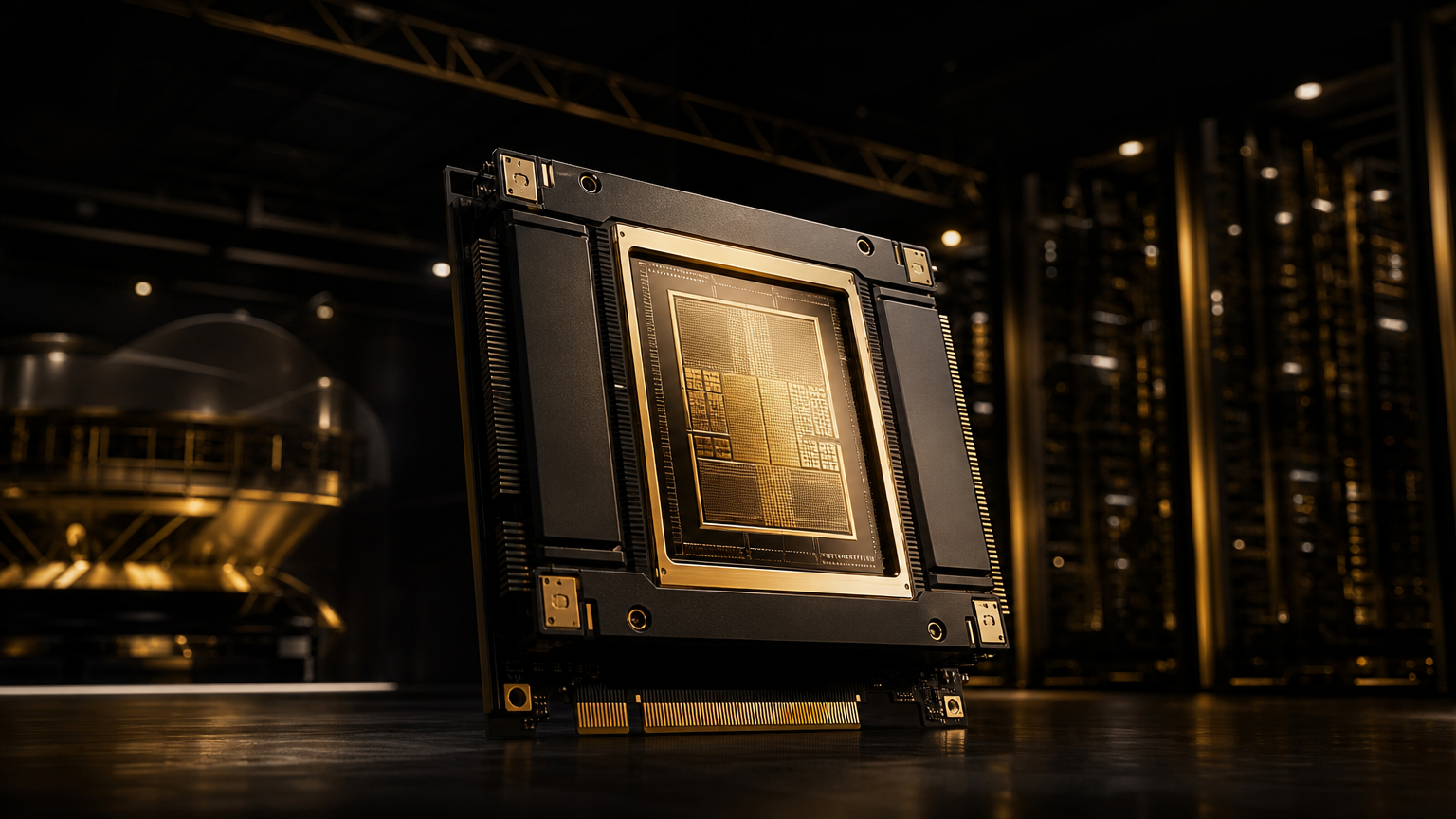
Alibaba has put a new marker on the frontier-AI map: a planned 5-trillion-to-10-trillion-parameter model, a new Zhenwu V900 accelerator, and a target for Alibaba Cloud data center capacity to exceed 20 gigawatts by 2032.
A frontier-scale pledge, not just a bigger model
Alibaba’s latest AI announcement is designed to be read as a full-stack declaration: bigger models, in-house chips, and a much larger cloud footprint. Chief Executive Eddie Wu said the company plans to train a new artificial intelligence model with 5 trillion to 10 trillion parameters, while also unveiling the Zhenwu V900 AI chip and setting a goal for Alibaba Cloud’s global data center capacity to surpass 20 gigawatts by 2032 .
The number is deliberately attention-grabbing. A 10-trillion-parameter system would sit at a scale far beyond what most commercial models publicly disclose today, and Alibaba is presenting the ambition alongside the infrastructure needed to make such a system plausible rather than as a stand-alone laboratory boast . That matters because parameter count is only one dimension of model capability. Data quality, architecture, training method, inference efficiency, post-training, tool use and safety controls can all determine whether a giant model is actually useful.
Still, scale has consequences. Training a model in the 5-trillion-to-10-trillion-parameter range would imply extraordinary requirements for compute density, networking, memory bandwidth, power delivery and cooling. Alibaba’s message is that it does not intend to rent its way into that future one GPU at a time. It wants the model, the chips and the cloud capacity to advance together.
Zhenwu V900: the hardware half of the story
The new chip is central to the announcement. Reuters reported that Alibaba described the Zhenwu V900 as the most powerful AI chip in China and said it delivers three times the performance of its predecessor . Chinese semiconductor-market coverage also reported that T-Head, Alibaba’s chip unit, released the Zhenwu V900 and that its compute power rises to three times that of the Zhenwu M890 .
Bloomberg’s report, carried by Free Malaysia Today, adds a key scaling detail: the V900 accelerator can be combined in clusters of up to 500,000 units for frontier-model training . If Alibaba can deliver that cluster vision in production, the V900 is not just a chip announcement; it is a statement about systems engineering. Frontier AI training is bottlenecked not only by the arithmetic inside accelerators, but also by how efficiently hundreds of thousands of chips can communicate, recover from failures, feed data and stay powered.
That is why the 20GW target matters. Wu said Alibaba Cloud is aiming for more than 20 gigawatts of globally operated data center capacity by 2032, and PANews reported that he framed the plan as a response to very strong customer AI demand at the Apsara Conference . A 20GW cloud footprint is a massive energy and infrastructure commitment. It points to long-term demand assumptions not only for training huge foundation models, but also for serving them to enterprise and consumer applications at scale.
Why the model and chip announcements are inseparable
Alibaba’s announcement would be less convincing if it consisted only of a parameter-count target. The hard part of frontier AI is not naming a big model; it is finding the capital, power, silicon, networking and operating discipline to train and serve it. By pairing the 5-trillion-to-10-trillion-parameter model plan with the Zhenwu V900 and a 2032 data center target, Alibaba is trying to show that it sees the AI race as an infrastructure race .
This is also a strategic response to the AI accelerator market. The V900 is being positioned as an alternative to Nvidia-class accelerators, and the Bloomberg report described Alibaba as rolling out the chip to compete with Nvidia and support a large data center expansion . For Chinese cloud and AI firms, domestic silicon is not simply a cost-control lever. It is also a hedge against supply uncertainty, export controls and the risk that foreign accelerators become either unavailable or too constrained to support national-scale AI ambitions.
The plan also strengthens Alibaba’s cloud pitch. If the company can offer access to foundation models, model services, custom AI chips and high-density cloud capacity as a package, it can sell customers a more integrated AI platform. PANews reported that T-Head’s annual AI chip shipments are expected to rise significantly . That suggests Alibaba is preparing for deployment beyond a one-off demonstration and into a broader commercial infrastructure buildout.
The parameter-count caveat
The headline number will attract attention, but it should not be mistaken for a guaranteed intelligence score. Parameter count measures the number of learned weights in a model, not the quality of the model’s reasoning, reliability, grounding, multimodal skill or usefulness in real workflows. A smaller model with better data, better architecture and better post-training can outperform a larger model on specific tasks.
That caveat is especially important because the industry has moved toward more nuanced model designs. Mixture-of-experts systems, sparse activation, retrieval, tool use, agent workflows and long-context engineering can all change the relationship between total parameters and practical performance. A 10-trillion-parameter model may not activate every parameter for every query, and the user-facing cost will depend heavily on architecture and serving efficiency.
Alibaba’s claim is therefore best read as a capacity signal. It tells customers, competitors and investors that the company is willing to build at a scale normally associated with the largest global AI players. It also signals that Alibaba expects demand for AI services to keep rising fast enough to justify heavy infrastructure spending.
Capital, power and execution risk
The plan is expensive by design. Bloomberg’s report noted that Alibaba has committed more than US$53 billion over three years to expand its AI capabilities and raised about US$10.2 billion through a Hong Kong follow-on share offering in August . Those figures give the announcement financial context: a frontier-scale model program is not a software project alone. It is a capital-expenditure cycle involving chips, facilities, power, networking and operations.
Execution risk is equally large. Building enough data center capacity is not just a matter of buying land and servers. Alibaba will need stable power access, cooling solutions, grid connections, supply chains, chip yields, cluster-management software and customers willing to pay for the resulting AI services. A 500,000-chip cluster sounds impressive, but reliability at that scale is difficult. Even small failure rates can become operationally meaningful when the system grows to hundreds of thousands of components.
There is also market risk. If AI demand grows more slowly than expected, or if model-efficiency breakthroughs reduce the need for massive training clusters, the economics of a 20GW buildout could look different. Conversely, if AI agents, coding assistants, enterprise automation and multimodal systems continue to expand, Alibaba’s integrated model-chip-cloud approach could become a major advantage.
A Chinese hyperscaler’s frontier-AI bid
Alibaba is positioning itself as one of the few companies that can compete across the full AI stack: foundation models, chips, cloud infrastructure and commercial AI services. The latest announcements at Apsara Conference make that ambition explicit. The company is not merely saying it wants a larger model; it is saying it wants the compute base to train and operate it.
The 5-trillion-to-10-trillion-parameter target is the dramatic part. The Zhenwu V900 and 20GW cloud-capacity goal are the operational part. Together, they show how frontier AI is becoming less like a model-release contest and more like a contest of industrial capacity. Alibaba’s very expensive summon spell from the cloud now has a number, a chip name and a power target.
Sources from the last 72 hours
- [1]Alibaba plans AI model with 5 trillion to 10 trillion parameters, unveils new chipSep 22, 2026, 2:52 AM UTC
- [2]Alibaba unveils AI chip to drive 20GW of data centres by 2032Sep 22, 2026, 2:58 AM UTC
- [3]Alibaba: Will Fully Invest in AI Infrastructure Construction, Alibaba Cloud Data Center Scale to Exceed 20GW by 2032Sep 22, 2026, 12:00 AM UTC
- [4]阿里巴巴:将全力投入AI基础设施建设 2032年阿里云数据中心规模将超20GWSep 22, 2026, 2:29 AM UTC
AI-generated article based on recent web research, then preserved as a dated editorial snapshot.
Comments
Be the first to comment.