
Daily Podcast full article
Alibaba unveils high-performance AI chip in full-stack AI push
Alibaba’s new Zhenwu V900 accelerator is more than a chip announcement: it is a statement that the company wants to control the AI stack from silicon and supernodes to Qwen models and cloud services, while China’s developers look for domestic alternatives to constrained foreign accelerators.
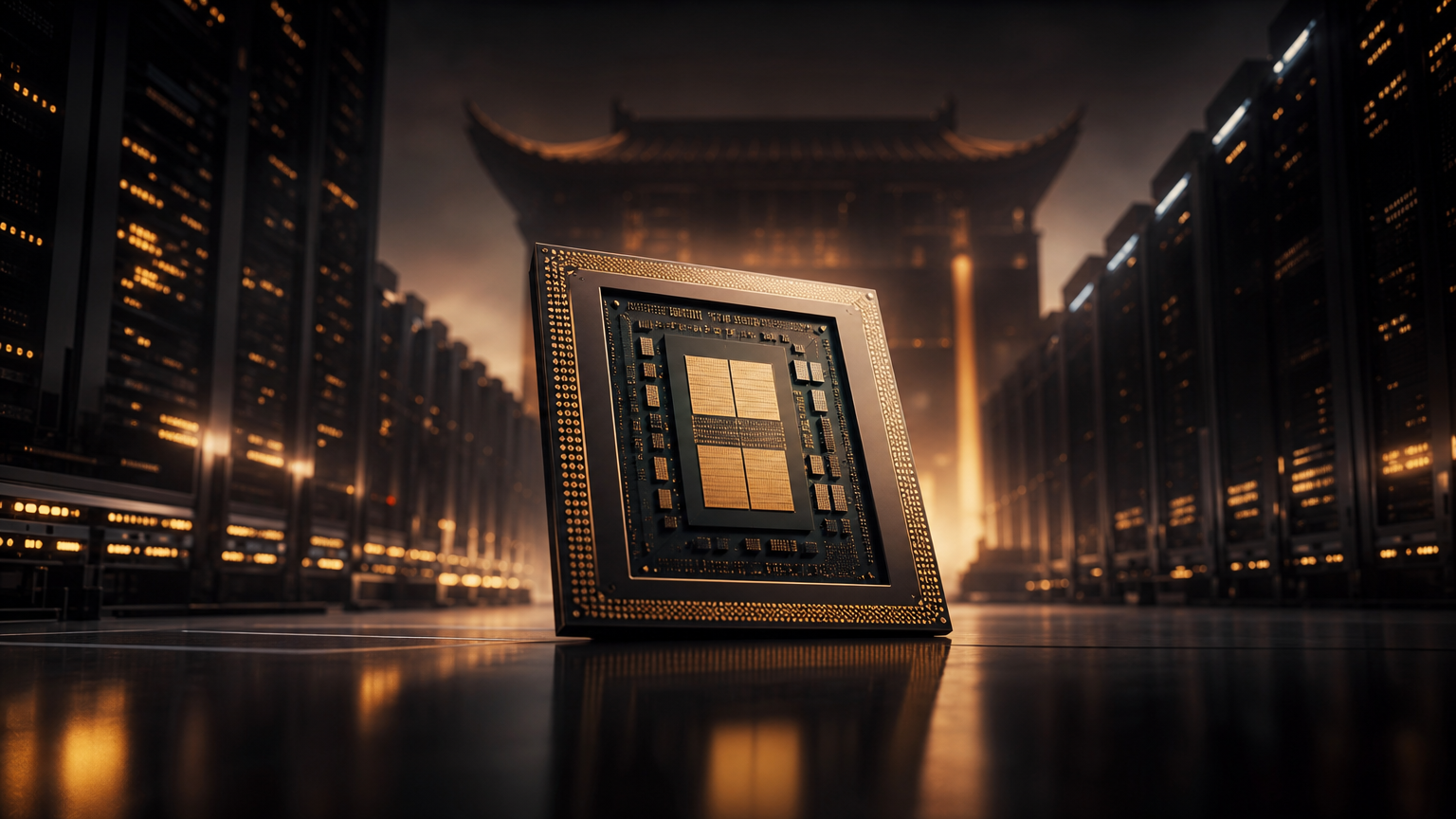
A chip launch with strategic weight
Alibaba used its Apsara Conference in Hangzhou on September 22, 2026, to unveil the Zhenwu V900, a new AI training and inference processor from its T-Head chip-design unit, and to frame the launch as part of a broader push across chips, cloud infrastructure, foundation models and AI agents . Chief Executive Eddie Wu described the V900 as “China’s most powerful AI chip,” saying it delivers three times the performance of Alibaba’s previous Zhenwu M890 generation .
That performance claim is company-provided, but the context makes the announcement significant even before independent benchmarks arrive. AI compute has become the bottleneck for frontier-model training, inference and cloud deployment, and Chinese technology companies are racing to build alternatives to Nvidia processors as U.S. export controls tighten access to advanced accelerators . Alibaba is not simply presenting a component; it is arguing that an integrated system can reduce dependence on outside chip suppliers and support a domestic AI ecosystem.
What Alibaba says the V900 can do
The official product details put the V900 squarely in the category of high-density data-center AI accelerators. Alibaba says the chip includes 216 GB of GPU memory and 1,200 GB/s of inter-chip bandwidth, supports multiple data formats including FP8 and FP4, and is designed for both high-precision training and low-precision inference workloads . The company also said the V900 is scheduled for mass production and commercial release in the first quarter of 2027 .
The cluster story may matter as much as the individual chip. Alibaba said an upgraded supernode server will combine the V900 with its ICN Switch, Panmai SmartNIC and Zhenyue SSD controller, creating a full-stack system that can support supernode clusters of up to 500,000 cards . Reuters reported that Wu described these large clusters as infrastructure for training and running the largest AI models .
That emphasis on the full system is deliberate. In frontier AI, accelerator performance is only one constraint. Memory capacity, chip-to-chip bandwidth, network latency, storage, scheduling software, model-serving software and power availability all shape real-world output. By showing the chip beside networking and storage components, Alibaba is trying to present T-Head silicon as part of a coherent platform rather than a one-off accelerator.
Qwen models make the silicon story larger
The V900 arrived alongside Alibaba’s most ambitious model roadmap to date. Reuters reported that Alibaba is developing an AI model up to four times larger than its current flagship, and that the company plans future Qwen models in the 5 trillion to 10 trillion parameter range . Alibaba’s current Qwen 3.8 Max has 2.4 trillion parameters, according to both AP and Reuters reporting .
Alibaba’s own roadmap says Qwen 4 is already in training, with future Qwen 4.5 and Qwen 5 models expected to scale toward the 5 trillion to 10 trillion parameter range . The point is not just that Alibaba wants bigger models. The more important signal is that Alibaba is trying to align model ambition with hardware capacity, cloud capacity and inference economics.
For developers, that alignment could be decisive. A powerful model is less useful if inference is expensive or capacity is rationed. A capable chip is less compelling if it lacks a mature software stack, model ecosystem and cloud distribution channel. Alibaba’s pitch is that Qwen, Model Studio, T-Head chips and Alibaba Cloud can be optimized together.
Why developers and data-center operators should care
For developers, the immediate question is not whether the V900 beats Nvidia’s top international products in a laboratory comparison. The practical question is whether Alibaba can turn the chip into reliable, affordable cloud capacity for training, fine-tuning and inference. AP reported that Alibaba’s Zhenwu chips are used in its data centers to provide computing for the company and its cloud clients .
For data-center operators, the V900 announcement points to a different procurement map. Alibaba is claiming not only a faster processor but also a supernode architecture that integrates compute, switching, networking and storage . If it works at scale, that could give Chinese cloud customers another vertically integrated path for AI workloads, especially where foreign accelerators are expensive, constrained or politically sensitive.
The commercial timing remains important. A chip scheduled for mass production and release in Q1 2027 is not the same as broad availability today . Alibaba’s ability to manufacture enough chips, qualify the systems, keep power and cooling costs manageable, and deliver a software stack that developers trust will determine whether the V900 becomes a cloud workhorse or remains a headline product.
The cloud-capacity bet
Alibaba paired the chip announcement with a large data-center ambition. Reuters reported that Wu set a target for Alibaba Cloud’s global data-center capacity to exceed 20 gigawatts by 2032 . Bloomberg also reported that Alibaba is positioning the V900 as a way to support a major data-center expansion in coming years .
That number is striking because it frames AI as an infrastructure business as much as a software business. A 20-gigawatt target points to massive demand for power, cooling, land, networking equipment, servers and supply-chain coordination. It also implies that Alibaba expects AI inference and agent workloads to become a durable source of cloud demand, not a short-term boom.
Wu told the Apsara audience that customer demand for AI was “exceptionally robust,” and Reuters reported that supply-chain constraints are limiting how quickly Alibaba can expand . In other words, the V900 is part of a capacity race: the company wants to create more compute supply at the same time that models and AI agents consume more tokens, memory and inference cycles.
Market reaction and competitive pressure
Investors reacted positively. Reuters reported that Alibaba’s Hong Kong-listed shares rose 5.1% on Tuesday to their highest level in a month after the announcements . Dow Jones reported through MarketScreener that the shares rose as much as 5.1%, outperforming a smaller gain in the Hang Seng Tech Index .
The market’s reaction reflects both excitement and pressure. Alibaba has committed heavily to AI while continuing to defend its core commerce businesses, and competitors are moving quickly. Dow Jones noted that Alibaba faces China’s AI startups such as DeepSeek and Moonshot AI, as well as larger technology rivals including ByteDance, while domestic chip competition includes Huawei, Cambricon and Baidu’s Kunlunxin .
That competition sharpens the V900’s strategic role. If Alibaba can combine in-house silicon, cloud infrastructure and Qwen models into a dependable platform, it gains more control over cost, capacity and product timing. If it cannot, the company risks being squeezed between specialized AI labs, domestic chip rivals and global cloud platforms.
The real boss battle: execution
The Zhenwu V900 gives Alibaba a stronger story in China’s AI hardware race, but the hardest fight begins after the keynote. The company must prove that its performance claims hold up in production, that clusters can be deployed at scale, that developers can access capacity without friction, and that the economics work for both Alibaba Cloud and its customers.
The launch also shows how AI competition is shifting. The winners will not be chosen by model size alone, or by chip specifications alone. They will be decided by how well silicon, networking, cloud software, models and applications reinforce one another. Alibaba’s message from Hangzhou is that it wants to own that whole chain. The next test is whether the V900 can move from a strategic announcement to the infrastructure layer that developers actually build on.
Sources from the last 72 hours
- [1]Alibaba Unveils Roadmap on Full-Stack AI Strategy from Chips, Cloud Infrastructure, Models to AgentsSep 22, 2026, 3:40 AM UTC
- [2]Alibaba deepens AI push with new chip, bigger model; shares jump 5%Sep 22, 2026, 2:52 AM UTC
- [3]Alibaba Unveils New AI Chip, Outlines Plan for Larger Model -- UpdateSep 22, 2026, 6:35 AM UTC
- [4]Alibaba Unveils AI Chip to Drive Global Data Center Buildout (1)Sep 22, 2026, 2:47 AM UTC
- [5]China’s Alibaba unveils new powerful chip and ambitious AI model plansSep 22, 2026, 7:16 AM UTC
AI-generated article based on recent web research, then preserved as a dated editorial snapshot.
Comments
Be the first to comment.