
Daily Podcast full article
JPMorgan sees $1T AI buildout as debt pressure mounts
Jamie Dimon’s latest AI warning is less about software hype than about steel, silicon, power and credit. The JPMorgan chief says hyperscaler-related AI spending could reach about $1 trillion in 2027, a scale that turns data centers into a macroeconomic force and puts debt financing under sharper scrutiny.
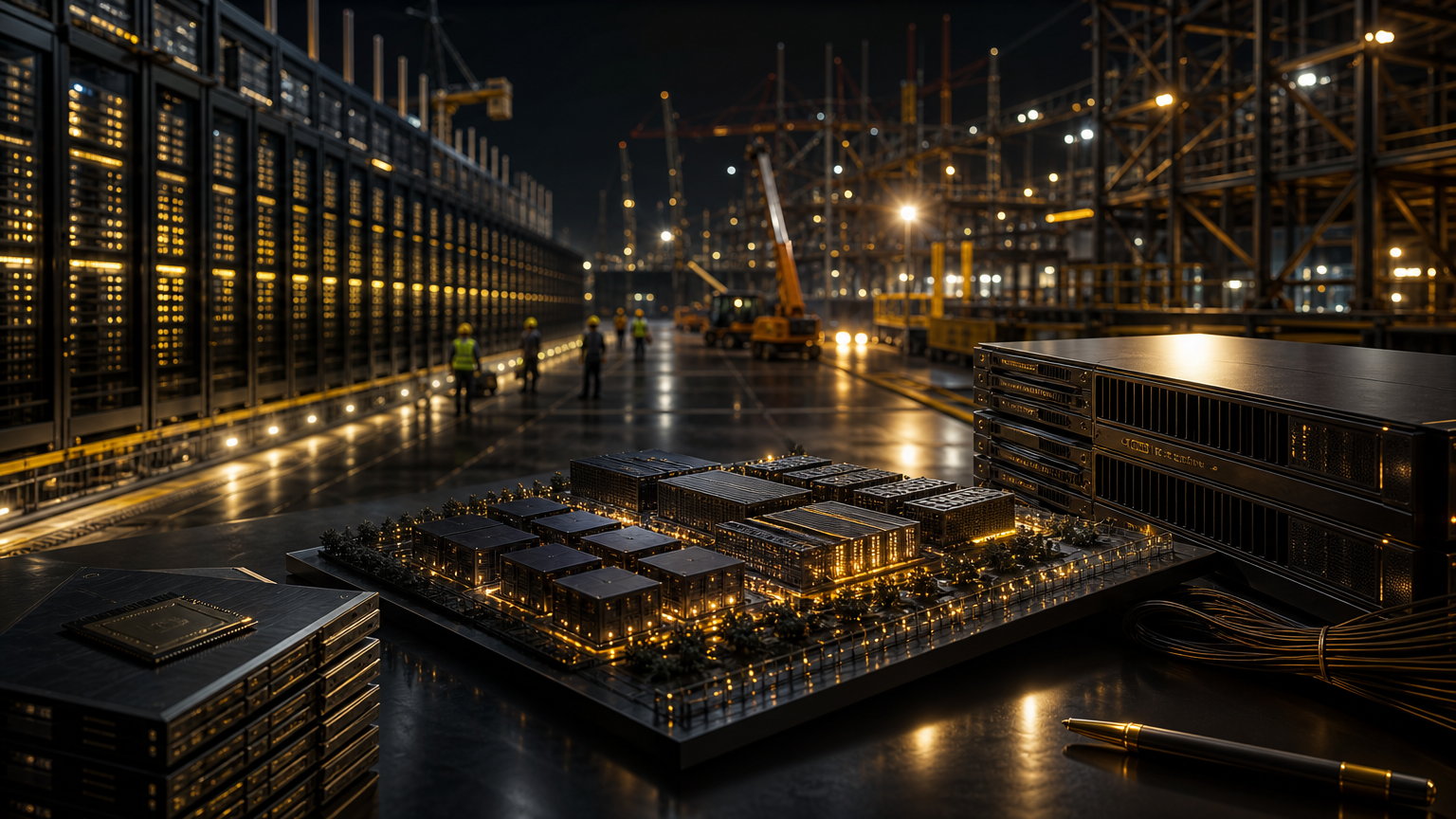
A trillion-dollar infrastructure cycle
JPMorgan Chase chief executive Jamie Dimon has put a hard number on the AI buildout: spending across the hyperscaler ecosystem could reach about $1 trillion next year, after rising from roughly $300 billion in 2025 to about $700 billion in 2026 . That estimate, delivered on the sidelines of the JPMorgan India Conference, frames artificial intelligence not as a normal software upgrade but as an industrial investment cycle built from data centers, chips, servers, networking equipment, power plants and construction labor .
The distinction matters. Software booms are usually judged by users, margins and recurring revenue. This one is also being judged by substations, transformers, optical links, cooling systems and the ability to borrow or internally fund enormous capital programs. Dimon said the spending surge could add about one percentage point to GDP each year and may add somewhat to inflation as companies hire workers, build facilities and buy equipment . In other words, the AI story has moved from the product roadmap into the macro data.
That shift explains why the $1 trillion figure landed with force. Hyperscalers such as Amazon, Microsoft, Alphabet, Meta and Oracle are no longer only buyers of cloud hardware; they are becoming the anchor tenants, financiers and demand engines for a broad physical supply chain . The spending boom is cascading into GPUs, memory, servers, optical components, networking chips, electrical gear and cooling systems . Someone effectively clicked “sudo build the entire stack,” and the market is now calculating who can pay the invoice.
Why Dimon is not calling it a simple bubble
Dimon’s tone was not a clean bubble call. In a separate Economic Times interview, he said AI is real, JPMorganChase has been investing in it for 14 years, and the bank already uses it across areas such as risk, fraud, marketing, document reading and customer generation . He also said the huge capital investment has not yet fully reached companies, meaning today’s visible use cases may still represent only a small part of what the infrastructure is intended to support .
That is the optimistic case: the physical buildout arrives before the productivity wave is fully measurable. If AI reduces error rates, improves coding and reshapes customer service, then some of today’s spending may look excessive only because the revenue model is immature . Dimon compared the uncertainty with the internet era, arguing that the internet did pay off, but not always for the companies or on the timetable investors expected .
The caution is equally clear. Dimon said the open question is whether, after investing trillions of dollars, there will be enough revenue to pay for it . He also told CNBC-TV18 that returns on AI spending will not always be straightforward because some investment is simply “table stakes” for large technology firms that cannot afford to fall behind . That is a crucial point: if a company spends because competitors are spending, the project may be strategically necessary even before it is economically proven.
Debt is becoming the pressure point
The trillion-dollar buildout is not only a technology story; it is a balance-sheet story. Axios reported this week on analysis describing the AI ecosystem as a tightly connected network in which hyperscalers, model developers, chip companies, data center operators and neoclouds finance one another, buy from one another and depend on one another . The same analysis mapped 255 public companies tied to the AI supply chain, with a combined market capitalization of about $50 trillion and nearly $6 trillion in debt .
That interconnection is where debt pressure enters. Large hyperscalers still have strong cash generation and credit ratings, but the risk is more acute one ring away from the core: neoclouds and data center platforms with higher leverage, thinner margins and weaker cash flows . These companies can be highly exposed to a single large customer or contract, and a change in one hyperscaler’s investment plan can become existential for smaller suppliers .
The analogy is not that AI debt is the same as mortgage debt before 2008. Axios notes that many companies in the AI supply chain are building real physical assets, and the biggest firms remain financially strong . The warning is narrower but important: opaque and concentrated exposures can still transmit stress if financing costs rise, if compute prices fall, or if expected demand arrives more slowly than planned .
Markets are still rewarding the buildout
For now, investors are not treating Dimon’s trillion-dollar number as a stop sign. A Stocktwits-syndicated report noted that Big Tech and Magnificent Seven shares had regained momentum, with renewed enthusiasm tied to continuing AI infrastructure spending . The same report said Wall Street forecasts for 2027 AI infrastructure spending range from about $1 trillion to $1.4 trillion, with some estimates moving above Dimon’s headline number .
That market reaction reveals the paradox. The spending boom supports chipmakers, component suppliers, cloud platforms and power-equipment companies, so the investment itself becomes a growth signal. But the bigger the buildout becomes, the more investors must ask whether the eventual AI revenue pool can cover depreciation, interest expense, leases, power costs and replacement cycles.
Dimon’s broader macro warning reinforces that concern. He said demand for capital from infrastructure, remilitarization and government deficits could push interest rates higher, and he acknowledged the possibility of a market correction even if AI is not necessarily the cause . In a low-rate world, the AI buildout would already be enormous. In a higher-rate world, the divide between cash-rich platforms and debt-dependent challengers becomes sharper.
What to watch next
The first checkpoint is capex guidance. If hyperscalers continue to raise 2027 spending plans, the $1 trillion threshold may become the market’s base case rather than an upper bound . The second is credit quality: investors should watch whether bond spreads, leases, private-credit deals and data-center financing structures begin to price in more risk .
The third is utilization. A data center is not a software subscription; it must be filled, powered and monetized. If AI model demand, enterprise adoption and consumer products keep absorbing compute, the infrastructure cycle can continue. If demand pauses, smaller leveraged operators may feel stress first .
Dimon’s message is therefore balanced but uncomfortable. AI may be real, useful and eventually deflationary, yet the path to that payoff is being paved with one of the largest private capital programs in modern business history . The $1 trillion buildout is not proof that the AI boom will fail. It is proof that AI has become too physical, too expensive and too financed to analyze like ordinary software.
Sources from the last 72 hours
- [1]AI is real, and it will pay off, just as the Internet did, says JPMorganChase CEO Jamie DimonSep 21, 2026, 7:20 PM UTC
- [2]AI is becoming too interconnected to failSep 21, 2026, 11:20 AM UTC
- [3]JPMorgan CEO Sees Hyperscaler Spending Hitting $1 Trillion Next Year And Still Growing — Investors Are Shrugging It Off For NowSep 22, 2026, 7:30 AM UTC
- [4]Jamie Dimon says hyperscaler AI spending could hit $1 trillion next yearSep 22, 2026, 1:48 AM UTC
AI-generated article based on recent web research, then preserved as a dated editorial snapshot.
Comments
Be the first to comment.