
Daily Podcast full article
Mercedes Picks Wayve AI Driver for Future Cars
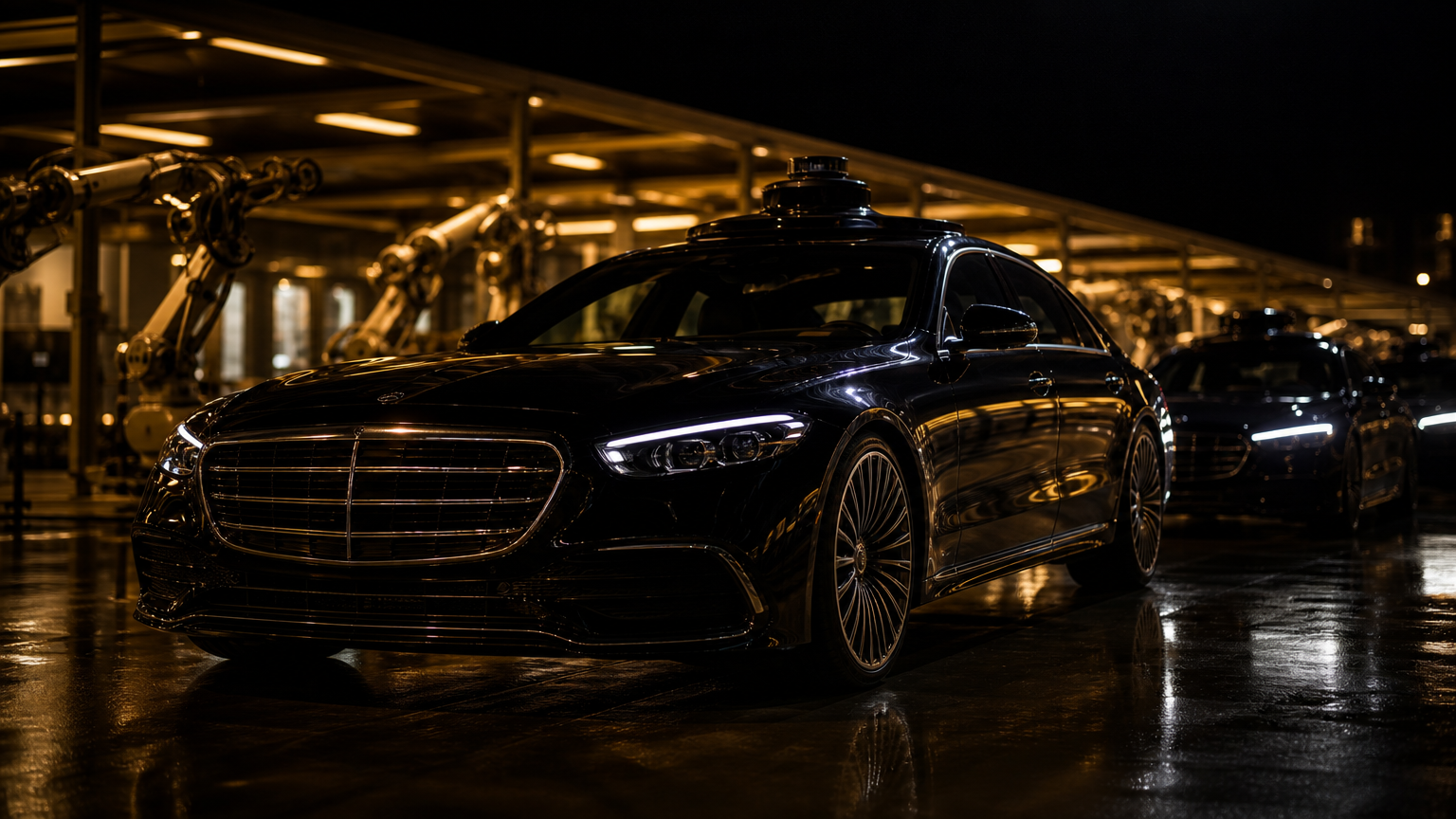
Mercedes-Benz has signed a definitive production agreement to bring Wayve’s end-to-end AI Driver into future vehicles, targeting customer availability within the next two years and giving the British autonomy startup its first production foothold in the premium segment.
The deal: a production agreement, not another demo
Mercedes-Benz and Wayve have moved their autonomy relationship from strategic flirtation to a signed production agreement. The companies said on September 22, 2026, that future Mercedes-Benz vehicles will integrate the Wayve AI Driver, with customer-facing advanced urban and highway point-to-point driving assistance expected to begin within the next two years . That timeline matters: it puts the first vehicles on a 2028-ish horizon, close enough to shape product planning but still far enough away to leave room for validation, regulatory approvals and model-by-model rollout decisions.
Wayve describes the arrangement as a “definitive production agreement,” a stronger phrase than a memorandum of understanding or technology exploration . Electrek’s report frames it the same way: Mercedes is not merely testing the British startup’s software, but preparing to build it into future Mercedes vehicles . In an autonomy market crowded with pilots, showcases and limited trials, the production language is the center of gravity.
The announcement does not name the first Mercedes model, region, trim level, price or exact launch date beyond “starting in the next two years” . It also does not assign a formal SAE automation level, something Electrek specifically noted as absent from the announcement . For customers, that means the safest reading is not “driverless Mercedes tomorrow,” but “a new generation of assisted driving is now on Mercedes’ product roadmap.”
Why Mercedes chose Wayve
Mercedes already has autonomy assets of its own, including production driver-assistance systems and a software-defined vehicle strategy built around MB.OS. The Wayve deal therefore looks less like outsourcing the entire future and more like adding a new autonomy layer to a broader stack. Wayve says its AI Driver has been integrated into Mercedes-Benz production system architecture using Mercedes hardware, MB.OS and map interfaces . That is the practical heart of the deal: the AI Driver has to fit inside a real Mercedes engineering environment, not just perform in a prototype.
For Mercedes, the attraction is speed and scalability. Wayve’s system is built around an “AV2.0” philosophy: an end-to-end embodied AI model that learns driving behavior from data and generalizes to new cities and road environments without relying on HD maps, geofences or city-specific retraining . If that promise holds up in production, it could help Mercedes add more capable assistance across markets without hand-building a bespoke rules-and-maps stack for every location.
Jörg Burzer, Mercedes-Benz’s chief technology officer, called the partnership the world’s first integration of the Wayve AI Driver in the premium segment and said the companies are laying the foundation to roll out the technology worldwide . That statement is carefully phrased. It does not claim full autonomy everywhere; it claims a premium-segment integration and a foundation for broader rollout. In automotive autonomy, that distinction is essential.
What Wayve gets
For Wayve, this is validation from one of the most demanding brands in the car business. The company has long argued that autonomy should be a licensable AI product that can run across many vehicle platforms. A Mercedes production agreement tests that thesis with a manufacturer whose customers expect safety, polish and consistency.
The deal follows Mercedes-Benz’s strategic investment in Wayve’s Series D funding round earlier in 2026 and builds on a multi-year technical partnership between the companies . Electrek reported that Wayve’s Series D totaled 1.5 billion dollars and valued the company at 8.6 billion dollars, with Mercedes among its strategic backers . That makes the new agreement more than a one-off supplier contract: Mercedes has both a technical and financial interest in Wayve’s success.
Alex Kendall, Wayve’s co-founder and CEO, said the pace and depth of the companies’ development work show a deep technical alignment between the teams . The phrase sounds like standard partnership language, but it points to the hardest part of this type of deal: converting a startup’s AI capability into automotive-grade software that survives production constraints, validation demands, over-the-air updates and customer expectations.
The technology bet: learning over hand-coding
Wayve’s pitch is that the next leap in autonomy will come from learned driving intelligence rather than from systems built mainly around hand-coded rules, HD maps and geofenced domains. Its AI Driver is described as learning to drive in a more human-like way, reasoning and adapting to surroundings without HD maps . The system was trained on NVIDIA AI infrastructure hosted on Microsoft Azure, according to Wayve .
Electrek compared Wayve’s learned, end-to-end philosophy with Tesla’s approach while contrasting it with heavily mapped, geofenced robotaxi systems . The comparison is useful, but only up to a point. Tesla sells its system directly under its own brand, Waymo operates a robotaxi service, and Wayve is positioning itself as an AI supplier to automakers. Mercedes is buying into the supplier model: it wants advanced assistance inside Mercedes cars without necessarily turning Mercedes into a full-stack AI lab on every layer.
That supplier model could become powerful if it works. The same underlying AI Driver is designed to scale across the autonomy spectrum, from advanced driver assistance to fully driverless products, and across consumer cars and robotaxis . That gives Mercedes a possible path from supervised assistance toward more automated functions over time. But it also raises the bar for safety evidence, because a generalized AI system must prove not just that it can drive impressively in demonstrations, but that it can behave predictably across rare, messy, local and high-stakes scenarios.
What customers should expect first
The announcement’s product wording is deliberately conservative: “advanced urban and highway point-to-point driving assistance” . That sounds closer to a sophisticated assisted-driving feature than to an unsupervised robotaxi. It suggests a system intended to handle stretches of a journey across city streets and highways, while still likely remaining within a defined customer-use framework.
Electrek also underlined what is missing: no named Mercedes model, no named SAE level and no firmer date than within two years . Those omissions should temper hype. A signed production agreement is significant, but customers cannot yet configure a Wayve-powered Mercedes, and the feature’s geographic availability, driver-monitoring requirements and legal status remain unknown.
The online self-driving community reacted with the expected mix of excitement and skepticism. One Reddit discussion amplified Wayve’s own claim that the AI Driver had been integrated into Mercedes hardware and MB.OS, while commenters questioned whether this would become a real mass-production feature or remain another autonomy announcement . That skepticism is healthy. The autonomy industry has spent years overpromising. The difference here is that Mercedes and Wayve are now using production-agreement language and tying the target to a two-year deployment window.
The bigger signal
This deal says something about where premium automakers think autonomy is going. Mercedes is not making a single binary bet. It is combining its own vehicle architecture, MB.OS and safety expertise with a specialist AI supplier whose core claim is generalizable driving intelligence. That is a pragmatic hedge: keep control of the vehicle and customer experience, but bring in a focused autonomy company for the hardest AI layer.
For Wayve, Mercedes is the kind of partner that can turn a technical story into a product story. For Mercedes, Wayve is a way to move faster in AI-driven assistance without abandoning the brand’s safety-first posture. For the industry, the key milestone is that end-to-end learned driving software is no longer only a research narrative, a demo-roadtrip narrative or a robotaxi narrative. It is now attached to a premium production vehicle program.
KITT just discovered that the neural network got the keys. The next question is whether Mercedes and Wayve can make those keys feel safe, useful and luxurious enough for real customers within two years.
Sources from the last 72 hours
- [1]Mercedes-Benz signs deal to put Wayve AI Driver in cars within 2 years | ElectrekSep 22, 2026, 2:49 PM UTC
- [2]Wayve signs deal with Mercedes-Benz! : r/SelfDrivingCarsSep 22, 2026, 2:15 PM UTC
- [3]Wayve and Mercedes-Benz Partner to Bring the Wayve AI Driver to Future Mercedes-Benz VehiclesSep 22, 2026, 12:00 AM UTC
AI-generated article based on recent web research, then preserved as a dated editorial snapshot.
Comments
Be the first to comment.