
Daily Podcast full article
Osteoporosis trial cuts fractures 94%
A small first-in-human osteoporosis trial reports a 94% drop in fragility fractures after one infusion of a patient’s own sugar-tagged bone marrow cells, shifting the conversation from simply slowing bone loss toward the possibility of rebuilding bone. The result is striking, but the study’s phase 1 design, ten-participant size and lack of a control group mean the next test is replication, not celebration.
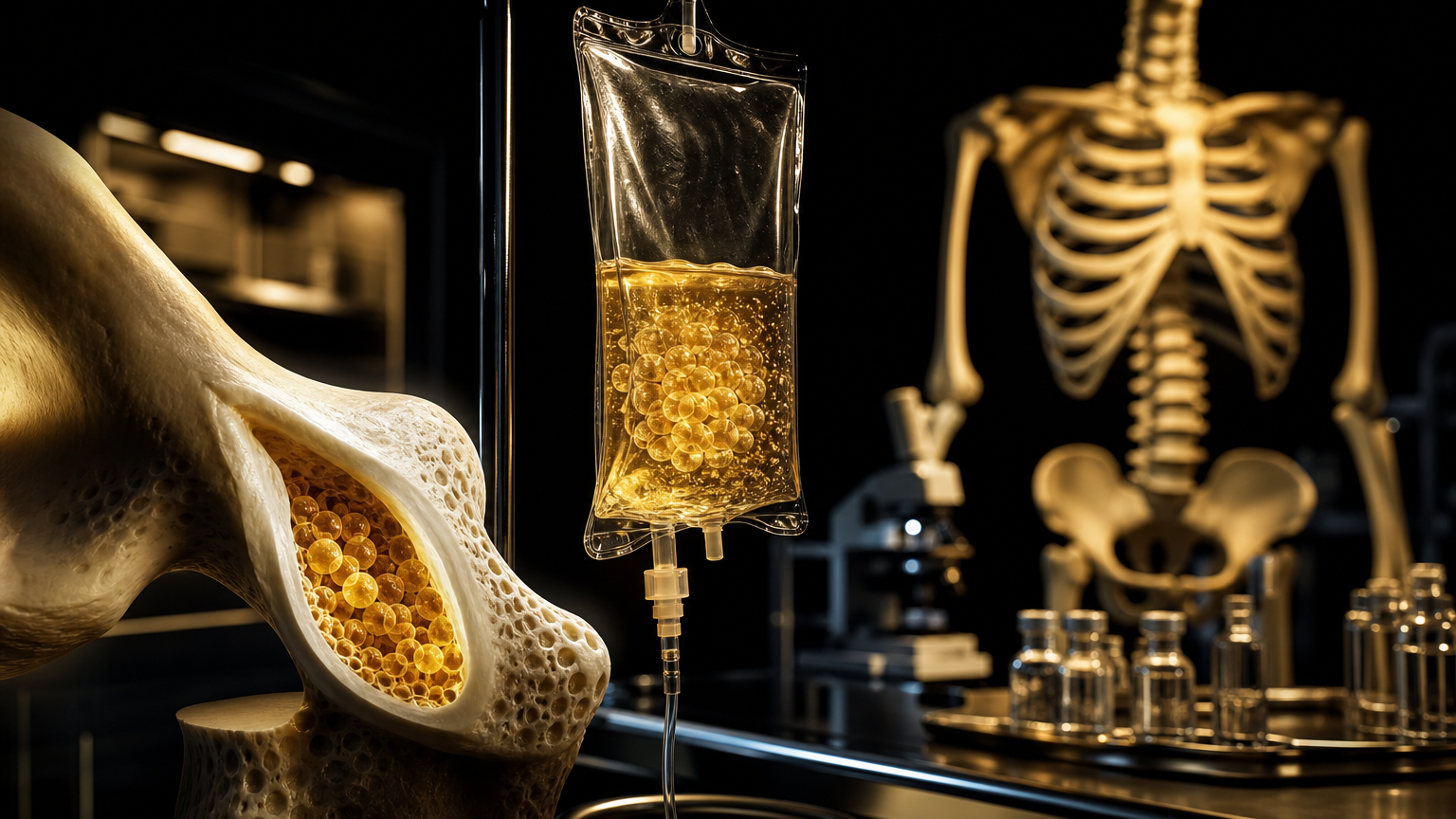
A striking signal, not yet a new standard
The headline number is hard to ignore: in a recent osteoporosis trial, fragility fractures fell by 94% after a single infusion of modified mesenchymal stem/stromal cells derived from each patient’s own bone marrow . For osteoporosis, that matters because fractures are not a laboratory surrogate; they are the outcome patients fear most, the event that can begin a cascade of pain, loss of independence, disability and further fracture risk.
The treatment is not a pill, not a monthly injection and not a classic antiresorptive drug. It is a cell therapy. Researchers collected bone marrow cells from women with advanced osteoporosis, expanded the mesenchymal stem/stromal cells in the laboratory, then chemically altered their surface sugars so the cells could better home to bone marrow tissue before being infused back into the bloodstream . The approach is being discussed as a regenerative strategy because it aims to help repair skeletal tissue, rather than only slow the rate at which bone is lost.
That distinction is the reason the story is attracting attention. Most osteoporosis care today is organized around reducing future fracture risk by suppressing bone resorption or stimulating bone formation through drugs that must be taken repeatedly. In contrast, this trial tested whether a one-time infusion of a patient’s own engineered cells could create a measurable, durable shift in bone biology .
What the trial actually did
The reported study was a phase 1, first-in-human trial involving ten women with advanced osteoporosis, aged roughly from their early fifties to early seventies, all of whom had already experienced at least one fragility fracture . Each participant received a single intravenous infusion of autologous bone marrow-derived mesenchymal stem/stromal cells that had been modified through enzymatic exofucosylation .
That term sounds technical, but the idea is straightforward. Mesenchymal stem/stromal cells can contribute to bone-forming lineages, but when they are infused into the blood they do not automatically travel efficiently to the skeleton. The researchers used a sugar donor molecule and an enzyme to create an HCELL-like surface feature, effectively giving the cells a bone-marrow homing signal . In shorthand, the therapy tried to solve the “delivery problem” that has limited many cell-therapy concepts: getting the right cells to the right tissue.
The primary purpose was safety, not definitive proof of efficacy. The trial was open-label, single-center and non-randomized, meaning every participant received the therapy and there was no placebo or active-treatment comparison group . That design is appropriate for an early safety test, but it also places strict limits on how far the results can be generalized.
Why the 94% figure matters
The fracture data are still remarkable. In the two years before infusion, the women collectively had eight fragility fractures per year; in the two years after infusion, that rate dropped to 0.5 fractures per year, a 94% reduction . A separate report described the effect over longer follow-up as a drop from 0.54 to 0.11 fractures per patient-year across approximately six years of observation .
Those numbers are important because osteoporosis studies often lean heavily on bone mineral density, bone turnover markers or imaging changes. Those measures matter, but patients ultimately want fewer broken hips, wrists, vertebrae and other bones. A therapy that appears to reduce actual fragility fractures, even in a small uncontrolled trial, deserves careful follow-up.
The biological signals also pointed in the same direction. Reports of the trial describe increases in bone mineral density, greater bone tissue area, elevated markers associated with bone formation and improvements in pain or disability measures after treatment . One account noted that bone tissue area increased in most patients after post-infusion biopsy, while pain scores were lower at 24 months .
The regeneration claim: promising, but still provisional
The most important scientific question is whether this treatment truly regenerates bone in a clinically meaningful way. The trial’s authors and coverage describe changes consistent with an osteoregenerative effect: improved volumetric bone mineral density, better trabecular bone measurements and bone metabolism markers that suggest increased bone formation .
That matters because osteoporosis begins by weakening the internal architecture of bone, especially trabecular bone, the spongy lattice that helps absorb load. If a therapy can rebuild that architecture, the field could move beyond “less decline” toward “structural recovery.” That is the potential paradigm shift.
But potential is not proof. In a ten-person trial with no control arm, some apparent effects can be inflated by selection, regression to the mean, background care, changes in activity, fracture ascertainment or simply chance. The women enrolled were very high-risk patients, which makes the pre-treatment fracture rate high and the post-treatment decline dramatic. That does not invalidate the signal, but it does mean the next trial must be larger, controlled and ideally randomized.
Safety is encouraging, but scale is the next test
The safety finding is also central. The Hochland report says no participant experienced serious adverse events related to the therapy over an average follow-up of about six years . That is reassuring for a first-in-human cell therapy, especially one involving ex vivo expansion and surface modification of autologous cells.
Still, safety in ten patients is a beginning. Cell therapies raise practical and regulatory questions: how reproducibly cells can be manufactured, how stable the product is, whether older or medically fragile patients’ cells behave consistently, how much the treatment costs, and whether rare adverse effects appear only after hundreds or thousands of recipients. A one-time therapy sounds simple at the bedside, but behind it are marrow collection, laboratory culture, quality testing, enzymatic modification, release criteria and infusion logistics.
The reports also emphasize that the cell modification does not appear to be genetic engineering in the permanent DNA-editing sense. The sugar modification is designed to help the cells navigate to bone marrow and then fade over time . That could reduce some long-term concerns, but it does not eliminate the need for systematic monitoring.
What patients should and should not take from this
The hopeful reading is clear: a single infusion may have sharply lowered fractures in women with advanced osteoporosis and produced signs of bone rebuilding. For patients who continue to fracture despite existing therapy, that is a powerful idea.
The cautious reading is just as important: this is not yet an approved, widely available osteoporosis treatment, and it should not prompt anyone to stop prescribed osteoporosis medication. Current therapies have strong evidence bases, and decisions about bisphosphonates, denosumab, anabolic agents or sequential treatment should remain individualized medical decisions.
The public reaction already reflects that tension. In patient discussion spaces, some readers called the results promising while others pointed out the small sample size and the complexity of stem cell procedures . That mix of hope and skepticism is exactly the right posture for an early trial with an unusually large effect size.
The next milestone
The essential next step is replication in a larger controlled trial. Reports indicate that a larger study is being planned, with the goal of testing whether the fracture reduction and bone-regeneration signals hold up in a broader population . That trial will need to answer several questions: Does the 94% fracture reduction persist when compared with a control group? Which patients benefit most? How durable is the effect after one infusion? Can the therapy be manufactured reliably across sites? And how does it compare with the best existing osteoporosis regimens?
If those answers are positive, this could materially change treatment expectations for women with severe osteoporosis. The field would have a credible path from fracture prevention to skeletal repair. But until then, the best summary is disciplined optimism: the bones may have shown a 94% armor upgrade in this early study, but medicine still has to prove the armor works outside the prototype.
Sources from the last 72 hours
- [1]Stem Cell Therapy Developed in Murcia Cuts Advanced Osteoporosis Fractures by 94%Sep 21, 2026, 7:02 PM UTC
- [2]Osteoporosis fractures fall by 94% in small first-in-human stem cell trial with a single intravenous infusionSep 20, 2026, 4:52 PM UTC
- [3]Stem Cell Treatment for OsteoporosisSep 21, 2026, 4:12 PM UTC
- [4]New Treatment Reduces Women’s Osteoporosis Fractures By 94%Sep 22, 2026, 12:00 AM UTC
AI-generated article based on recent web research, then preserved as a dated editorial snapshot.
Comments
Be the first to comment.