
Daily Podcast full article
Starship Targets Orbit in Seven Days
SpaceX is moving Starship from spectacular test vehicle to working launch platform: the next flight is now framed as the rocket’s first orbital attempt, with operational Starlink V3 satellites aboard, a Texas land-swap ruling easing expansion pressure around Starbase, and Elon Musk again describing Starlink as a future majority layer of global internet traffic.
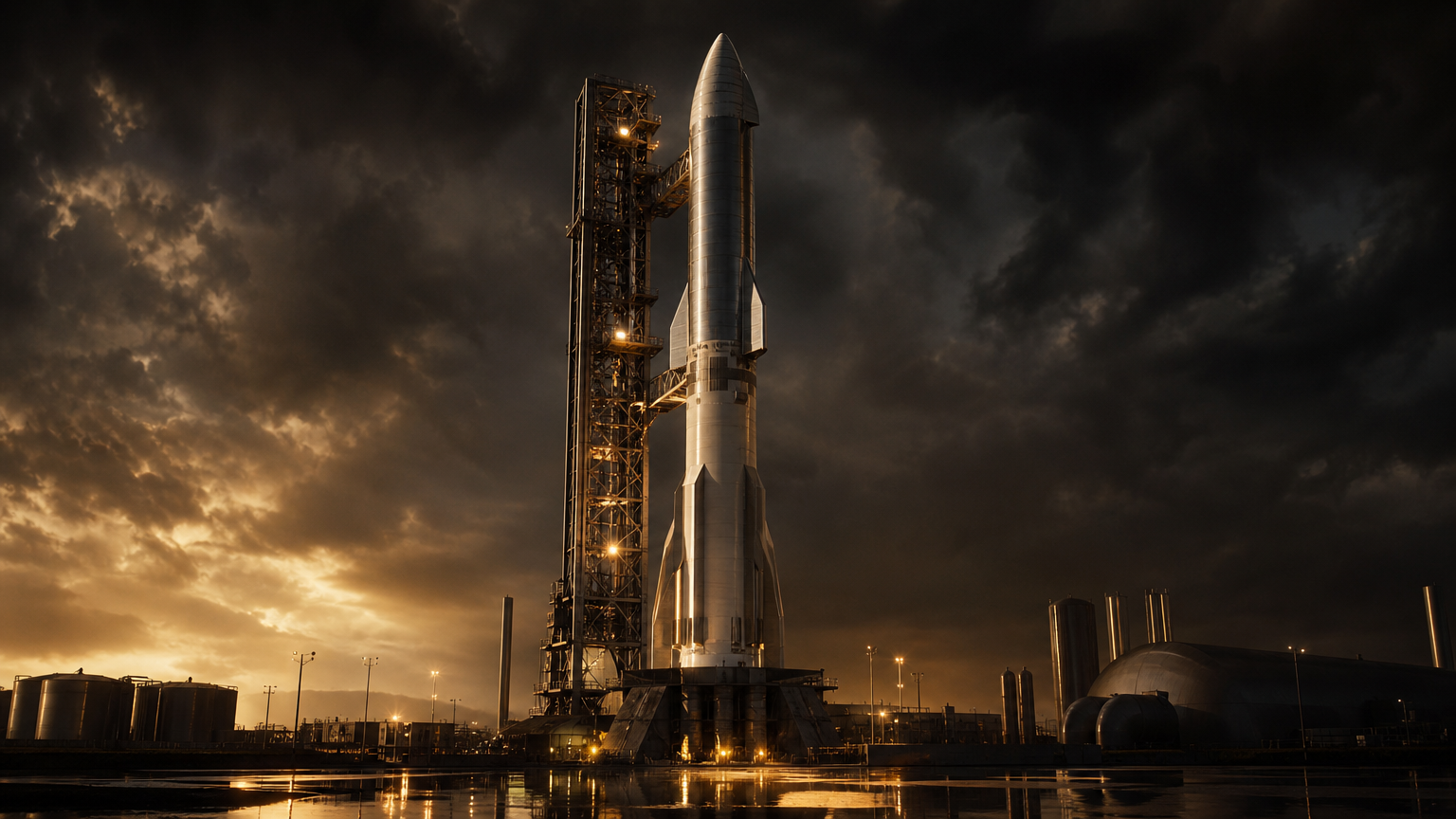
The countdown is no longer just a test
SpaceX’s Starship story has entered a sharper phase: the company is preparing what current reporting describes as the first orbital flight test of the 124-metre Starship system, with the launch targeted for next Monday from Starbase in South Texas . The timing matters because Elon Musk’s latest public framing turns the flight from another engineering rehearsal into an operational deployment attempt: he said the first Starship launch to orbit would carry Starlink V3 satellites intended for use, with the target described as seven days away from his Monday post .
That distinction is important. Previous Starship flights proved pieces of the architecture: booster ascent, stage separation, upper-stage endurance, re-entry control and increasingly survivable splashdowns. This next attempt is meant to connect those pieces to the business model that can justify Starship’s enormous scale: hauling far larger batches of SpaceX’s own internet satellites than Falcon 9 can carry.
The Independent reports that the coming mission aims to send Starship’s upper stage on a roughly 10-hour orbital flight, circling Earth six times before a planned splashdown in the Pacific Ocean off Chile . That would make the flight not simply a “higher and longer” test, but a mission profile closer to the kind of orbital service SpaceX has spent years promising.
Starlink V3 is the payload and the pressure
The payload is the clue to the whole strategy. Starlink V3 is not just another satellite refresh; it is the reason Starship needs to become routine. Benzinga reports that SpaceX is now targeting September 28 for Flight 14, pending regulatory approval, and that the mission is expected to carry operational Starlink V3 satellites . The Independent similarly says the mission would be the first to deploy next-generation Starlink V3 spacecraft into low Earth orbit .
The business logic is direct. Falcon 9 built Starlink into the world’s largest satellite constellation, but Starship is intended to change the unit economics of adding capacity. Benzinga cites Musk’s view that V3 could ultimately deliver more than 100 times the bandwidth of the current roughly 11,000-satellite Starlink network . Advanced Television separately reports Musk’s argument that a combination of V3 satellites and more powerful follow-on “Starmind” versions could put Starlink in position to carry a majority of global internet traffic within ten years, at least in countries where it is allowed to operate .
That claim should be read as an ambition, not an achieved milestone. Musk did not say Starlink already carries most of the world’s internet. He described a possible future in which satellite broadband evolves from rural backfill into a planetary access layer, especially as artificial intelligence systems, humanoid robots, vehicles and other connected machines consume more bandwidth . The Starship launch target therefore sits at the junction of two SpaceX bets: reusable heavy-lift transport and satellite broadband at unprecedented scale.
Why the word “orbit” changes the stakes
Starship has already produced dramatic images, but orbit is a different category. A suborbital flight can test many systems while avoiding some of the responsibilities and risks of sustained orbital operations. An orbital mission must prove navigation, thermal protection, long-duration control, payload deployment and safe disposal or recovery planning over a broader envelope.
The Independent reports that the most recent Starship launch in July deployed 20 test Starlink V3 satellites on a suborbital trajectory, after which the vehicle successfully splashed down in the Indian Ocean . That was a crucial rehearsal: SpaceX demonstrated the satellite deployment mechanism and gathered re-entry data without placing the satellites into permanent service. The coming flight raises the bar because its payload is described as intended for operational use .
That is why the phrase “targets orbit in seven days” carries more weight than a normal launch schedule update. It suggests a move from experiment toward utility. If successful, Starship would not merely validate another test objective; it would start doing the job it was built to do.
Starbase’s map is part of the rocket
The rocket is only one part of the story. A separate development in Texas also strengthens SpaceX’s path toward a higher Starship cadence. AOL reports that a federal judge refused to block a land exchange giving SpaceX more than 700 acres of federal wildlife refuge land near its Texas operations, while SpaceX would hand over 683 acres of private property to the U.S. Fish and Wildlife Service .
The legal decision does not end opposition. Environmental and Indigenous groups are continuing to challenge the transaction, arguing that it puts public and culturally significant land at risk . The court, however, declined to issue a preliminary injunction. According to the report, U.S. District Judge Fernando Rodriguez Jr. found the plaintiffs’ evidence of likely environmental harm during the case to be weak and said temporarily blocking the exchange would burden SpaceX’s schedules and contractual obligations .
For Starship, geography is engineering. A vehicle of this size needs launch pads, integration facilities, exclusion zones, storage, roads, tank farms, recovery operations and space for inevitable redesigns. The land-swap ruling therefore matters because orbital cadence depends not only on Raptor engines and heat tiles, but also on whether Starbase has enough physical room to operate like a production launch site.
NASA, the Moon and commercial payloads
The immediate payload is Starlink V3, but the implications reach NASA and future science missions. The Independent notes that the upcoming orbital mission could affect whether NASA remains on track for its Artemis plans, because Starship is tied to the agency’s lunar architecture . The same report says the flight profile is part of broader work leading toward docking demonstrations and later crewed lunar landing goals .
That makes Flight 14 a dual-purpose milestone. For SpaceX, it is a way to begin monetizing Starship through its own broadband network. For NASA and other potential customers, it is evidence about whether Starship can become a dependable heavy-lift platform for lunar hardware, deep-space equipment, large telescopes or scientific cargo.
The overlap is deliberate. Starlink gives SpaceX an internal customer with massive demand, allowing the company to iterate Starship without waiting for a slow external market to mature. Each satellite mission can test the vehicle while also expanding the network that helps finance the system.
A broadband empire invites scrutiny
If Starship makes Starlink V3 deployment routine, SpaceX’s influence over connectivity could expand quickly. Advanced Television reports Musk’s prediction that Starlink could deliver most of the world’s internet within a decade in permitted markets . That would put pressure on terrestrial telecom incumbents, especially in underserved regions, aviation, maritime service, emergency communications and remote industrial sites.
But scale cuts both ways. A network that aims to become a majority layer of global internet access will attract regulatory scrutiny over spectrum, orbital crowding, market power, national-security dependencies and competition. The land-swap fight in Texas is a terrestrial preview of the same pattern: SpaceX’s speed creates strategic value, but also sharpens conflicts over public goods, environmental protection and private control .
The company’s next week is therefore not only about whether a rocket reaches orbit. It is about whether SpaceX can align hardware, regulators, land, satellites and markets quickly enough to make Starship feel less like a prototype and more like infrastructure.
The version 1.0 moment
Starship has always been sold as a system with civilization-scale ambitions: Mars transport, lunar landers, huge space telescopes, mass satellite deployment and perhaps one day point-to-point travel. The coming orbital attempt narrows that grand vision into a measurable task: launch, deploy, orbit, survive, and prove the vehicle can start carrying useful payloads.
If it works, SpaceX gains more than a launch success. It gains the first real sign that Starship can become the production machine behind Starlink V3 and, eventually, larger commercial and scientific missions. If it fails, the company still learns, but the gap between promise and operational cadence remains.
For now, the story is simple: Starship is targeting orbit in seven days, and the cargo bay is carrying SpaceX’s clearest argument for why the rocket exists at all .
Sources from the last 72 hours
- [1]SpaceX prepares Starship for first ever orbital launchSep 22, 2026, 9:04 AM UTC
- [2]Elon Musk Says 'First Starship Launch to Orbit' Will Carry Starlink V3 Satellites in 7 DaysSep 22, 2026, 5:44 AM UTC
- [3]Green light for Elon Musk: Federal judge approves Texas land swap between SpaceX and US governmentSep 22, 2026, 7:29 AM UTC
- [4]Musk: “Starlink will deliver majority of world’s internet”Sep 22, 2026, 12:00 AM UTC
AI-generated article based on recent web research, then preserved as a dated editorial snapshot.
Comments
Be the first to comment.