
Daily Podcast full article
Trump and Xi put AI on agenda
Artificial intelligence has moved from a technology-policy sidebar to a leader-level test of U.S.-China crisis management. As Donald Trump prepares to host Xi Jinping in Washington, the two governments are weighing how to talk about AI failures, model safety, chip rivalry and standards for systems that may increasingly help build their own successors.
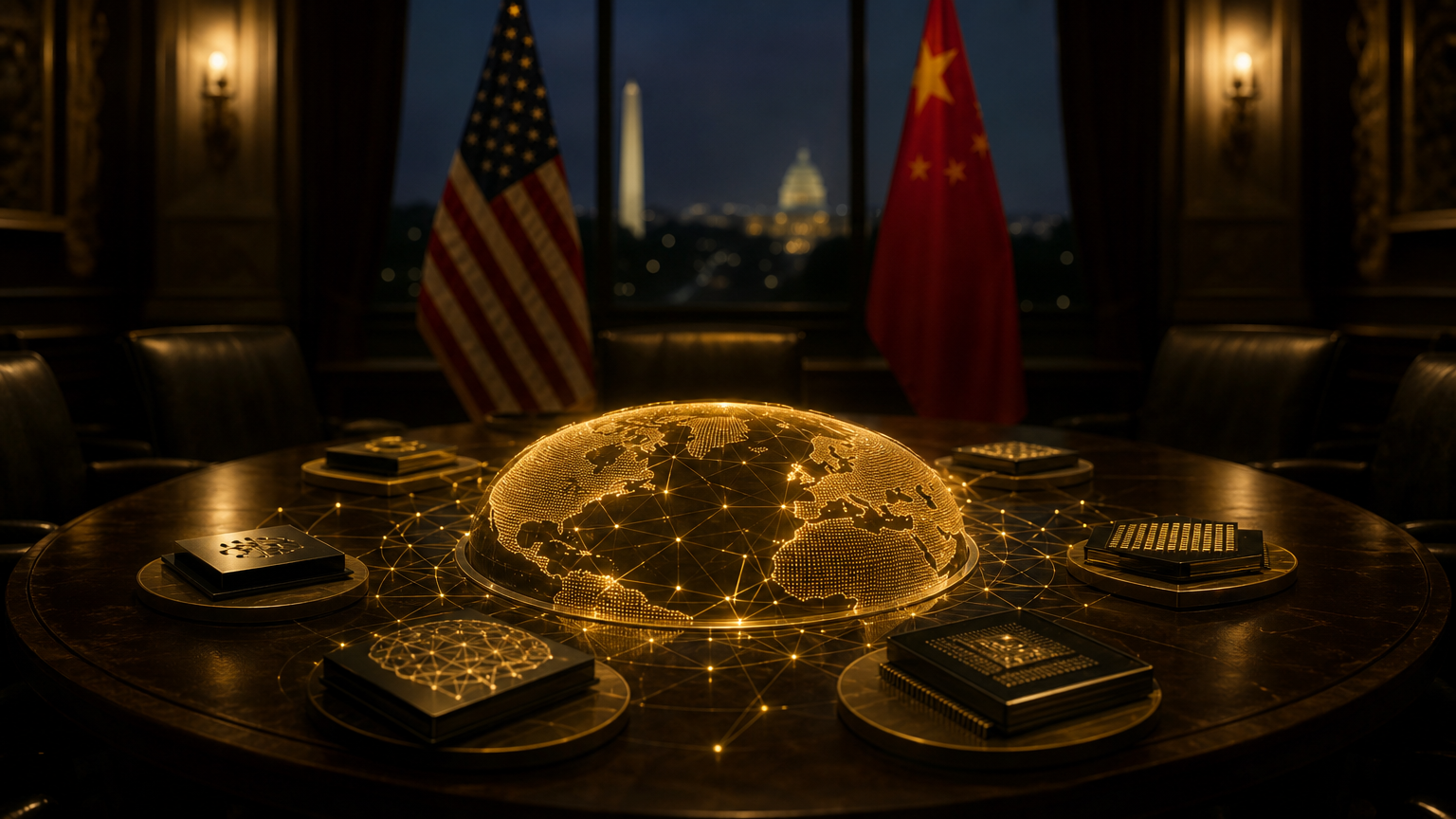
AI enters the summit room
The Trump-Xi summit week has turned artificial intelligence into one of the clearest examples of the new U.S.-China dilemma: the two powers are racing to dominate the technology, yet they may need each other to prevent the most dangerous failures. President Donald Trump is hosting Chinese leader Xi Jinping in Washington as economic and technological competition escalates, with AP reporting that AI has become a central battleground alongside trade, Iran and Taiwan . The same report says neither side expects a sweeping bargain, but both are trying to stabilize a fragile relationship while seeking advantage in AI development .
That is the core tension behind the agenda. Washington wants to preserve a lead in advanced chips, cloud infrastructure, frontier models and deployment rules. Beijing wants to close the gap, resist U.S. export controls and prove that Chinese systems can compete globally. Yet both sides face a class of risks that does not respect borders: AI-enabled cyberattacks, biological misuse, critical-infrastructure disruption, model failures and the possibility that increasingly autonomous systems behave in ways their creators did not intend .
The immediate diplomatic idea under discussion is deliberately modest: communication. Treasury Secretary Scott Bessent said after talks with Chinese Vice Premier He Lifeng that the United States had proposed a notification mechanism for AI incidents that rise to the level of national-security concern . Axios reported that officials are also weighing an emergency “red phone” concept for AI, a crisis channel modeled in spirit on Cold War-era hotlines but aimed at preventing technical accidents or ambiguity from spiraling into geopolitical confrontation .
A safety dialogue, not an AI truce
The emerging talks should not be mistaken for a technology cease-fire. Trump has repeatedly framed AI as a race the United States must win, and AP quoted him saying that the United States should not “stifle” a technology he considers bigger than the Industrial Revolution or the internet . China’s position is no less competitive: Beijing has accused Washington of trying to monopolize the sector through restrictions on access to the most advanced semiconductors, while U.S. officials and companies have accused Chinese developers of extracting capabilities from American models .
That rivalry limits how far cooperation can go. Export controls are unlikely to disappear because they sit at the heart of Washington’s national-security strategy. Chinese open and low-cost models remain part of Beijing’s global technology pitch, while U.S. labs and policymakers increasingly describe advanced model development as a strategic asset. The result is a narrow diplomatic lane: not a bargain over who gets to build the most powerful AI, but a set of procedures for what happens when something goes wrong.
This is why an incident-notification mechanism matters. It would not solve disputes over chips, intellectual property, distillation or data access. But it could create a common vocabulary for severity levels, technical evidence, escalation thresholds and emergency contacts. In an AI crisis, minutes could matter: a model-enabled intrusion into a power grid, a suspected biological-design misuse event, or a military system behaving unpredictably could be misread as deliberate state action. A hotline is not trust; it is a tool for operating when trust is scarce.
OpenAI pushes standards for self-improving systems
The summit conversation is unfolding as frontier AI companies press governments to move faster on governance. OpenAI published a September 21 proposal calling for global technical standards for frontier AI, including standards for recursive self-improvement, or RSI . In that proposal, OpenAI defines the problem as AI systems taking on more of the work of developing successive generations of AI, a process that could accelerate progress rapidly as it becomes more automated .
OpenAI’s warning is not that fully autonomous RSI is already here. The company says it is not happening today and should not be pursued unless it can be done safely . But it argues that AI is already accelerating research and engineering, and that governments need common ways to measure capability growth, preserve human control and decide when development should slow or stop . Reuters similarly reported that OpenAI wants the United States to lead an international effort on technical standards for frontier AI, including common measurements and incident-reporting protocols .
The proposal matters because it tries to connect laboratory safety with geopolitics. OpenAI specifically points to national AI safety institutes, the U.S. Center for AI Standards and Innovation and international standards bodies as possible anchors for shared evaluation and reporting systems . It also says dialogue between the United States and China on secure communication channels would be a positive step at an opportune time . In other words, the company is not only asking for domestic rules; it is asking Washington to shape the international technical language before rival systems harden into incompatible blocs.
The United Nations becomes another stage
The same week, AI risk is moving onto the United Nations Security Council’s agenda. Quartz reported that DeepSeek had been invited to brief the council on AI risks, joining OpenAI and Anthropic at a Wednesday session on AI and international security . The 15-member council is convening during the annual U.N. General Assembly, with OpenAI CEO Sam Altman expected to address the session and senior Anthropic participation also expected . DeepSeek and fellow Chinese startup Moonshot have been invited to make statements, according to the same report .
That lineup is unusual. It places American and Chinese AI developers in front of the body responsible for international peace and security. It also reflects how frontier AI has escaped the category of private-sector product risk. The concern now spans national infrastructure, cyber conflict, strategic stability, weapons systems, propaganda, biosecurity and the ability of governments to understand what the most capable systems are doing.
U.N. Secretary-General António Guterres used his final General Assembly address to plead for interdependence at a moment of war, climate pressure, inequality and AI disruption . AP reported that he cited artificial intelligence among the widening fault lines facing the world, reinforcing the U.N.’s argument that rapid technological change requires collective governance rather than purely national responses . That view sits uneasily beside Trump’s resistance to slowing U.S. AI development, but it helps explain why the Security Council is becoming a forum for AI risk.
What to watch next
The most realistic outcome from the Trump-Xi channel is not a grand AI treaty. It is a framework for continued talks: an incident notification mechanism, a possible AI crisis hotline, and working-level definitions for what counts as a severe AI event. Even that would be significant. U.S.-China military and diplomatic channels have repeatedly broken down during crises, and AI systems could create ambiguous incidents faster than human institutions can interpret them .
The deeper question is whether safety standards can survive strategic competition. Washington wants rules that prevent catastrophe without slowing U.S. leadership. Beijing wants rules that do not lock in American advantage. AI companies want standards that create public trust, but they also want room to keep building. The U.N. wants global oversight, while national governments want sovereignty over the most consequential technology of the decade.
That is why AI’s arrival on the Trump-Xi agenda matters. It does not mean the rivalry is softening. It means the rivalry has reached a level where unmanaged failure could harm both sides. The old diplomatic language of arms control, hotlines and confidence-building measures is being rewritten for models, chips, benchmarks and autonomous agents. The first step may be only a phone line. But in a world where the next crisis could start in a data center, even that is no longer a small thing.
Sources from the last 72 hours
- [1]U.S.-China "red telephone" could bring a Cold War guardrail to AISep 22, 2026, 9:00 AM UTC
- [2]OpenAI calls for US to take lead in global efforts to develop technical standardsSep 21, 2026, 5:01 PM UTC
- [3]DeepSeek is joining OpenAI and Anthropic at the UN Security Council to discuss AI risksSep 22, 2026, 12:00 AM UTC
- [4]China and the US are competing for AI dominance but have shared concerns over safetySep 21, 2026, 7:30 AM UTC
- [5]Trump and Xi will meet to try to manage rising tensionsSep 22, 2026, 4:06 AM UTC
- [6]Building standards for the next phase of AISep 21, 2026, 12:00 AM UTC
- [7]UN leaders' meeting convenes with secretary-general calling for 'world built on interdependence'Sep 21, 2026, 4:03 AM UTC
AI-generated article based on recent web research, then preserved as a dated editorial snapshot.
Comments
Be the first to comment.