
Daily Podcast full article
Alibaba targets 20GW AI expansion by 2032
Alibaba Cloud’s new 20GW-by-2032 target turns China’s AI race into an infrastructure story: models, chips, data centers, cooling, power procurement and grid access are now part of the same competitive equation.
The headline is no longer just the model
Alibaba’s latest Apsara Conference message was deliberately bigger than another foundation-model update. The company said the global data-center capacity operated by Alibaba Cloud should surpass 20 gigawatts by 2032, a target presented by CEO Eddie Wu as necessary for a future in which machine intelligence is supplied at industrial scale . That figure is the center of the story because it reframes AI competition from a software benchmark contest into a capital, energy and execution race.
Alibaba also used the same event to describe a full-stack AI strategy spanning Qwen models, proprietary processors, AI servers, networking, storage, agent platforms and cloud services . In practice, that means the company is trying to reduce the distance between model design and the infrastructure that trains and serves those models. The strategic logic is clear: if AI demand grows faster than available compute, the cloud provider that controls more of the stack can tune costs, performance and supply more aggressively.
The 20GW goal is not current installed capacity. It is a 2032 target for Alibaba Cloud’s globally operated data-center footprint, and Alibaba has not disclosed a current baseline or a detailed regional split for the build-out . That absence matters. A target expressed in gigawatts sounds concrete, but investors, customers and suppliers will still need to know how much of it becomes powered, permitted, cooled and utilized capacity.
Why 20GW is a serious infrastructure number
Twenty gigawatts is comparable to the load of multiple large metropolitan areas, depending on the power profile used for comparison. For AI infrastructure, it implies a vast ecosystem of accelerator racks, high-density servers, electrical substations, backup systems, fiber, liquid cooling, storage and operational software. It also implies a multi-year queue for components and power connections.
Alibaba’s own language points to that bottleneck. Reuters reported that Wu described customer demand for AI as exceptionally robust, while warning that supply-chain constraints limit how quickly Alibaba can expand capacity . AP also reported that Wu said global shortages across the AI data-center supply chain are limiting the speed at which the company can scale compute infrastructure . Those constraints are not cosmetic; they are the execution risk inside the 20GW promise.
The power number also changes the supplier map. Server makers, cooling specialists, optical-networking vendors, high-voltage equipment suppliers, construction firms and energy providers could all benefit if the plan is funded and staged as announced. But the same number raises hard questions: where will Alibaba secure reliable power, how fast can utilities interconnect new sites, how much of the footprint will sit in China versus overseas markets, and how much capacity will be reserved for Alibaba’s own models rather than external cloud customers?
Chips and models are part of the capacity plan
Alibaba tied the power target to a broader product roadmap. The company said Qwen 4 is in training and that future Qwen 4.5 and Qwen 5 series models are projected to scale to 5 trillion to 10 trillion parameters . Reuters similarly reported that Wu said Alibaba’s Qwen team plans to train a new model in that 5 trillion to 10 trillion parameter range for more complex, longer-horizon tasks .
That model ambition helps explain the 20GW target. Larger training runs require clusters with fast interconnects, large memory pools and high reliability. Large-scale inference may become just as demanding if customers deploy agents, video generation, coding systems and enterprise workflow automation at scale. Alibaba’s bet is that future AI consumption will not be a short-lived spike; it will become a persistent load.
The company also introduced the Zhenwu V900, a new AI processor from its T-Head semiconductor unit. Alibaba said the chip is designed for demanding AI workloads, offers 216GB of memory and 1,200GB/s of inter-chip bandwidth, and supports multiple data precisions including FP8 and FP4 . Reuters reported that Wu described the V900 as delivering three times the performance of its predecessor, the M890, and said it can be linked in clusters of up to 500,000 chips . Data Center Dynamics reported that mass production and commercial release are scheduled for the first quarter of 2027 .
This matters because a 20GW cloud plan cannot depend only on buying accelerators in a constrained global market. Alibaba’s chip roadmap is an attempt to control availability, cost and optimization inside its own data centers. It also reflects the geopolitical reality that Chinese AI companies face U.S. restrictions on some advanced AI chips, making domestic alternatives strategically important .
The next 12 months: regions, products and enterprise demand
Alibaba Cloud followed the 20GW roadmap with a separate global infrastructure and AI portfolio update on September 23. The company said it will establish its first cloud regions in Türkiye, Finland and the Netherlands over the next 12 months, while expanding its data-center footprint in Malaysia, Germany, the United Arab Emirates, France and Hong Kong . It also said it currently operates 107 availability zones across 31 regions .
That announcement gives the long-term 20GW goal a nearer-term operating context. The company is not only talking about distant hyperscale campuses; it is also pushing cloud regions closer to customers and partners. Alibaba framed the expansion as a way to provide localized cloud and AI services for enterprises across key markets .
The product layer is equally important. Alibaba Cloud announced Smart Studio for companies building their own Model-as-a-Service platforms, Smart Fusion for multi-model collaboration and token-cost reduction, and Smart Video for generating videos up to one hour long from prompts and natural-language refinement . These products are demand creators: they are designed to make AI deployment easier, which in turn can raise compute consumption.
The investment test
Cloud Computing News noted that Alibaba’s 20GW target follows its earlier commitment to invest more than 380 billion yuan, about $52 billion at the time, in cloud computing and AI infrastructure over three years . The same report said Alibaba did not disclose current data-center capacity or a regional breakdown for the planned expansion . That leaves the market with a large ambition but incomplete measurement.
Reuters reported that Alibaba’s Hong Kong-listed shares rose 5.1% after the announcements, reaching their highest level in a month . That reaction suggests investors saw the roadmap as more than conference theater. Still, the hard test will come later: booked capacity, customer utilization, margins, chip yields, power contracts and construction milestones.
The key question is not whether Alibaba can announce a 20GW AI build-out. It has. The question is whether it can turn the number into productive, available and profitable capacity by 2032. If it succeeds, Alibaba Cloud becomes not merely a participant in China’s model race, but one of the major operators of the energy-hungry machine behind it. If it falls short, the 20GW target will stand as a reminder that AI leadership is now constrained by transformers, turbines and transmission lines as much as by tokens.
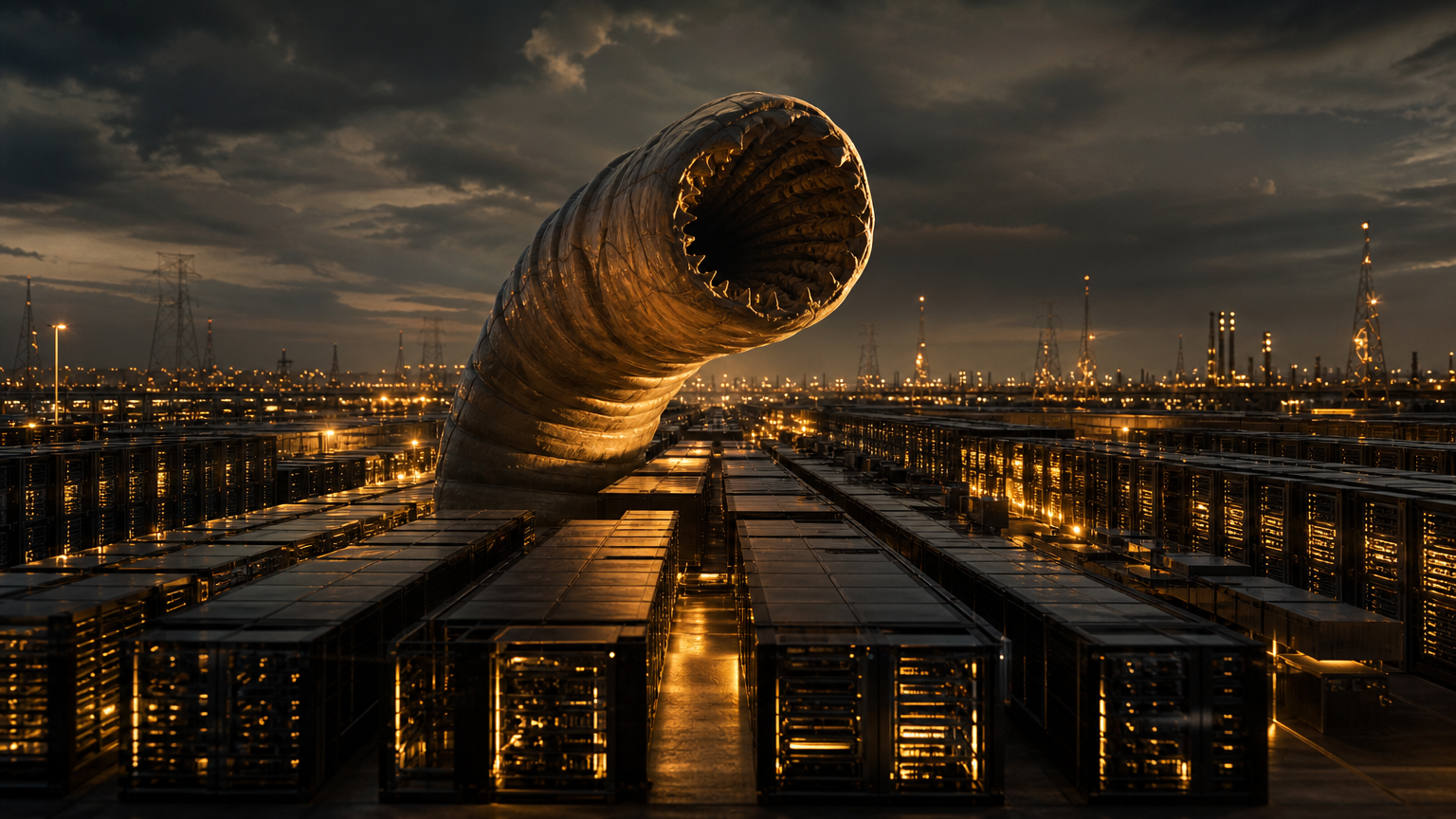
For now, the signal is unmistakable: Alibaba wants the AI market to read its future in gigawatts. Twenty gigawatts should keep even a sandworm-sized cluster well fed, but only if the grid, supply chain and customers arrive on schedule.
Sources from the last 72 hours
- [1]Alibaba Unveils Roadmap on Full-Stack AI Strategy from Chips, Cloud Infrastructure, Models to AgentsSep 21, 2026, 4:00 PM UTC
- [2]Alibaba Cloud Expands Global Infrastructure and AI Portfolio to Accelerate Enterprise AI AdoptionSep 22, 2026, 4:00 PM UTC
- [3]Alibaba deepens AI push with new chip, bigger model; shares jump 5%Sep 22, 2026, 2:52 AM UTC
- [4]Alibaba unveils Zhenwu V900, says cloud capacity will hit 20GW by 2032Sep 22, 2026, 12:00 AM UTC
- [5]Alibaba Cloud plans 20GW AI infrastructure expansion by 2032Sep 23, 2026, 12:00 AM UTC
- [6]Alibaba unveils new AI technologies in challenge to the USSep 22, 2026, 7:16 AM UTC
AI-generated article based on recent web research, then preserved as a dated editorial snapshot.
Comments
Be the first to comment.