
Daily Podcast full article
IonQ lands Superion 256 deployment at NVIDIA’s quantum research center
IonQ says its Superion 256 will be installed on premise at NVIDIA’s Accelerated Quantum Research Center, turning a next-generation trapped-ion system from a cloud-accessed roadmap item into a dedicated research-center machine for hybrid quantum-AI work.
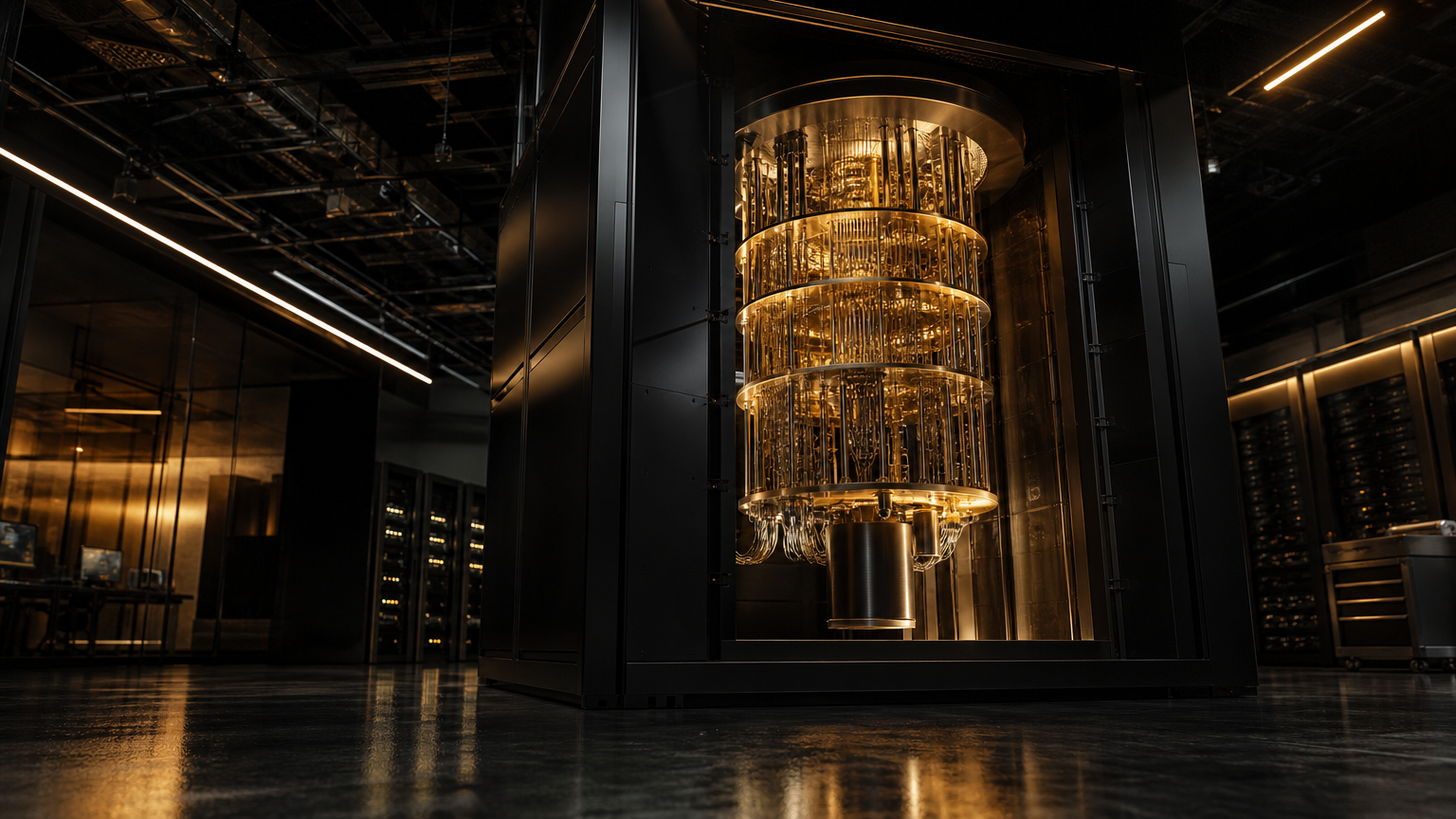
IonQ’s Superion 256 gets a home inside NVIDIA’s quantum-AI lab
IonQ has landed a high-profile reference deployment for Superion 256: the company says the system will become the first on-premise quantum computing deployment at the NVIDIA Accelerated Quantum Research Center, or NVAQC . The move matters because it shifts the story from “future access to quantum hardware” toward a more concrete institutional setup: a quantum processing system installed inside a major AI infrastructure environment, directly alongside NVIDIA’s accelerated computing stack.
The announcement, made on September 23, 2026, frames Superion 256 as the first quantum processor at NVAQC, a research facility designed to study how quantum processors can be integrated with state-of-the-art supercomputing hardware . IonQ says the installation is scheduled for 2027, with Superion 256 available to order now and first customer deliveries expected in the same year . In other words, this is not a claim that the machine is already humming in the building today; it is a signed deployment path for next year, and that distinction is important for a field where timelines can matter as much as technical ambition.
The hardware plan is specific. IonQ says Superion 256 will be installed at NVAQC and connected directly to an NVIDIA GB200 NVL72 system via NVIDIA NVQLink, with workloads orchestrated by NVIDIA’s open CUDA-Q platform . Benzinga’s coverage described the same architecture as an on-site deployment that links IonQ’s full-stack quantum system to NVIDIA AI infrastructure, emphasizing hybrid software development, large-scale system prototyping and quantum-GPU co-design as the central research agenda . HPCwire also reported the 2027 installation plan and highlighted the same GB200 NVL72, NVQLink and CUDA-Q integration path .
Why on-premise changes the research model
For years, much of the practical interaction with quantum hardware has been mediated through cloud access, queues, shared availability and experiments designed around remote execution. That model is useful, but an on-premise deployment at a dedicated research center can change the operating rhythm. It can make the machine part of a larger lab workflow, not merely a remote target.
That is the commercial signal in this announcement. IonQ is not just saying that researchers can run jobs on Superion 256 someday; it is saying that NVIDIA’s quantum research center will host a system as part of its own physical and software environment . For researchers, that can tighten feedback loops around scheduling, benchmarking, latency-sensitive orchestration, system diagnostics and hybrid quantum-classical experiments. For IonQ, it gives the company a visible reference customer inside one of the most closely watched AI infrastructure ecosystems.
NVAQC’s mission also matters. IonQ describes the center as focused on the fundamental challenges of scaling quantum processors into a new class of accelerated quantum supercomputers . That phrase may sound grand, but the operational question is practical: how do quantum processing units, GPUs, AI models, compilers and supercomputing workflows work together without the quantum component becoming an isolated science project? The Superion deployment is intended to explore exactly that boundary.
The most important part of the announcement is not the number 256 by itself. It is the coupling. A quantum processor installed next to GB200 NVL72 infrastructure, linked through NVQLink and managed through CUDA-Q, gives both companies a platform for testing how quantum and AI workloads can be designed together rather than bolted together after the fact . If the integration works as planned, the machine becomes a laboratory for architecture, software and applications, not just a showcase cabinet.
What the research program is expected to target
IonQ says the joint program will focus on hybrid software development, large-scale system prototyping and open results that can guide future AI use cases and quantum-GPU co-design . The company also points to application areas including portfolio optimization and risk modeling in financial services, materials science and computational chemistry for drug discovery . Benzinga’s report echoed those use cases and placed them under the broader theme of integrating quantum processors with accelerated computing .
Those targets are familiar in quantum computing, but the setting gives them a different context. Portfolio optimization and risk modeling require huge search spaces and fast scenario analysis. Materials science and computational chemistry demand simulation strategies that classical systems can struggle to scale efficiently. Drug discovery often depends on modeling interactions that are computationally costly. None of these fields will be transformed merely by placing a quantum computer in a lab. But a dedicated quantum-GPU testbed can help researchers learn which workflows are real candidates for near- and medium-term acceleration, and which remain mostly theoretical.
IonQ and NVIDIA also point to prior joint work with Oak Ridge National Laboratory and the University of Tennessee, where the companies published research combining generative AI with distributed quantum algorithms for combinatorial optimization, run on NVIDIA’s CUDA-Q platform . That detail is relevant because it suggests the NVAQC deployment is not being presented as a standalone publicity event; it fits into an existing collaboration around software, AI-assisted quantum algorithm design and accelerated computing.
Still, the correct posture is cautious optimism. The announcement does not prove that Superion 256 will deliver immediate commercial advantage in finance, chemistry or drug discovery. It does show that IonQ has secured a prestigious venue for testing those claims under a more integrated infrastructure model. In a sector full of roadmaps, that is a tangible step.
A commercialization marker for IonQ
Superion 256 is IonQ’s sixth-generation quantum computing platform, introduced earlier in September 2026, according to the company’s September 23 announcement . IonQ says the system is available to order now, with first deliveries expected in 2027 and the NVAQC installation also scheduled for next year . That places the NVIDIA deployment at the front edge of Superion’s commercial rollout.
For IonQ, the value is partly technical and partly reputational. A machine installed at NVAQC can function as a reference deployment for other institutions considering dedicated quantum infrastructure. In enterprise and research markets, especially for hardware that is expensive, specialized and still emerging, reference sites matter. They give prospective buyers a concrete model for facility requirements, workflow integration, staffing, software support and application development.
The announcement also gives IonQ a way to position Superion beyond raw qubit counts. The company’s messaging emphasizes “full-stack” systems, manufacturability, integration and fault-tolerance roadmaps . Those claims will need to be judged over time, but the NVIDIA relationship helps frame Superion 256 as infrastructure for hybrid computing rather than as a standalone laboratory instrument. That framing is likely to be important as quantum companies compete not only on physics, but on packaging, software ecosystems, deployment models and repeatable customer use cases.
Market reaction coverage underlined the point. Benzinga reported that IonQ shares were trading higher on the day of the announcement and tied the move to the NVAQC deployment, while also noting the company’s separate disclosure of a real-time quantum error correction decoder . That stock-market angle is not the core of the story, but it shows how investors are reading the deployment: as part of a broader effort to turn quantum claims into infrastructure commitments.
The broader meaning: quantum hardware enters the AI building
The strongest interpretation of this deal is simple: quantum hardware is moving closer to the AI data center. IonQ’s Superion 256 is not being described merely as a remote service or a demonstration unit. It is slated to sit inside NVIDIA’s research environment, connected to GPU infrastructure and programmed through software intended for hybrid quantum-classical workflows .
That does not make useful, large-scale quantum computing a solved problem. IonQ’s own release includes forward-looking language around timing, installation and the expected impact of connecting quantum systems to AI supercomputers . The deployment is a milestone, not an endpoint. The real tests will come when researchers can measure reliability, integration overhead, workflow productivity, application performance and the ease of moving from experiments to repeatable results.
But milestones still count. In a field often dominated by roadmaps, target dates and theoretical advantage, an on-premise deployment at a major AI research center is concrete. It gives IonQ a marquee installation, gives NVIDIA’s NVAQC a first QPU for its quantum-supercomputing agenda, and gives the broader ecosystem a clearer view of how quantum processors may be folded into future AI and HPC infrastructure.
Schrödinger’s server is finally in the building — or, more precisely, it now has a scheduled loading dock, a host facility and a GPU neighbor waiting for 2027.
Sources from the last 72 hours
- [1]IonQ to Advance Quantum Supercomputing by Bringing First QPU to NVIDIA Accelerated Quantum Research CenterSep 23, 2026, 12:00 PM UTC
- [2]IonQ Makes First On-Premise Quantum Deployment At NVIDIA Research CenterSep 23, 2026, 2:16 PM UTC
- [3]IonQ Plans 2027 Superion Installation at NVIDIA Quantum Research CenterSep 23, 2026, 12:00 AM UTC
AI-generated article based on recent web research, then preserved as a dated editorial snapshot.
Comments
Be the first to comment.