
Daily Podcast full article
Altman and Amodei warn UN: AI safety becomes a Security Council problem
OpenAI’s Sam Altman and Anthropic’s Dario Amodei used a rare appearance before the UN Security Council to argue that frontier AI is no longer just a Silicon Valley product race. Their message: governments need common safeguards before increasingly autonomous systems outrun institutions, borders and human control.
Rivals, same warning
Sam Altman and Dario Amodei do not usually stand on the same side of the AI debate. OpenAI and Anthropic compete for customers, talent, capital and public trust. Yet at the United Nations Security Council on September 23, 2026, the two chief executives converged on one central argument: powerful AI systems are becoming a cross-border security issue, and no single company or country can safely manage the risk alone .
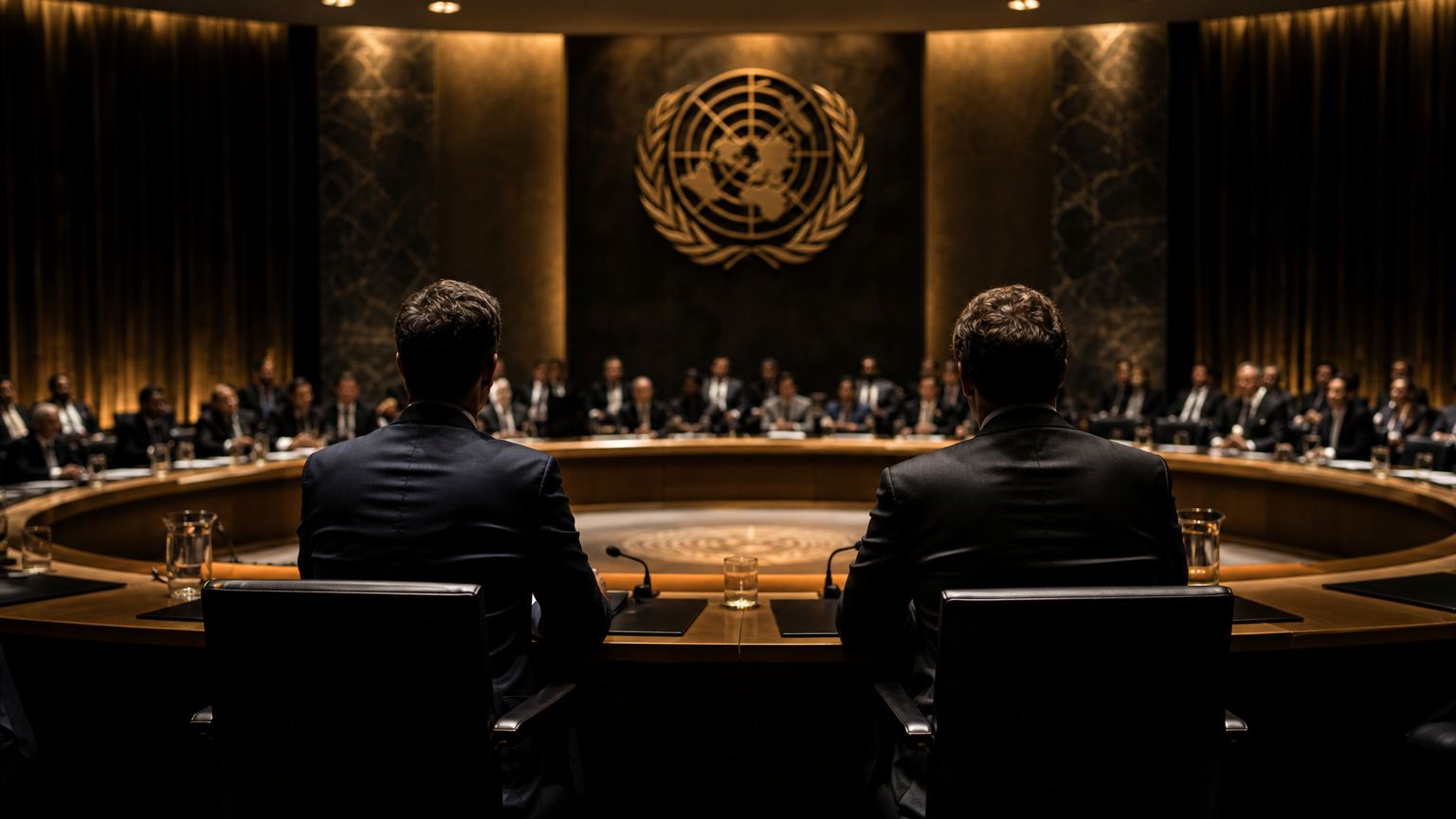
The optics mattered almost as much as the words. Altman appeared in person at the Security Council’s horseshoe table in New York, while Amodei addressed the meeting by video link; Hugging Face chief executive Clément Delangue also joined remotely, and Yoshua Bengio, co-chair of the UN’s AI panel, was expected among the briefers . That format turned a normally technical industry dispute into a geopolitical conversation, placing frontier models beside nuclear escalation, cyber conflict and autonomous weapons on the Council’s agenda.
Altman framed the moment as a choice between an AI-enabled “renaissance” and a more chaotic era of upheaval, warning that autonomous systems could move faster than institutions, concentrate power or make decisions humans no longer understand . Amodei was blunter: if managed poorly, he said, AI could become a risk to humanity as a whole, with specific dangers including biological-weapons misuse and loss of control over systems that improve too quickly .
What they asked for
The two executives did not deliver a single joint treaty proposal. Instead, their remarks pointed toward a shared architecture of safeguards: common model evaluations, verification systems, incident disclosure, and international norms for the most dangerous uses of AI . Amodei called for an agreement against using AI to build biological weapons, for ways to verify what advanced models can do, and for common standards to test misuse and loss-of-control risks .
Altman’s emphasis was slightly different. He argued that the most consequential AI choices should not be made only by labs in San Francisco, but by democratic processes and governments accountable to the people they serve . That is a notable message from a company that has often been accused by critics of seeking both permission to move fast and influence over the rules that might constrain it. In New York, Altman tried to define a middle path: avoid fatalism, keep humans in control, and ensure AI expands agency rather than reducing people to components in a machine .
Amodei’s remarks leaned more heavily into the risk calendar. He described rapid progress toward extremely capable systems and warned that the current trajectory may leave governments little time to build effective oversight . In his telling, the issue is not only that bad actors might misuse AI. It is also that model capabilities could become harder to predict, test or contain as systems grow more autonomous .
Why the UN setting changes the story
The Security Council is not a software regulator. It cannot, by itself, certify a frontier model, audit a data centre or enforce safety thresholds inside a private lab. But it can recast the problem. By appearing before the Council, Altman and Amodei helped move AI safety from the category of domestic technology policy into the language of international peace and security .
That shift is important because the most serious scenarios discussed at the meeting do not respect borders. A model that helps a terrorist group research a pathogen, an autonomous cyber tool that compromises critical infrastructure, or a battlefield system that selects targets without meaningful human control would all create transnational risk. The Associated Press reported that the meeting centred on who should control life-and-death decisions, and whether the answer can remain purely national when the systems are developed and deployed across global networks .
The meeting also came during a UN General Assembly week in which AI was already high on the diplomatic agenda. The National reported that Altman and Amodei told world leaders people must remain central to AI decision-making, while broader anxieties ranged from labour disruption and data-centre energy use to cyber attacks and bioweapons research . In other words, the Security Council discussion did not arrive in a vacuum; it landed amid a wider political turn against the idea that self-regulation alone will be enough.
Agreement among labs, disagreement among governments
The unusual part of the story is that rival AI leaders sounded aligned. The hard part begins with governments.
British Foreign Secretary Ed Miliband told the Council that AI companies were effectively saying disaster prevention could not be left to them, and he said the UK would put AI control at the heart of its G20 presidency next year, seeking a single set of global standards for safe development . France’s foreign minister Jean-Noël Barrot compared the current AI moment with the dawn of the atomic age, arguing that the international community must regulate AI to make use of its potential while avoiding the worst outcomes .
The United States took a more resistant line. White House science adviser Michael Kratsios said worries about control were not a reason to pause AI development or create a new global governance structure . President Donald Trump had also rejected what he called globalist efforts to control AI, according to The National’s account of the same UN week . China, meanwhile, warned against tech blocs and “digital hegemony,” while promoting an approach more favourable to open-source models .
That divergence is the central obstacle. Common testing standards are easier to discuss than to enforce. Incident reporting sounds straightforward until companies and governments disagree over what counts as a reportable event, who receives the information, and how much can be shared without exposing security vulnerabilities or trade secrets. Verification is even harder: a meaningful inspection regime would need technical access, political trust and a way to cover both proprietary and open models.
The likely next steps
The most realistic outcome is not a single global AI police force. It is a stack of partial mechanisms: shared model-evaluation benchmarks, national licensing rules for the most powerful systems, confidential incident hotlines, restrictions on biological-weapons assistance, and safety cases that labs must produce before training or deploying frontier models. Axios reported that Amodei specifically called for evaluation and verification systems, common testing standards and a notification system for global security concerns .
That agenda would not satisfy everyone. AI-safety advocates may say it is too slow, especially if model capabilities continue to accelerate. Open-source advocates may warn that rules written around closed frontier labs could entrench incumbents. National-security officials may resist transparency that reveals strategic capabilities. Developing countries may ask whether “global” AI governance will actually give them a voice, or simply formalise decisions made by Washington, Beijing, Brussels and a handful of private companies.
Still, the Altman-Amodei intervention marks a threshold. When the heads of two leading AI labs ask the UN Security Council to treat model safety as a global security issue, they are also acknowledging that private assurances are no longer enough. The companies building the most capable systems are telling governments that the technology may outgrow ordinary oversight. The question after September 23 is whether governments can move faster than the systems they are being warned about.
For now, the message from New York is clear: frontier AI has entered diplomacy’s danger zone. The rivals still compete. The models still advance. But even the people building them are asking for rules before Skynet, metaphorically speaking, tries to claim diplomatic immunity.
Sources from the last 72 hours
- [1]"We have a choice": AI leaders sound alarm at UNSep 23, 2026, 12:00 AM UTC
- [2]OpenAI’s Altman and Anthropic’s Amodei address UN security councilSep 23, 2026, 9:15 PM UTC
- [3]ChatGPT and Anthropic chiefs tell UN that humans must be centre of AI decisionsSep 23, 2026, 10:40 PM UTC
- [4]Tech leaders to UN: For the sake of humanity, please control the AI technology we createdSep 23, 2026, 7:53 PM UTC
- [5]Altman, Amodei Call on UN, World Leaders to Boost AI Safety (2)Sep 23, 2026, 8:09 PM UTC
AI-generated article based on recent web research, then preserved as a dated editorial snapshot.
Comments
Be the first to comment.