
Daily Podcast full article
SpaceX Debuts at $2 Trillion as Wall Street Meets the Launchpad
SpaceX’s $2 trillion public-market debut is no longer just an IPO story. In the same news cycle, investors are weighing index-demand fears, a stacked Starship Flight 14 vehicle awaiting its first orbital attempt, Crew-13’s October ISS target and a Japanese chipmaker’s push to put AI compute closer to orbit.
A $2 trillion listing becomes a systems test
SpaceX debuts at $2 trillion, and the market is still working out what that sentence means. The company’s public arrival gave investors direct exposure to a business that combines launch services, satellite broadband, crew transportation, spacecraft development and a growing AI-infrastructure narrative. A September 23 market report said the stock’s record-setting summer debut had reached a $2 trillion market capitalization on its first day of trading, while also noting that the feared distortion of broad indexes had so far been limited by the company’s small public float .
That detail matters. A normal mega-cap listing is already a stress test for index providers, passive funds and investors who suddenly own a company because an index owns it. SpaceX is stranger: it is not simply a software platform or a semiconductor supplier, but a capital-intensive industrial operator whose valuation depends on rockets flying, satellites scaling, contracts renewing and future architectures becoming cheaper with repetition. Morningstar’s analysis, cited in the September 23 report, said SpaceX represented only about 0.1% of the Total Market Index at the end of August despite the first-day $2 trillion market cap, which helps explain why the feared forced-buying shock did not dominate the market .
The calmer index outcome does not make the valuation simple. It makes the investment case more specific. Public investors are no longer buying a distant myth about reusable rockets; they are buying a live operating machine that must fund Starship, maintain Falcon and Dragon reliability, expand Starlink and potentially build space-based compute infrastructure at the same time.
Starship moves from spectacle to deliverable capacity
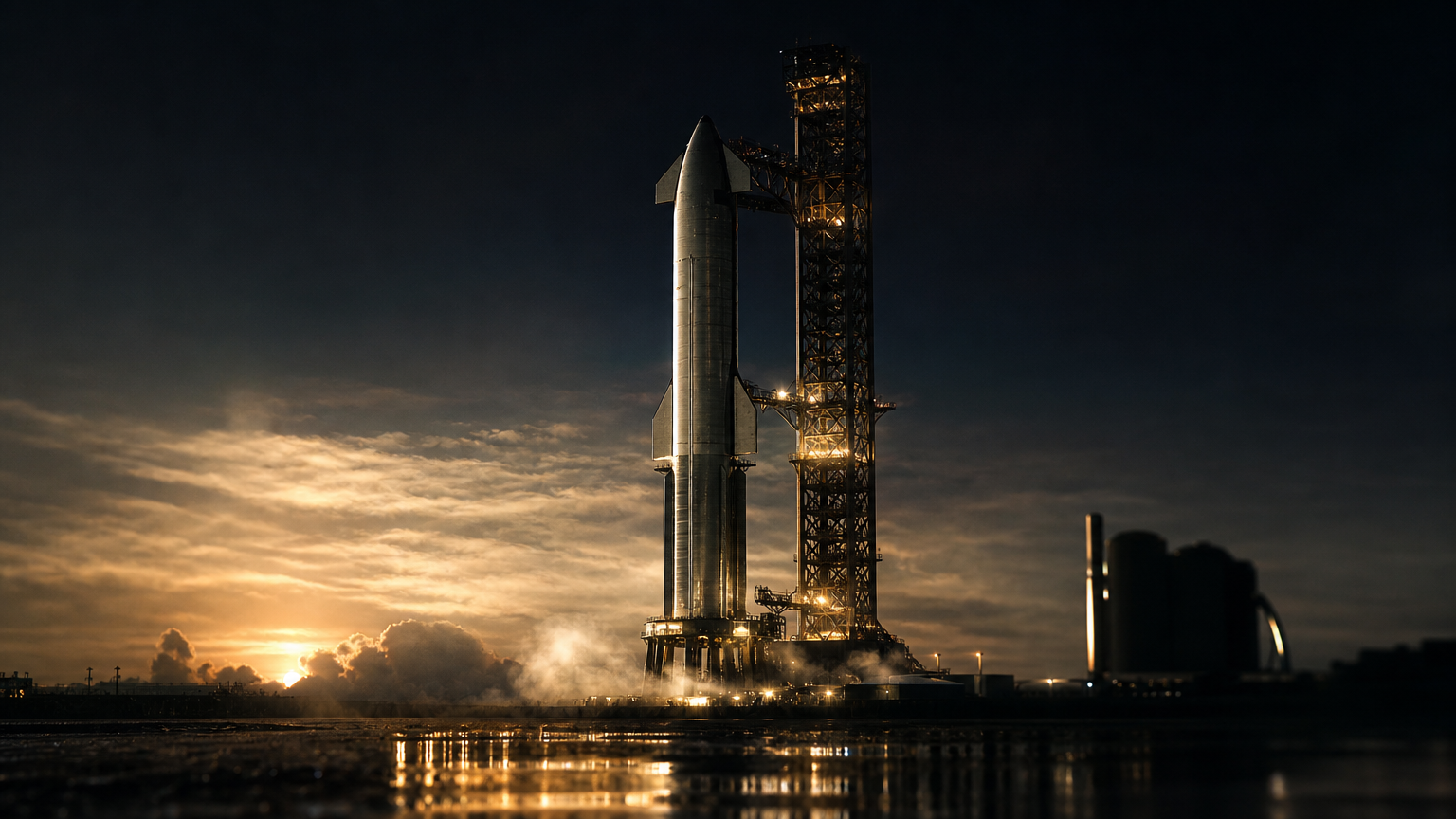
The most immediate operational proof point is Starship Flight 14. Spaceflight Now reported on September 23 that SpaceX had assembled the Starship-Super Heavy vehicle at Pad 2 in Starbase, Texas, for what would be the program’s first orbital flight, pending Federal Aviation Administration approval . The report identified the upper stage as Ship 41 and the booster as Super Heavy B21, and said the fully stacked vehicle stands 124 meters tall .
This is not just another launch webcast. Flight 14 is being treated as a shift from experimental flights toward orbital logistics. Spaceflight Now reported that, assuming approval, the launch could come as soon as September 28 at 7:15 a.m. Central time, on a nearly 10-hour mission expected to deploy 26 next-generation Starlink Version 3 satellites . That payload plan is important because it connects Starship’s engineering promise directly to SpaceX’s revenue machine: Starlink capacity, broadband performance and satellite replacement economics.
For investors, the logic is circular but powerful. Starship needs high flight cadence to justify its cost structure; Starlink can absorb large amounts of mass to orbit; larger Starlink satellites can improve network economics; stronger network economics can help fund more Starship development. The risk is that any weak link in that chain becomes visible in public markets. A private SpaceX could ask patient investors to tolerate iteration. A public SpaceX at $2 trillion has to explain each delay, anomaly and capital need to shareholders who can sell in seconds.
Production cluster, beta server
At the same time, SpaceX is still running the “production” side of its human-spaceflight business. NASA’s station blog reported on September 23 that the International Space Station crew was preparing for a crew swap as NASA’s SpaceX Crew-13 mission announced a launch date . The same NASA update said the Crew-12 quartet had begun packing personal items for return to Earth after Crew-13 arrives no earlier than October 1 .
The Canadian Space Agency also said on September 23 that NASA and SpaceX were targeting 11:10 a.m. on October 1 as the earliest launch opportunity for Crew-13, which includes CSA astronaut Joshua Kutryk . FOX 35 Orlando reported the same target time and said Crew-13 would launch from Cape Canaveral Space Force Station in a SpaceX Dragon capsule atop a Falcon 9 rocket, with arrival at the ISS expected about nine hours after liftoff .
That juxtaposition is the real SpaceX story. Starship is the high-beta future; Falcon 9 and Dragon are the operating base. Crew-13 shows why NASA, international partners and investors care about discipline. The mission follows a delay from an oxidizer leak in Dragon’s propulsion system, which FOX 35 said NASA and SpaceX had addressed by replacing an oxidizer valve . In other words, SpaceX’s most futuristic valuation is anchored to mundane execution: valves, reviews, quarantine, launch windows, station handovers and safe return plans.
Why chips in orbit now belong in the valuation debate
The third thread is less visible but potentially just as consequential. Nikkei Asia reported that Japan’s EdgeCortix is looking to work with SpaceX on chips for space data centers . The premise is straightforward: if satellites and orbital platforms process more data locally, they may reduce the need to downlink raw information to Earth before extracting value from it.
That is where SpaceX’s infrastructure footprint becomes more than transport. Launch access lowers deployment friction. Starlink provides a communications layer. Starship could eventually move heavier orbital hardware. Specialized processors could make satellites more autonomous, especially where power, radiation tolerance and cooling constraints make terrestrial data-center assumptions unusable.
EdgeCortix’s role also fits the broader post-IPO question. If SpaceX is valued like one of the world’s most important technology platforms, investors will look for platform-like optionality. Orbital compute offers one version of that story. It is not enough to launch satellites; the market wants to know whether SpaceX can host, power, connect and monetize workloads above Earth.
The market has discovered orbit, but orbit has discovered accountability
The $2 trillion debut puts SpaceX in a rare category: a public company whose valuation depends on both quarterly confidence and decade-scale infrastructure ambition. The September 23 reassessment of index fears suggests the listing did not break passive markets, at least not yet . But the company’s news flow already shows why this will not trade like a simple tech stock.
Starship Flight 14 asks whether fully reusable heavy-lift can move from aspiration to orbital payload delivery . Crew-13 asks whether SpaceX can keep routine astronaut transport boring, safe and punctual . EdgeCortix’s chip ambitions ask whether SpaceX’s launch and satellite network can become a foundation for in-orbit computing .
That is the new bargain. Wall Street gets a ticker tied to the final frontier. SpaceX gets access to public capital and public scrutiny. The debut answered one fear — whether a $2 trillion listing could find a place in the market. The next tests will be harder: whether the company can keep making the market believe that rockets, broadband, crew capsules and orbital AI infrastructure are parts of the same compounding machine.
Sources from the last 72 hours
- [1]SpaceX’s historic $2 trillion debut defied one of the market's big fearsSep 23, 2026, 7:48 PM UTC
- [2]SpaceX stack Starship and Super Heavy for first orbital flightSep 23, 2026, 12:00 AM UTC
- [3]Crew Studies Advanced Health Tech and Gears Up for Next Crew SwapSep 23, 2026, 7:22 PM UTC
- [4]New launch date and last opportunity for media to speak with CSA astronaut Joshua Kutryk before launch of Crew-13Sep 23, 2026, 4:00 AM UTC
- [5]NASA, SpaceX target October for Crew-13 launch from Florida to ISSSep 23, 2026, 5:54 PM UTC
- [6]Japan's EdgeCortix looks to work with SpaceX on space data center chipsSep 23, 2026, 4:18 PM UTC
AI-generated article based on recent web research, then preserved as a dated editorial snapshot.
Comments
Be the first to comment.