
Daily Podcast full article
Elon Musk’s AI push brings 1.2 million NVIDIA GPUs online
Elon Musk’s SpaceXAI is turning the AI race into an infrastructure contest, with a claimed path to 1.2 million NVIDIA GB200 and GB300-class GPUs online by year-end, just as Anthropic locks in an $11.6 billion Akamai cloud deal and Wall Street models hyperscaler AI capex at trillion-dollar scale.
The headline is compute, not chatbot polish
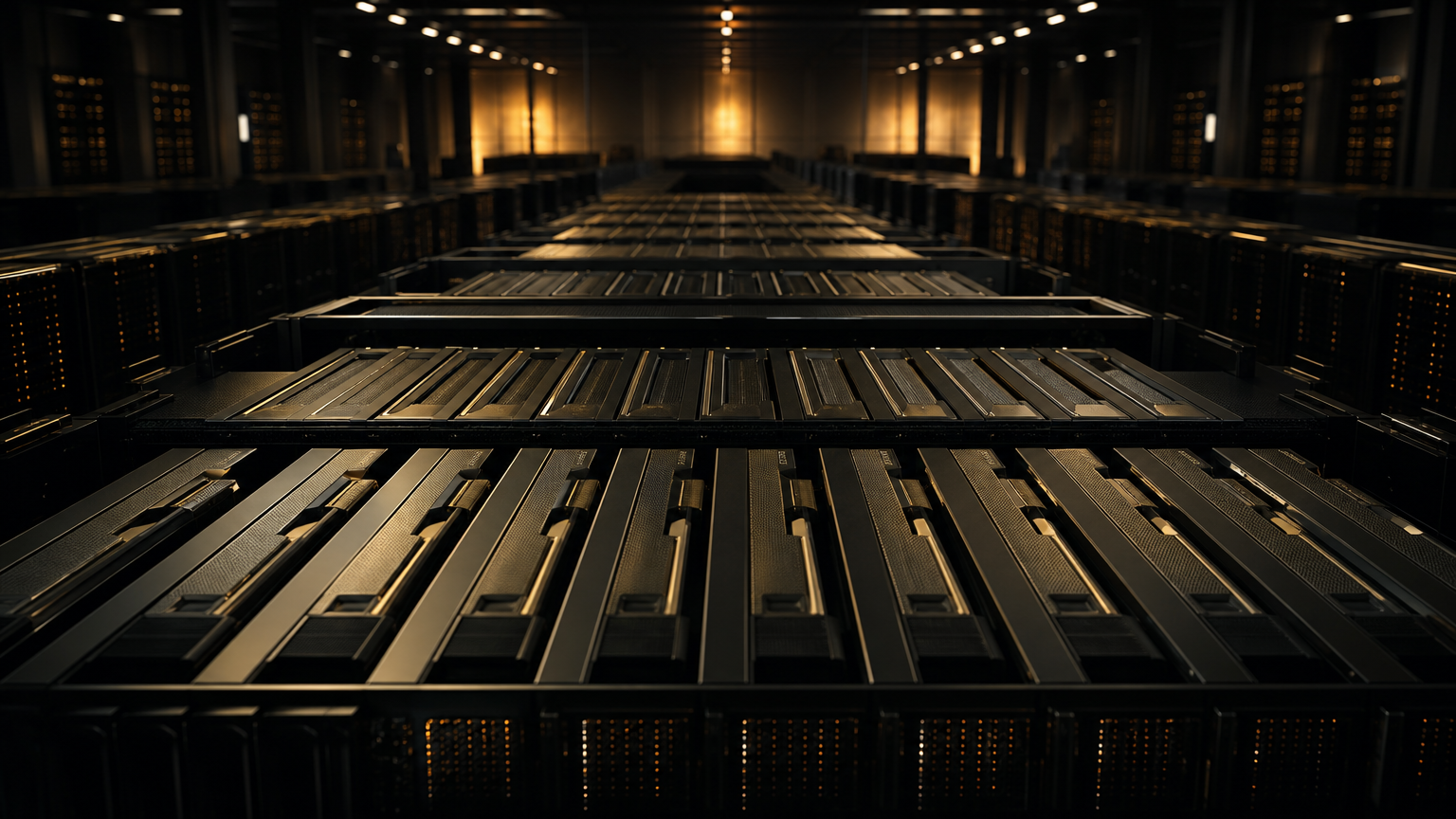
Elon Musk’s latest AI push is no longer best understood as a model-release story. It is a data-center story, a power story, a supply-chain story, and a financing story. According to Wccftech’s September 25 report, Musk’s SpaceXAI effort is centered on bringing a massive NVIDIA fleet online through the Colossus project in Memphis, with a year-end path that adds up to roughly 1.2 million of NVIDIA’s newest GB200 and GB300-class GPUs .
That number needs careful reading. The report says Colossus 2 is currently described as running on 110,000 NVIDIA GB200 GPUs and 440,000 GB300 GPUs, with Musk claiming additional 220,000-GPU GB300 batches are expected by the end of this week, the end of November, and the end of December . In other words, the “1.2 million” figure is not simply a snapshot of what is already fully operational at this minute; it is Musk’s stated ramp plan for the latest-generation NVIDIA systems through the end of 2026 .
The strategic point is still clear. SpaceXAI is trying to compress years of AI infrastructure expansion into months. Musk framed the challenge bluntly, saying that bringing massive compute online rapidly is “incredibly difficult,” while arguing that SpaceX’s execution culture gives it an advantage . He also claimed that if the current acceleration continues, SpaceX could reach “pole position” in AI within about six months .
Colossus becomes the center of Musk’s OpenAI challenge
The immediate target is competitive parity with the frontier labs. Wccftech reports that Musk linked the GPU ramp to his ambition to match Anthropic’s Fable-class systems and OpenAI’s GPT-6-class models within the next two to three months . That is an aggressive claim, especially because model performance depends on more than chips: data quality, training runs, post-training, evaluation, product distribution, safety work, and developer adoption all matter.
Still, the hardware scale changes the conversation. Colossus 1 was already presented as a major compute project, relying heavily on NVIDIA’s H100 generation and supplemented by GB200 systems . Colossus 2 shifts the emphasis to Blackwell-era GB300 capacity, which Wccftech describes as an advanced Blackwell Ultra variant paired with Grace CPU infrastructure . That means Musk is not merely buying more GPUs; he is trying to move SpaceXAI’s stack onto the most current NVIDIA architecture available at scale.
The risk is execution. Large GPU clusters are not plug-and-play assets. They require power, cooling, networking, memory supply, procurement timing, cluster orchestration, fault management, and skilled operations. The bigger the fleet, the more small frictions become system-level problems. Musk’s six-month “pole position” line is therefore less a forecast than a testable operational claim: can SpaceXAI convert installed hardware into reliable training and inference capacity fast enough to matter?
Anthropic shows the same race from the customer side
The same week, Anthropic made the infrastructure race visible from a different angle. Akamai announced a seven-year, $11.6 billion contractual commitment with Anthropic for cloud infrastructure, focused on supporting Anthropic’s growing CPU workload demands through Akamai Cloud’s distributed infrastructure and software . Akamai said the relationship could expand by up to another $9 billion, taking the potential commitment to about $20 billion .
That deal is important because it broadens the AI infrastructure story beyond GPU scarcity. GPUs dominate the frontier-training narrative, but large-scale AI products also need CPUs, memory, storage, routing, edge delivery, reliability engineering, and managed capacity. Akamai’s filing says Anthropic committed to approximately $11.6 billion under two project plans, each with an initial seven-year term, subject to delivery and service availability conditions .
The commercial structure also looks more like a strategic supply alliance than a normal cloud bill. Akamai issued Anthropic a warrant tied to the relationship, representing up to approximately 5% of Akamai’s common stock on an as-converted basis, with vesting linked to the initial commitment and potential expansion . Pulse 2.0 reported that Akamai expects roughly $5.5 billion in related capital expenditures and about $1.7 billion of additional 2026 capex to secure and pre-purchase components, including memory .
That is the new AI economy in miniature: the model company wants guaranteed capacity, the infrastructure provider needs capital commitments, and the contract itself becomes part of the financing story.
Inference is turning AI into an industrial race
The broader market signal is that inference capacity is becoming a strategic input. Bloomberg, republished by Yahoo Finance, reported that Anthropic’s Akamai contract adds to the AI developer’s expanding list of data-center deals and follows an earlier $1.8 billion computing agreement between the companies . The same report noted that Akamai will supply access to CPUs, whose role in supporting AI services has gained renewed importance in the data center .
That fits the wider industry pattern. The Washington Examiner wrote on September 25 that AI is entering a phase in which the question is less about who can build the largest model and more about who controls the infrastructure required to run AI at scale . It also cited estimates that inference capacity among the five largest North American cloud providers could rise roughly 122% this year, faster than training capacity, while nine major global cloud providers could exceed $886.7 billion in capital expenditures .
Goldman Sachs’ reported forecast pushes that capital-intensity argument even further. Bloomberg reported on September 25 that Goldman expects AI infrastructure spending by the five largest U.S. hyperscalers to rise 50% in 2026, reaching $1.2 trillion . If that estimate holds, the AI race is no longer just a software cycle. It is a capital expenditure cycle on the scale of energy, telecom, and heavy industry.
Why Musk’s number matters
Musk’s 1.2 million-GPU push matters because it shows how frontier AI competition is being reframed. For the first wave of generative AI, the market rewarded surprising model capability. For the next wave, the limiting factor may be whether a company can reserve enough chips, energize enough data centers, and finance enough capacity to serve billions of daily requests.
That does not mean model quality is irrelevant. OpenAI and Anthropic still have deep research teams, strong product ecosystems, and large enterprise footprints. Musk’s claim that SpaceXAI can surpass them within six months should be treated as a high-risk assertion, not a neutral industry consensus . But the compute buildout makes the claim more than mere rhetoric. If SpaceXAI truly brings roughly 1.2 million latest-generation NVIDIA GPUs online on the timetable described, it would represent one of the most ambitious AI infrastructure ramps yet reported .
The key caveat is that “online” must eventually mean more than powered racks. It must mean stable utilization, efficient networking, usable developer capacity, successful training runs, fast inference, and enough revenue to justify the capital burn. That is where the Akamai-Anthropic deal is so revealing: the winners may be the companies that turn compute into durable service contracts, not just the ones that announce the biggest clusters .
The final boss is physical capacity
The story tying Musk, Anthropic, Akamai, NVIDIA, and Goldman’s hyperscaler forecast together is simple: AI is becoming physical. The competitive bottleneck is shifting from clever demos to industrial execution. Chips, memory, power, real estate, cooling, networking, debt markets, and long-term customer contracts now shape the frontier as much as benchmarks do.
Musk is betting that SpaceXAI can win by building faster than everyone else. Anthropic is betting that long-term infrastructure commitments can secure the capacity its models need. Akamai is betting that AI can reposition its distributed cloud business beyond its content-delivery roots. Wall Street is betting, or warning, that the bill for all of this is moving into trillion-dollar territory.
At this scale, AI is no longer just code running in the cloud. It is the cloud being rebuilt around AI.
Sources from the last 72 hours
- [1]Elon Musk Goes All In To Bring A Whopping 1.2 Million NVIDIA’s Latest GPUs Online In His Mega Data Center To Take On OpenAISep 25, 2026, 2:46 PM UTC
- [2]Musk Says SpaceX Will Take AI ‘Pole Position’ in Six Months If Growth HoldsSep 24, 2026, 12:00 AM UTC
- [3]Akamai Announces $11.6 Billion Multi-year Agreement with Anthropic to Support Growing DemandSep 24, 2026, 12:00 AM UTC
- [4]Form 8-K for Akamai Technologies INC filed 09/24/2026Sep 24, 2026, 12:00 AM UTC
- [5]Akamai Announces $11.6 Billion Seven-Year Agreement With Anthropic For AI InfrastructureSep 25, 2026, 1:14 PM UTC
- [6]Anthropic Strikes $12 Billion AI Computing Deal With AkamaiSep 24, 2026, 8:16 PM UTC
- [7]The race for AI inference is really a race for infrastructureSep 25, 2026, 3:00 PM UTC
- [8]Goldman Sees Hyperscaler AI Capex Rising 50% to $1.2 TrillionSep 25, 2026, 12:00 AM UTC
AI-generated article based on recent web research, then preserved as a dated editorial snapshot.
Comments
Be the first to comment.