
Daily Podcast full article
NASA Gives SpaceX Nearly $1B as Crew Dragon Wins More Time and Starship Clears a Launch Rehearsal
NASA’s latest SpaceX award adds three more Crew Dragon missions to the International Space Station, while Starship’s Flight 14 campaign has reached a crucial wet dress rehearsal milestone ahead of a planned first orbital attempt. Together, the developments show why NASA’s reliance on SpaceX is not just about one contract, but about cadence, operational memory and the hard-to-replace machinery of a mature launch partnership.
A nearly billion-dollar vote of confidence
NASA has added three more crewed Dragon missions to SpaceX’s Commercial Crew Transportation Capability pipeline, a $946 million contract modification covering Crew-15, Crew-16 and Crew-17 . The award pushes SpaceX’s total NASA crew mission count under the agreement to 17, with mission-readiness dates scheduled in 2027 and 2028 and the performance period extending through 2030 .
That is the headline number, but the operational meaning is broader. The modification is not merely a purchase of seats to orbit; it includes launch and ground operations, in-orbit services, return and recovery, cargo transportation and the lifeboat role Dragon provides while docked to the International Space Station . In other words, NASA is buying an integrated crew-transport system, not a rocket ride with extra paperwork.
The contract also increases the total value of SpaceX’s CCtCap work with NASA to $5.92 billion . For SpaceX, it is another major public-sector revenue stream tied to services the company has already demonstrated at scale. For NASA, it is a continuity play: keep the ISS staffed, keep science moving, and avoid letting crew access become a single-point failure as the station approaches the end of the decade.
Why incumbency matters in orbit
The award reinforces a central reality of the modern U.S. space program: once a provider accumulates flight cadence, certification history and day-to-day experience with NASA systems, it becomes difficult to replace quickly. NASA established the commercial crew partnership in 2014 with both SpaceX and Boeing, but SpaceX’s Dragon was certified for NASA crew transportation in November 2020 and has since become the regular astronaut-transport workhorse for Falcon 9 and Dragon rotations .
That does not mean NASA wants a one-provider universe. The agency’s stated commercial-crew model is built around independent transportation systems, and the latest award is best read as a bridge that protects near-term access while the broader redundancy picture continues to evolve. Crew-13 planning underscores that operational reality: NASA and SpaceX are now targeting 11:10 a.m. EDT on Thursday, October 1, 2026, as the earliest launch opportunity for the next crew rotation to the ISS .
The Crew-13 schedule also shows how tightly the system is managed. NASA said teams would complete prelaunch activities and reviews over several days to confirm the crew, the station, Dragon and Falcon 9 before liftoff . The Canadian Space Agency separately confirmed the same October 1 target for Crew-13, in which CSA astronaut Joshua Kutryk is participating . Kutryk is scheduled for an approximately six-month stay aboard the station and will be the fourth CSA astronaut to fly a long-duration ISS mission .
The science behind the seats
NASA’s contract with SpaceX is not only about transportation logistics. The people riding Dragon carry experiments, maintenance duties and medical data that shape future spaceflight planning. NASA said Crew-13 astronauts will support biomedical and human-performance investigations, including work on how spaceflight affects blood flow and clotting . The agency also plans to test manual piloting skills, study countermeasures for vision and brain changes, gather health data and measure forces astronauts experience during return to Earth .
That scientific load makes the $946 million award easier to understand. The value is partly in launch access, but partly in the predictable cadence that lets NASA plan research campaigns, crew handovers and vehicle availability years in advance. A missed or uncertain crew-rotation capability would ripple through experiments, maintenance schedules and international-partner commitments.
Starship’s other signal
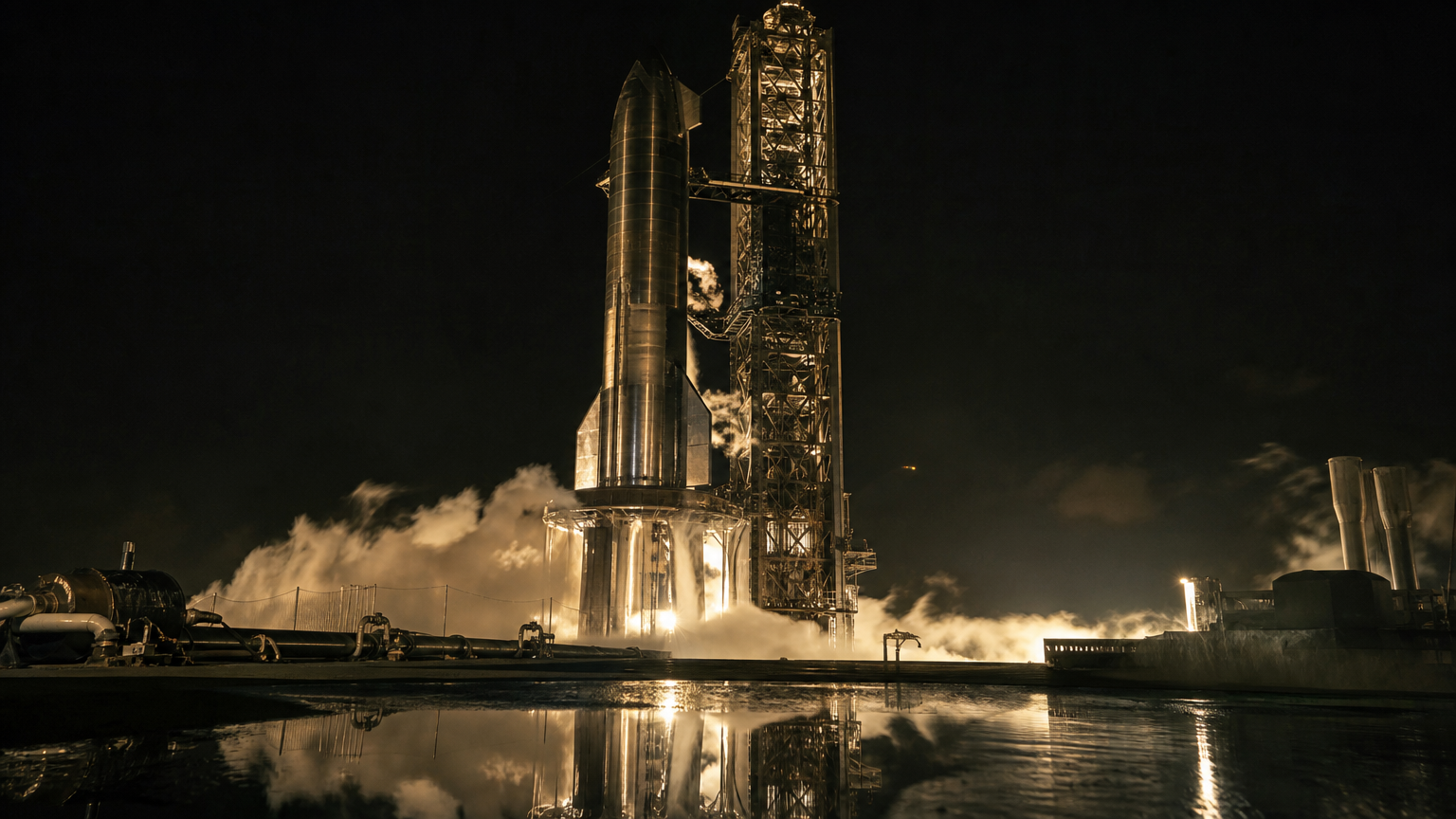
While the Crew Dragon award anchors SpaceX’s proven human-spaceflight business, the company’s Starship program is pushing toward a different category of capability. SpaceX assembled the Starship Flight 14 vehicle at Starbase, Texas, with Ship 41 stacked on Super Heavy Booster 21 ahead of what SpaceX and industry observers described as the vehicle’s first orbital launch attempt . Flight 14 is targeted for a 75-minute launch window opening at 8:15 a.m. EDT on September 28, pending regulatory approval .
The mission profile is ambitious because Flight 14 is intended to do more than repeat prior suborbital demonstrations. Space.com reported that Ship 41 has been loaded with 26 Starlink V3 satellites, and a successful orbital insertion would allow the first deployment of those upgraded satellites from Starship . Previous Starship flights used suborbital trajectories, meaning carried Starlink hardware did not remain in orbit .
On September 24, SpaceX moved through the key rehearsal gate: a wet dress rehearsal for Flight 14. During such a test, teams fuel the vehicle and run the major launch-day steps without igniting the engines . SpaceX announced the rehearsal complete, keeping the vehicle on track for the planned September 28 attempt . The fully fueled rehearsal matters because cryogenic propellants, countdown software, ground systems and vehicle plumbing often reveal integration problems only when the system is loaded like it will be on launch day.
Why Starship matters to NASA’s calendar
Starship is not the vehicle covered by the $946 million Commercial Crew modification, but the two developments belong in the same strategic frame. Crew Dragon represents the operational backbone NASA can use now; Starship represents the heavier-lift, higher-ambition architecture that could reshape payload deployment, lunar planning and eventually deep-space logistics.
NASA has contracted Starship as a lunar lander for the Artemis program, and Space.com reported that NASA expects an orbital spacecraft capable of docking with Orion for Artemis III in mid-2027 and a crew-certified vehicle to land astronauts on the Moon for Artemis IV in 2028 . That timeline makes every Starship integration milestone relevant far beyond SpaceX’s internal test campaign. A wet dress rehearsal is not a launch, but it is a high-value checkpoint in a chain that must eventually include orbital operations, payload deployment, propellant management and human-rating work.
Flight 14 also changes the commercial stakes. If Starship reaches orbit and deploys operational Starlink V3 satellites, SpaceX will have linked its launch-development program directly to its broadband network expansion . That would add another layer to the company’s vertical integration: the same organization designing the rocket, satellites, launch operations and customer-facing network would be testing the system as a single commercial machine.
The spreadsheet has thrust
The week’s message is straightforward: NASA is paying SpaceX nearly $1 billion for proven crew access while SpaceX is simultaneously testing the next vehicle that could alter future mission planning. The procurement spreadsheet, in this case, has real thrust.
For rivals, the contract shows how hard it is to dislodge an incumbent that has accumulated flight history, NASA certification experience and a functioning production-and-operations pipeline. For NASA, the award buys continuity through a sensitive transition period for the ISS. And for SpaceX, the combination of Crew Dragon extensions and Starship progress strengthens the company’s central position in U.S. human spaceflight: trusted enough to keep astronauts moving today, and ambitious enough to keep NASA’s planners watching tomorrow.
Sources from the last 72 hours
- [1]NASA Orders Three More SpaceX Crew FlightsSep 23, 2026, 4:00 PM UTC
- [2]NASA's SpaceX Crew-13 MissionSep 22, 2026, 9:49 PM UTC
- [3]New launch date and last opportunity for media to speak with CSA astronaut Joshua Kutryk before launch of Crew-13Sep 23, 2026, 4:00 AM UTC
- [4]SpaceX stacks massive Starship rocket ahead of 1st orbital launch attempt (video)Sep 23, 2026, 12:00 AM UTC
- [5]SpaceX Starship Flight 14 live updates: Pre-launch wet dress rehearsal underwaySep 24, 2026, 1:52 PM UTC
- [6]SpaceX's Starship megarocket aces launch rehearsal ahead of 1st orbital test flight (video)Sep 24, 2026, 10:24 PM UTC
- [7]NASA to Study Human Health, Performance During Crew-13 MissionSep 24, 2026, 12:00 AM UTC
AI-generated article based on recent web research, then preserved as a dated editorial snapshot.
Comments
Be the first to comment.