
Daily Podcast full article
10 Years of NVIDIA DGX: From One System to AI Factories
NVIDIA’s DGX anniversary is not just a hardware birthday. It is a useful lens on how AI infrastructure moved from a single dense training box in 2016 to today’s idea of the AI factory: integrated compute, networking, cooling, storage and software designed as one production system.
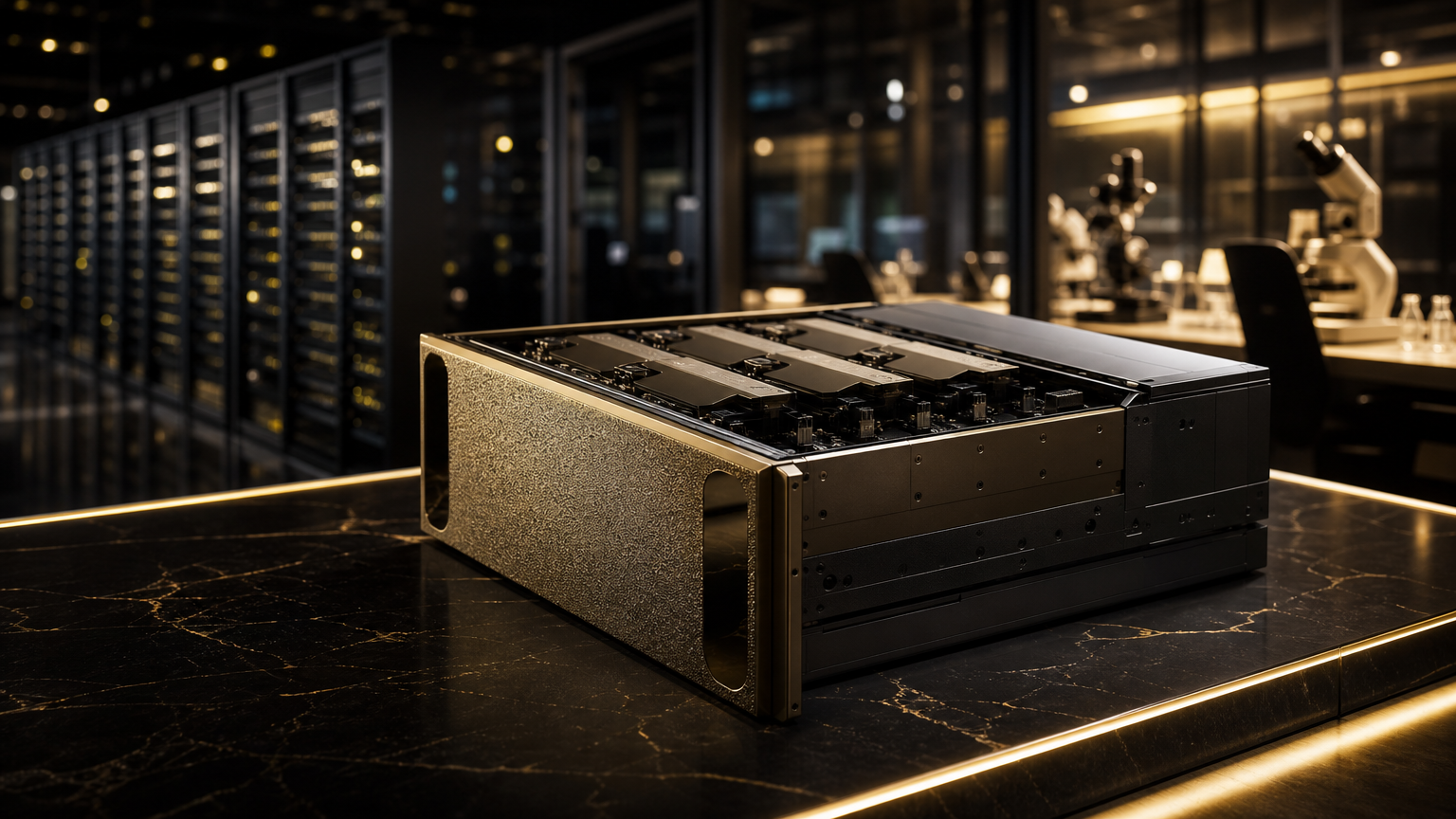
The system that became a template
Ten years after Jensen Huang introduced DGX-1 at GTC 2016, NVIDIA is presenting DGX less as a product line and more as an operating pattern for modern AI infrastructure . The company’s own anniversary framing is direct: DGX has moved “from a single system into a blueprint for AI factories,” while the reason for building it has stayed constant — to test the hard details of interconnects, cooling and software before customers and partners try to scale them .
That matters because DGX arrived at a moment when deep-learning researchers were often assembling their own high-performance rigs out of available parts . The original DGX-1 concentrated then-new GPUs, NVLink interconnect technology and a tuned software environment into one purpose-built AI training system . In hindsight, the central idea was not merely “more GPUs in a box.” It was that frontier AI would require repeatable systems engineering: compute density, memory movement, networking behavior, thermals, storage and frameworks all had to work together.
The anniversary video highlighted by NVIDIA and indexed by AI news trackers on September 24–25, 2026, shows the company deliberately telling the DGX story as an engineering arc rather than a simple product retrospective . That is the right angle. AI infrastructure has become too large, too expensive and too power-constrained to be improvised one cluster at a time.
Why DGX-1 was more than a fast workstation
The early DGX-1 solved a practical problem: it gave researchers a tightly integrated deep-learning machine at a time when the field’s ambitions were outrunning conventional servers . Its importance was not only peak performance; it was packaging, predictability and acceleration of experimentation. The system turned a messy procurement-and-integration problem into something closer to an appliance for AI research.
One symbolic deployment was the first DGX-1 delivered to OpenAI in 2016, which NVIDIA’s anniversary material treats as an early marker of dedicated infrastructure for frontier model research . The point is not that one box created modern AI. The point is that DGX-1 embodied a new assumption: AI progress would increasingly depend on specialized infrastructure, not only clever model code.
That assumption was reinforced as workloads grew. In 2017, Meta’s Fundamental AI Research lab used DGX systems to train ImageNet in about one hour, a milestone presented at the time as evidence that tasks once considered impractical could be compressed by dense, purpose-built compute . The historical lesson is still relevant in 2026: when the system is designed as a whole, research timelines change.
From box to SuperPOD
The next phase of DGX was scale-out. DGX SuperPOD expanded the single-system concept into a prescriptive cluster design meant to reduce the time and uncertainty of deploying large AI infrastructure . Instead of every organization inventing its own topology, cabling plan, storage layer and operational playbook, SuperPOD pushed the DGX logic into a repeatable architecture.
That is the bridge from “AI supercomputer” to “AI factory.” A supercomputer is often described by performance. A factory is judged by throughput, utilization, reliability, energy behavior and the cost of each useful output. NVIDIA’s current anniversary message leans into exactly that shift: DGX is valuable because it lets NVIDIA work through the details of interconnects, cooling and software, then hand customers a proven foundation .
This is also why the term “blueprint” is doing so much work. A blueprint is not a single machine. It is a way to build many machines with known constraints, known interfaces and known operating assumptions. For banks, universities, national labs, pharmaceutical companies and manufacturers, that repeatability can be as important as the silicon itself.
The customer map widened
The DGX story has also become a story of sectoral adoption. The latest subject material points to research labs, supercomputing centers, banking, drug discovery, manufacturing and developer workstations as part of the same continuum . That breadth is important because it shows the platform leaving the specialist lab and entering production environments.
In academic and national-scale computing, DGX SuperPOD-based systems appeared in projects such as the University of Florida’s HiPerGator and Linköping University’s Berzelius, with the anniversary summary connecting those deployments to TOP500 and Green500 visibility . In enterprise and government use, MITRE is cited for a federal AI sandbox, BNY for a Hopper-based DGX SuperPOD deployment, and Lilly for in silico drug-design work intended to compress parts of pharmaceutical R&D .
Those examples show DGX’s evolution from training appliance to institutional infrastructure. A bank does not buy AI compute for the same reasons as a university lab, and a drug-discovery group has different constraints from a factory operator. Yet each needs a reliable way to convert data, models and power into useful work.
Hopper, Blackwell and the factory era
The later DGX chapters reflect the changing shape of AI itself. With Hopper and Blackwell architectures, the emphasis moved toward larger models, longer context windows, memory bottlenecks and the operational demands of autonomous or agentic systems . That shift matters because the workload is no longer just training a model and shipping it. Increasingly, the workload is continuous: retrieval, reasoning, simulation, inference, fine-tuning, evaluation and deployment all competing for the same infrastructure.
NVIDIA’s anniversary message names the system-level problems that become decisive at this scale: interconnects, cooling and software . Those are not secondary engineering details. They determine whether expensive accelerators are actually used efficiently, whether clusters behave predictably, and whether organizations can move from impressive demos to production services.
The current DGX arc also extends downward as well as upward. Newer systems mentioned in the subject material connect hyperscale AI factories to smaller development environments, including DGX Spark and DGX Station-class workflows . That gives NVIDIA a “build once, scale up” story: prototype locally, move to clusters, and eventually operate at factory scale. The newsroom’s anniversary post reinforces that the strategic value of DGX is the tested foundation partners and customers can build on .
Why the anniversary matters now
The timing of the 10-year milestone is significant because AI infrastructure has become the bottleneck behind much of the industry’s ambition. In 2016, the question was how to give researchers enough dense compute to run advanced deep-learning experiments. In 2026, the question is how to industrialize intelligence production under real constraints: power, cooling, capital cost, supply chains, utilization and operational reliability.
DGX’s answer has been consistent: integrate the stack, prove the design, then scale it. The first version of that answer was DGX-1. The current version is the AI factory blueprint. NVIDIA’s official social post on the anniversary makes the same point in plain language, thanking customers including BMW Group, BNY, DeepL, Eli Lilly, Foxconn, Linköping University, Meta, MITRE, OpenAI and the University of Florida as part of the DGX journey .
That customer list also hints at the next decade. The demand will not be only for faster chips. It will be for production systems that can host agents, translate at web scale, support drug discovery, run smart factories, serve government sandboxes and let developers test locally before scaling globally.
The through-line
The cleanest way to understand DGX after 10 years is to see it as a disciplined infrastructure feedback loop. NVIDIA builds a tightly integrated system, learns where the bottlenecks are, folds those lessons into larger designs, and then turns the result into a deployable foundation. DGX-1 made that loop visible in one box. SuperPOD extended it to clusters. AI factories make it an industrial model.
That is why the anniversary is more than nostalgia. It marks a decade in which AI compute moved from handcrafted research setups to repeatable production infrastructure. The next phase will be judged not by whether organizations can buy accelerators, but by whether they can operate them as coherent factories for intelligence. DGX is NVIDIA’s argument that AI needs a homebase, not just a command prompt.
Sources from the last 72 hours
- [1]Home | NVIDIA NewsroomSep 24, 2026, 12:00 AM UTC
- [2]10 Years of NVIDIA DGX: From One System to AI Factories · NVIDIA · HelloBro.aiSep 24, 2026, 4:00 PM UTC
- [3]AI news video coverage - aifeed.fyiSep 25, 2026, 12:00 AM UTC
- [4]#decadeofdgx | NVIDIA | 27 commentsSep 25, 2026, 1:10 AM UTC
AI-generated article based on recent web research, then preserved as a dated editorial snapshot.
Comments
Be the first to comment.