
Daily Podcast full article
Starship Flight 14 nears orbit
SpaceX has stacked Booster 21 and Ship 41 at Starbase for Starship Flight 14, a planned first orbital Starship attempt targeted for September 28, 2026, with a 75-minute morning window, 26 Starlink V3 satellites aboard, and a compressed SpaceX manifest placing Crew-13 and Transporter-18 only days behind it.
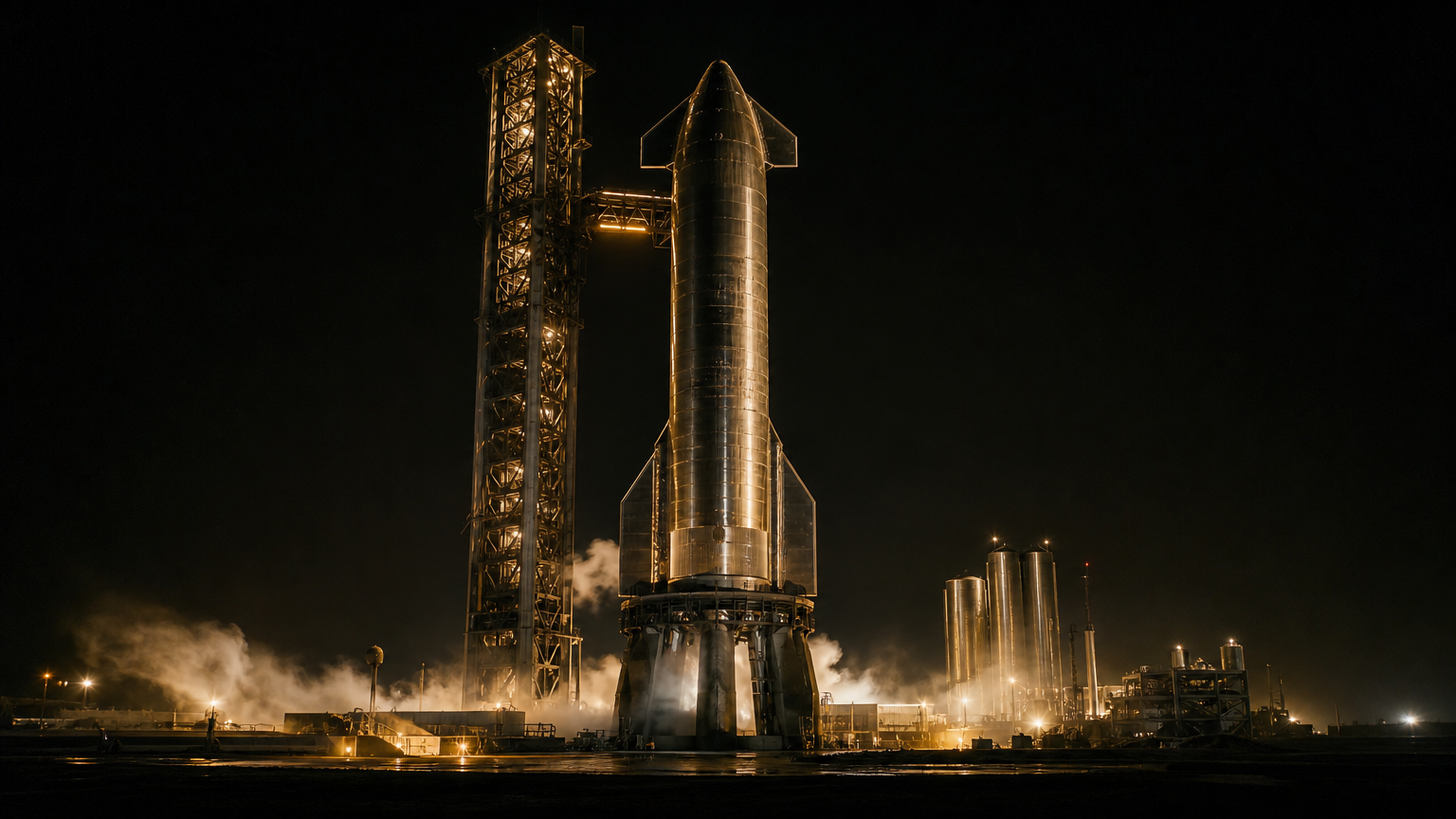
The next Starship test is no longer just another test
Starship Flight 14 has moved into the short countdown phase at Starbase, Texas, with SpaceX’s full Starship-Super Heavy stack assembled on Pad 2 and pointed at a first orbital attempt. Spaceflight Now reported that SpaceX stacked the 124-meter Starship-Super Heavy vehicle early on September 23 while it awaited FAA approval for the vehicle’s first orbital flight . The stack pairs Super Heavy Booster 21 with Ship 41, the upper stage that was moved from the production site to the pad and lifted onto the booster by the tower’s “chopsticks” .
The current target is Monday, September 28, with liftoff possible at 7:15 a.m. CDT, or 12:15 UTC, for a mission expected to run nearly 10 hours if the plan holds . Space.com’s live coverage also listed a 75-minute launch window opening at 8:15 a.m. EDT and described Flight 14 as Starship’s first attempt to reach orbit, pending regulatory approval . In other words: after years of increasingly ambitious integrated tests, SpaceX is trying to move Starship from the Kerbal Space Program tutorial phase into orbital operations.
What changed from the earlier Starship flights
The key difference is trajectory. Previous Starship integrated tests were designed around suborbital profiles, allowing the vehicle to gather ascent, separation, reentry and landing data without completing a full orbital mission. Flight 14 is designed to reach orbit, with Ship 41 expected to perform an orbital insertion burn roughly 25 minutes after liftoff if onboard systems meet SpaceX’s health criteria . The planned profile calls for roughly six orbits at about 275 kilometers altitude over nearly 10 hours, though SpaceX’s plan includes the possibility of shortening the mission to two or five orbits depending on vehicle health and return-burn redundancy .
That conditional approach matters. SpaceX is not simply trying to circle Earth for symbolism; it is trying to demonstrate that Starship can enter orbit, remain controllable through a long coast phase, protect its heat shield, and still preserve the ability to come back on a planned trajectory. SpaceBytes reported that Ship 41 is targeting splashdown in the Pacific west of Chile, while Booster 21 is expected to splash down in the Gulf, with no tower catch planned for either vehicle on this flight . That makes Flight 14 both ambitious and cautious: orbit is the new milestone, but recovery is still being treated as a data-gathering exercise rather than a full reuse demonstration.
Starlink V3 turns the test into an operational bridge
Flight 14 is also important because the vehicle is not flying empty. The mission is expected to carry 26 next-generation Starlink V3 satellites, making it the first Starship flight planned to deploy an operational payload into orbit . SpaceBytes reported that those 26 satellites are intended to remain in space and join the constellation within weeks, adding roughly 26 terabits per second of network capacity, about 10 times what a Falcon 9 launch of older V2 Mini satellites would add .
That is the strategic point behind Starship. Falcon 9 made reuse routine, but Starship is meant to change the amount of mass SpaceX can place in orbit per launch. If one Starship can deliver a payload class equivalent to many Falcon 9 Starlink launches, SpaceX gets a direct business reason to push beyond spectacular prototypes and toward repeatable orbital service. Starship’s promise has always been more than a large rocket: lower cost per kilogram, higher deployment cadence, and larger spacecraft or satellite designs that cannot fit comfortably into Falcon 9’s architecture.
The satellite payload also adds pressure. A suborbital test can be judged mainly by engineering data; an orbital deployment flight touches network economics, customer capacity, regulatory risk and SpaceX’s internal launch manifest. If Flight 14 succeeds, Starship begins to look less like a future system and more like the backbone for Starlink’s next expansion phase.
The heat shield is one of the quiet main events
The orbit attempt will draw the headlines, but the heat shield may decide how useful Starship becomes. SpaceBytes reported that Ship 41 includes extra fasteners in vulnerable tile areas, fixes for gaps where hot plasma previously penetrated, and curved tiles meant to reduce heating between tiles . The same report says two tiles recovered from Ship 40 are flying again on Ship 41, marking the first reuse of a Starship heat-shield component .
That detail is small but revealing. Starship’s business case depends on rapid reuse, and rapid reuse depends on a thermal protection system that can survive reentry without requiring slow, tile-by-tile refurbishment. A successful orbital coast and reentry will not prove the whole system is solved. But it can show whether the latest tile changes, inspections and reused components are moving in the right direction.
The mission plan also includes cameras on three deployed satellites to photograph Starship’s heat shield in orbit before reentry . That is a smart diagnostic loop: deploy the network payload, use part of the payload set to inspect the launch vehicle, then feed that evidence back into the next vehicle. In a program built on iterative flight testing, imagery of the heat shield may be as valuable as the orbital insertion itself.
Regulatory approval remains the gate
As of the latest reporting used here, Flight 14 still depended on regulatory clearance. Spaceflight Now reported that SpaceX was awaiting FAA approval after stacking the vehicle . Space.com likewise described the September 28 target as pending regulatory approval . The FAA’s Current Operations Plan Advisory dated September 25 listed “SPACEX STARSHIP FLT-14, STARBASE, TX” with a primary window on September 28 from 1215Z to 1414Z and a backup on September 29 over the same UTC window .
That distinction is important: range planning and airspace advisories do not equal a final launch license. They do show that the federal airspace system is preparing for the attempt. Starship’s scale, trajectory, debris risk modeling and reentry profile make the regulatory step central, especially because this flight aims at a true orbital mission rather than a shorter suborbital test.
A compressed SpaceX launch queue raises the stakes
Flight 14 is also sitting inside a dense SpaceX schedule. The FAA advisory lists Starship Flight 14 on September 28, Crew-13 from Cape Canaveral on October 1, and Transporter-18 from Vandenberg later on October 1 . The Canadian Space Agency said NASA and SpaceX are targeting 11:10 a.m. on October 1 as the earliest launch opportunity for Crew-13, which will carry CSA astronaut Joshua Kutryk to the International Space Station for a roughly six-month mission .
That gives SpaceX three major missions across four calendar days if the manifest holds: Starship from Texas, a crew rotation to the ISS from Florida, and a rideshare mission from California. This is the operational model SpaceX has been building toward: standardized vehicles, reusable boosters, parallel launch sites and vertically integrated mission services. It is also a scheduling puzzle. Weather, range availability, technical holds, crew constraints and FAA approval can all ripple through the queue.
For Starship, the timing makes the test feel larger than a single rocket. If the vehicle reaches orbit and deploys Starlink V3 satellites, SpaceX gets proof that Starship can begin carrying the company’s highest-value internal payloads. If delays stack up, the rest of the manifest has to flex around a rocket that is still experimental but increasingly central to SpaceX’s future.
Why Flight 14 matters
A successful Flight 14 would not make Starship fully operational overnight. SpaceX would still need to prove repeated orbital flights, reliable reentry, booster and ship recovery, fast refurbishment, on-orbit propellant transfer and eventually crew-rated lunar operations. But the first orbital Starship mission would be a boundary crossing. It would connect the architecture SpaceX has been testing since 2023 to the economics that justify the whole program: heavier payloads, faster constellation buildout, lower launch costs and a path toward NASA’s lunar ambitions.
That is why Flight 14 feels consequential. The rocket is real, the payload is real, the orbital plan is real, and the manifest around it is already behaving as though Starship is becoming part of SpaceX’s working launch system. The tutorial may not be over, but the next level is finally loading.
Sources from the last 72 hours
- [1]SpaceX Starship Flight 14 live updates: Pre-launch wet dress rehearsal underwaySep 24, 2026, 12:00 PM UTC
- [2]SpaceX Readies Starship Flight 14 for First Orbital MissionSep 25, 2026, 12:00 AM UTC
- [3]New launch date and last opportunity for media to speak with CSA astronaut Joshua Kutryk before launch of Crew-13Sep 23, 2026, 12:00 AM UTC
- [4]SpaceX stack Starship and Super Heavy for first orbital flightSep 23, 2026, 9:47 PM UTC
- [5]Current Operations Plan AdvisorySep 25, 2026, 4:01 PM UTC
AI-generated article based on recent web research, then preserved as a dated editorial snapshot.
Comments
Be the first to comment.