
Daily Podcast full article
Tesla Starts High-Volume Semi Production
Tesla has turned the long-delayed Semi from a closely watched pilot program into a full industrial wager, opening its dedicated Nevada truck plant, touting high-volume production, and aiming the Class 8 electric hauler at fleets that care less about hype than uptime, payload, charging and total cost per mile.
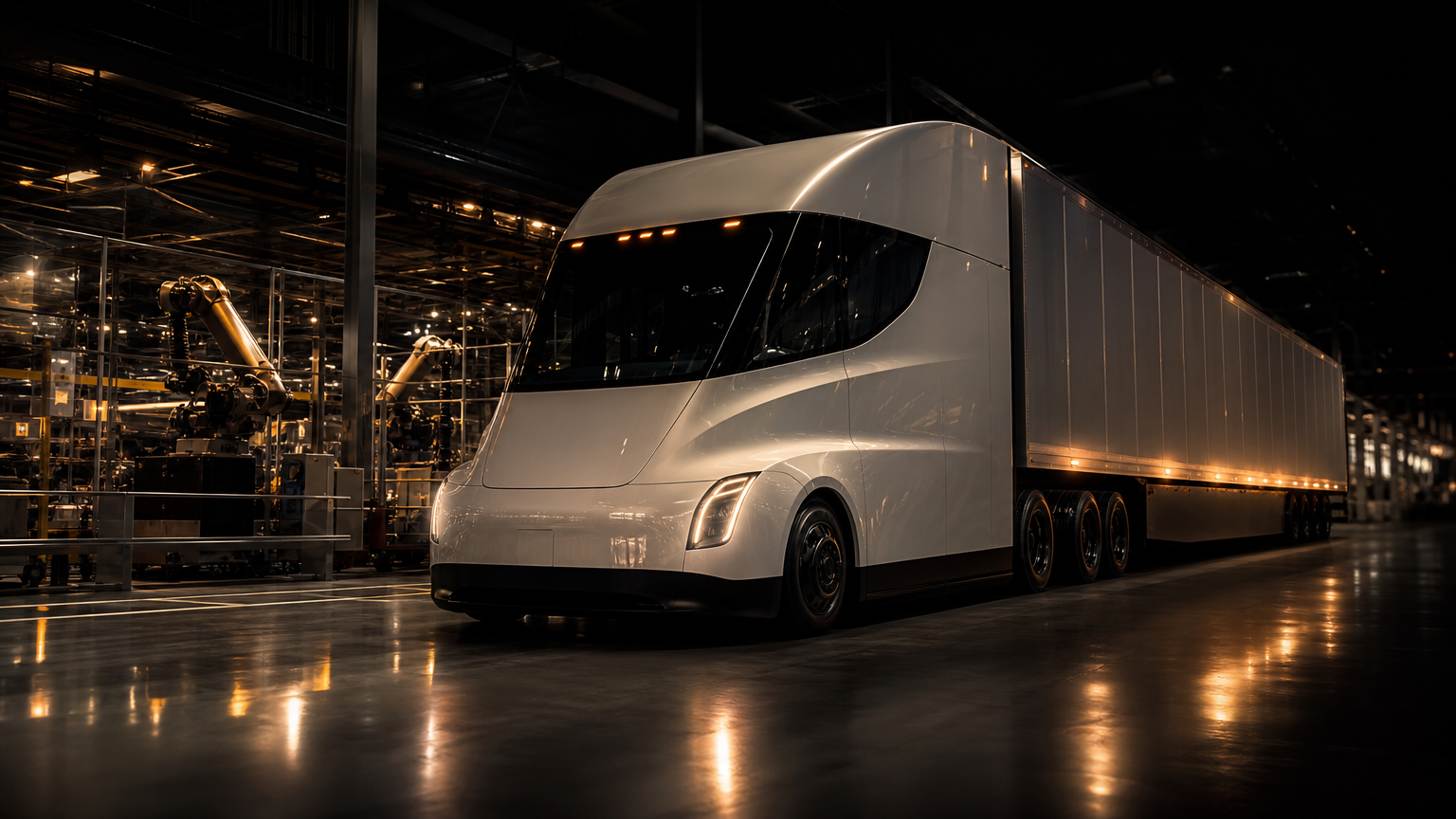
A delayed truck finally gets its factory moment
Tesla’s Semi has spent nearly nine years in the space between promise and proof. The company first unveiled the electric big rig in 2017, missed the original 2019 production expectation, and began limited deliveries to early customers such as PepsiCo in late 2022 . Now the story has shifted from prototypes and fleet trials to a purpose-built manufacturing bet in Sparks, Nevada, where Tesla formally rolled out the Semi at the inauguration of its dedicated plant .
The headline is straightforward: Tesla says the Semi is here, and that high-volume production is beginning. The rollout centered on the company’s first factory built specifically for the Semi, a site described during the event as a 1.8-million-square-foot plant designed to build 50,000 trucks a year across variants including Standard Range, Long Range and European-spec configurations . Other contemporary reports have rounded the plant at 1.7 million square feet, but the strategic point is the same: Tesla is no longer presenting the Semi as a boutique demonstration vehicle, but as a product meant to scale .
That distinction matters because commercial trucking is a very different market from passenger cars. Fleet buyers do not buy a Class 8 truck for novelty. They calculate route length, charging dwell time, payload impact, maintenance, driver acceptance, depot infrastructure, financing and residual value. Tesla’s event was therefore less about whether an electric truck can accelerate dramatically and more about whether an electric truck can become a repeatable freight asset.
What Tesla is promising
Tesla is pitching the production Semi around range, efficiency, charging and factory scale. CNBC reported that the Long Range version is rated at an estimated 500 miles on a full battery, while the Standard variant is rated at an estimated 325 miles . That range profile puts the Semi squarely into regional and many medium-haul operations first, especially routes that return to base and can use depot charging.
The production push also places charging infrastructure at the center of the business case. Tesla’s Semi pitch depends on access to a Megacharger network and predictable charging economics, because an electric truck’s value is not just the sticker price of the tractor. It is the combination of energy cost, route planning, utilization and downtime. If the truck can be charged cheaply and reliably on regular routes, battery-electric freight begins to look less like a climate experiment and more like a logistics spreadsheet.
The event also emphasized variant flexibility. The event post describing the factory said every Semi variant can be built on the same line, including Standard, Long Range and European-spec versions . If Tesla can actually execute that manufacturing flexibility, it would help the company serve fleets with different duty cycles without fragmenting production into narrow, low-volume subprograms.
The order book is starting to matter
The current launch would look much thinner without fleet commitments. CNBC reported that the industry coalition ZET SCALE selected Tesla as its primary original equipment manufacturer for an initial order of 2,500 trucks, with the coalition aiming to order more than 10,000 electric trucks across multiple providers . Reuters separately reported that the 2,500-truck order nearly doubles the existing U.S. fleet of electric Class 8 trucks, citing clean transportation nonprofit Catalyst Mobility .
Einride has also agreed to add 500 Tesla Semi trucks to its fleet, with some deployments planned this month . Those commitments do not prove Tesla can build 50,000 trucks a year, but they do give the Nevada plant a more credible early demand base than a handful of showcase units. For a vehicle that has often been judged by missed dates, signed fleet interest is an important change in texture.
Still, Tesla has not yet answered the question that matters most: ramp rate. Yahoo Finance noted that the first truck came off the high-volume line in late April and that the full ramp-up is still likely ahead . A 50,000-unit annual capacity sounds enormous, but nameplate capacity is not the same as actual output. The next proof points will be weekly production, delivered units, utilization by customers and the speed at which Tesla can install charging to match vehicle deliveries.
Why the timing is favorable, and difficult
Tesla’s move into heavy trucks lands at an unusual moment. On one hand, diesel costs and emissions pressure create a strong opening for electric freight . On the other, fleets are conservative for good reasons. A stranded passenger EV is an inconvenience; a stranded Class 8 truck can break a delivery contract, idle a driver and disrupt a supply chain.
That is why the Semi must prove itself beyond launch-stage theater. Tesla needs to show that battery packs can handle heavy duty cycles, that thermal systems can support repeated megawatt-class charging, and that the truck can maintain range under real loads, weather and grades. Event attendees and online posts highlighted visible hardware changes and discussion around cooling, including comments around a more complex heat-management setup . Those details may sound technical, but for trucking they are central: thermal management affects charging speed, battery life and reliability.
Tesla is also threading the Semi into its broader autonomy story. CNBC reported that Elon Musk told investors on Tesla’s July earnings call that Full Self-Driving capability would come to the Semi in the near future, while declining to give a specific date . That promise should be treated cautiously. Autonomous freight is attractive because it could reduce labor constraints and increase truck utilization, but Tesla is not alone here: CNBC noted that Aurora Innovation and Kodiak AI are already conducting driverless testing and hauling cargo with partners .
The real test: freight economics
The Semi’s production launch is important because it changes the question. For years, skeptics asked whether Tesla would ever build the truck in meaningful numbers. The question now becomes whether the truck can build a business case in meaningful numbers.
If Tesla can turn the Sparks plant into a reliable high-volume operation, the Semi could become one of the most consequential products in the company’s lineup. Heavy-duty trucks are a small share of vehicles on the road but a large source of fuel use and pollution; CNBC cited the International Council on Clean Transportation’s finding that trucks and buses are less than 10% of road vehicles globally yet account for nearly half of transport-related air pollution . A successful electric Class 8 truck would therefore hit both cost and emissions targets.
But the next chapter will be unforgiving. Fleets will measure the Semi by delivered units, uptime, charger availability, real-world energy consumption, service support and residual values. Tesla has supplied the spectacle: a dedicated plant, a livestreamed rollout, a 50,000-unit target and a sharper production message. Now it has to supply the boring part, every week, at scale.
For once, that boring part is the exciting part. The Semi no longer needs to transform onstage like Optimus Prime; it needs to transform freight economics, one route sheet at a time.
Sources from the last 72 hours
- [1]Tesla set to formally roll out Semi electric trucks at Nevada eventSep 24, 2026, 12:00 AM UTC
- [2]Tesla poised to scale production of heavy-duty Semi trucks with opening of Nevada factorySep 24, 2026, 10:54 PM UTC
- [3]Tesla Semi event puts the spotlight on trucking as busy month for EV maker rolls onSep 24, 2026, 11:00 AM UTC
- [4]Tesla Semi: "This is our first factory built for Semi." 50,000 units/year, every variant (Standard, Long Range, European spec) on the same line, 1.8M sq ftSep 25, 2026, 12:00 AM UTC
- [5]At the Tesla Semi Roll Out EventSep 25, 2026, 12:00 AM UTC
AI-generated article based on recent web research, then preserved as a dated editorial snapshot.
Comments
Be the first to comment.