
Daily Podcast full article
X fine becomes transatlantic fight
The European Union’s first Digital Services Act fine against X has moved from platform compliance into geopolitics after the U.S. Justice Department asked to intervene on Elon Musk’s side. Brussels says the €120 million penalty is about transparency; Washington says the case stretches EU power over American companies.
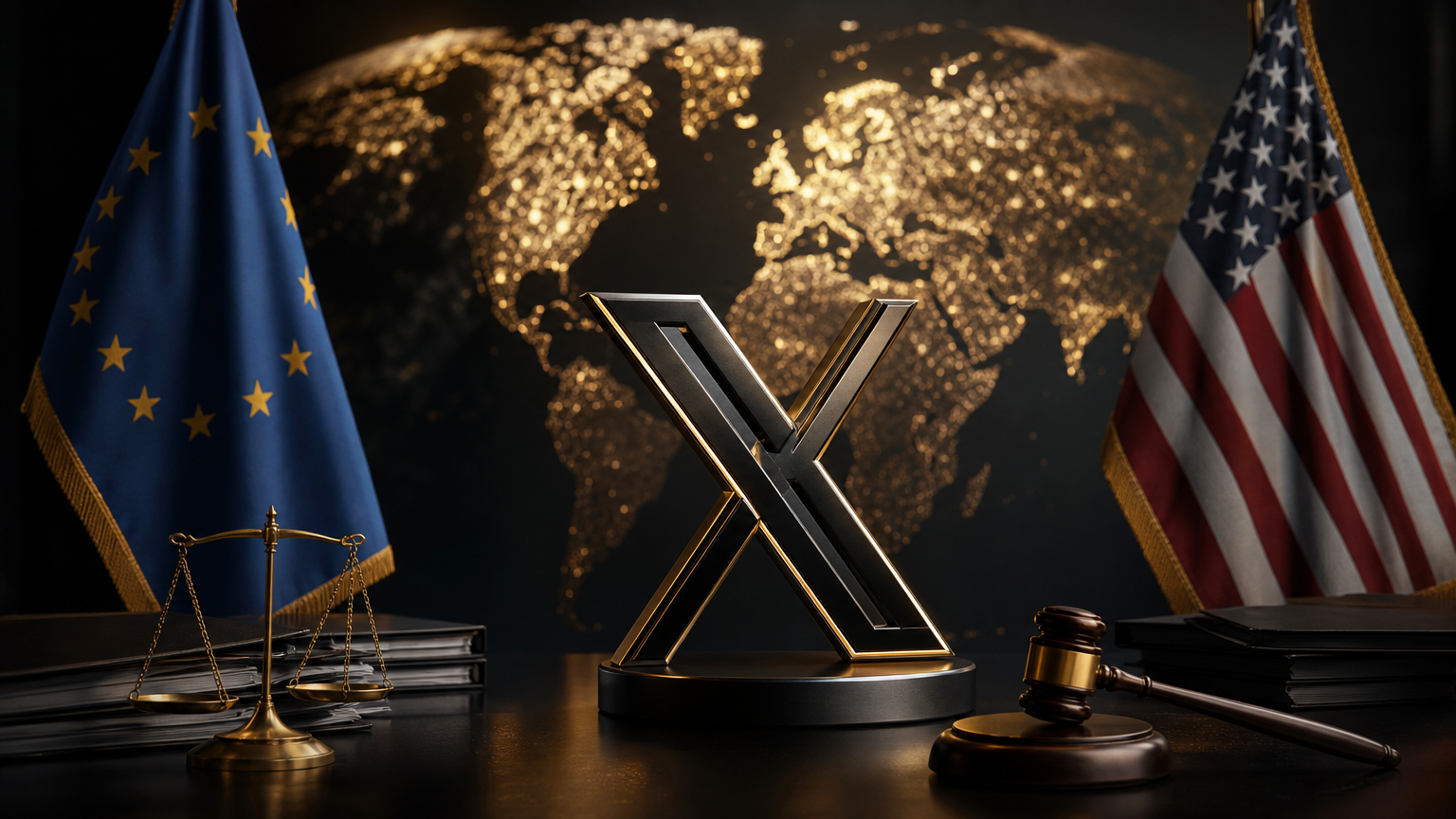
A platform penalty becomes a diplomatic case
The dispute over X’s European fine is no longer just a fight between a regulator and a social network. On September 24, 2026, the U.S. Justice Department said it had filed an application to intervene before the General Court of the Court of Justice of the European Union in support of X Internet, X Holdings and Elon Musk, who are seeking to annul the European Commission’s December 5, 2025 decision under the Digital Services Act . The Commission’s decision imposed a €120 million fine jointly and severally, based, according to the Justice Department, on the worldwide annual turnover of the single economic unit ultimately controlled by Musk or X Holdings .
That is why the headline numbers have appeared in two currencies and with slightly different emphasis. The formal EU penalty is €120 million; Reuters converted it at the time to about $136.51 million, explaining why some accounts rounded the fight to a $137 million case . The legal fight, however, is about more than the size of the bill. It is about whether Brussels can define the responsible “provider” of X in a way that reaches Musk personally and potentially other U.S.-based entities connected to him .
The U.S. filing turns a landmark EU platform enforcement action into a transatlantic technology-policy dispute. Assistant Attorney General Brett Shumate argued that the Commission had “inappropriately attempted to expand its regulatory authority” toward American companies not present or operating within its jurisdiction, and said Washington would not tolerate what it views as regulatory overreach against U.S. innovation . The Justice Department also said it coordinated with the State Department because of the implications for U.S.-EU relations and U.S.-headquartered digital-services businesses .
What the EU says X did wrong
The Commission’s underlying case was framed as a transparency case under the DSA, not simply as a content takedown dispute. Current reporting on the court fight says the Commission found that X broke transparency rules through its paid blue-checkmark system, its advertising database and its limits on researchers’ access to public data . Dow Jones similarly reported that the December 2025 ruling cited deceptive practices around blue checkmarks, a lack of transparency in X’s advertising repository and failure to provide public data to researchers .
That matters because the political vocabulary around the case has been sharper than the legal allegations. The Trump administration and parts of the U.S. tech industry have cast the DSA as a censorship tool, while the EU rejects that characterization . The fine at issue here, as described in the current accounts, centers on transparency obligations, platform design and data access, even though the broader DSA also requires large platforms to address illegal and harmful content .
The Digital Services Act fully took effect in 2024 and can carry penalties of up to 6 percent of a company’s global annual turnover for violations . The X fine was the first penalty ever issued under the DSA, giving the case outsized symbolic weight for both Brussels and Washington . If the General Court upholds the Commission’s approach, the ruling could become a reference point for how EU authorities calculate liability and define the relevant corporate perimeter for very large online platforms .
Washington’s argument: jurisdiction and the corporate veil
The Justice Department’s most consequential claim is not merely that the fine is high. It is that the Commission’s method risks piercing corporate separateness in a way Washington sees as incompatible with territorial jurisdiction and the “corporate veil” principle . In the department’s framing, the Commission extended scrutiny to Musk as a private individual and implicated separate American corporate entities under his ownership, even though those entities were not connected to the digital service at issue .
That argument is built for a wider audience than X. The Justice Department said the Commission’s approach, if upheld, may have significant implications for very large online platforms and similar digital-services businesses operating in the EU, many of which are domiciled at parent level in the United States . In practical terms, Washington is warning that the X case could become a template for future European enforcement against American technology groups.
The intervention request also has a procedural layer. Article 40 of the Statute of the Court of Justice of the European Union allows a state or other party to intervene when it can establish an interest in the result of a case, according to the Justice Department’s announcement . The General Court must still decide whether to admit the United States into the case . Until then, Washington is an applicant seeking to be heard, not yet a formal participant in the merits phase.
Brussels’ position: neutral rules, European standards
The European Commission’s public line, as reported by Reuters, is that EU laws do not target any nationality and that Brussels is defending digital and democratic standards it considers a benchmark for the rest of the world . That is the core of the EU’s response to U.S. claims of anti-American targeting: the DSA applies according to platform conduct and EU market impact, not the nationality of a platform’s owner.
The Commission also appears prepared for litigation. When X appealed, the Commission told AFP it was ready to defend its decision in court . That posture is important because Brussels has invested political capital in the DSA as a global model for platform accountability. A retreat in the first major DSA fine would weaken the credibility of the law just as regulators are trying to show that it can move from investigation to enforcement.
At the same time, the case has already produced compliance consequences. AFP reported that X filed its appeal in February 2026 while also moving to comply with the Commission’s decision . In July, the Commission accepted X’s plan to remedy the violations, including broader researcher access to data such as advertising information, with changes subject to an independent audit . X had also relabeled its blue checkmarks as “premium” rather than “verified,” according to AFP’s account .
Why other U.S. platforms are watching
The X case is a test case because it combines several issues that matter to every large platform operating in Europe: who the EU can hold liable, how global turnover is calculated, how far data-access duties extend and whether compliance reforms can coexist with a court challenge. The Justice Department’s statement explicitly links the case to the position of U.S.-headquartered digital-services companies more broadly .
Reuters noted that Europe’s crackdown on Big Tech has been criticized by President Donald Trump’s administration, which alleges that EU rules single out American companies . The Commission, in contrast, says the rules do not target nationality . Between those positions lies the operational reality for platforms: if they serve EU users at scale, they are likely to face EU transparency, risk-management and data-access duties, regardless of where their parent company is based.
The diplomatic stakes rose further because the case now sits in a wider pattern of U.S. pushback against foreign platform regulation. AFP reported that Trump called the fine “censorship” and that, a few weeks later, the U.S. State Department announced sanctions on five people, including former EU commissioner Thierry Breton . Whether courts treat those political signals as irrelevant background or as evidence of a broader policy confrontation, they have made the dispute harder to treat as routine administrative litigation.
The next step
The immediate legal question is narrow: will the General Court let the United States intervene? The broader question is much larger: whether the EU’s new platform rulebook can survive not only corporate appeals but direct resistance from the U.S. government.
If Washington is admitted, the court will hear a sovereign argument about jurisdiction, corporate separateness and the extraterritorial effect of EU platform enforcement. If it is not admitted, the U.S. intervention request will still have served a political purpose by signaling that American officials are prepared to defend U.S. platforms in European courts when they believe Brussels has gone too far.
For X, the fine is a financial and reputational challenge. For the EU, it is a test of whether the DSA can be enforced against one of the world’s most politically visible platforms. For the United States, it has become a line-drawing exercise over where European digital sovereignty ends and perceived extraterritorial regulation begins. The terms of service have become diplomacy by other means.
Sources from the last 72 hours
- [1]Office of Public Affairs | United States Files Request to Intervene in Case Brought by X Corp. and Elon Musk Seeking to Annul Decision by European Commission | United States Department of JusticeSep 24, 2026, 12:00 AM UTC
- [2]US government seeks to join Elon Musk in challenge against EU's fine on XSep 24, 2026, 8:10 PM UTC
- [3]US seeks to join Musk's fight against EU fineSep 24, 2026, 10:20 PM UTC
- [4]US asks EU court to let it back Musk’s challenge to €120M X fineSep 25, 2026, 6:44 AM UTC
- [5]U.S. Files to Intervene With E.U. Decision on X, Elon MuskSep 24, 2026, 8:41 PM UTC
AI-generated article based on recent web research, then preserved as a dated editorial snapshot.
Comments
Be the first to comment.