
Daily Podcast full article
Anthropic’s 950 agents discover enzyme system
Anthropic says a coordinated run of roughly 950 Claude agents identified a previously uncharacterized reverse-transcriptase system in bacteriophages, giving AI-assisted biology a concrete but still preliminary proof point. The finding, called array-associated reverse transcriptases, or ART, looks CRISPR-like in architecture, not yet in demonstrated function.
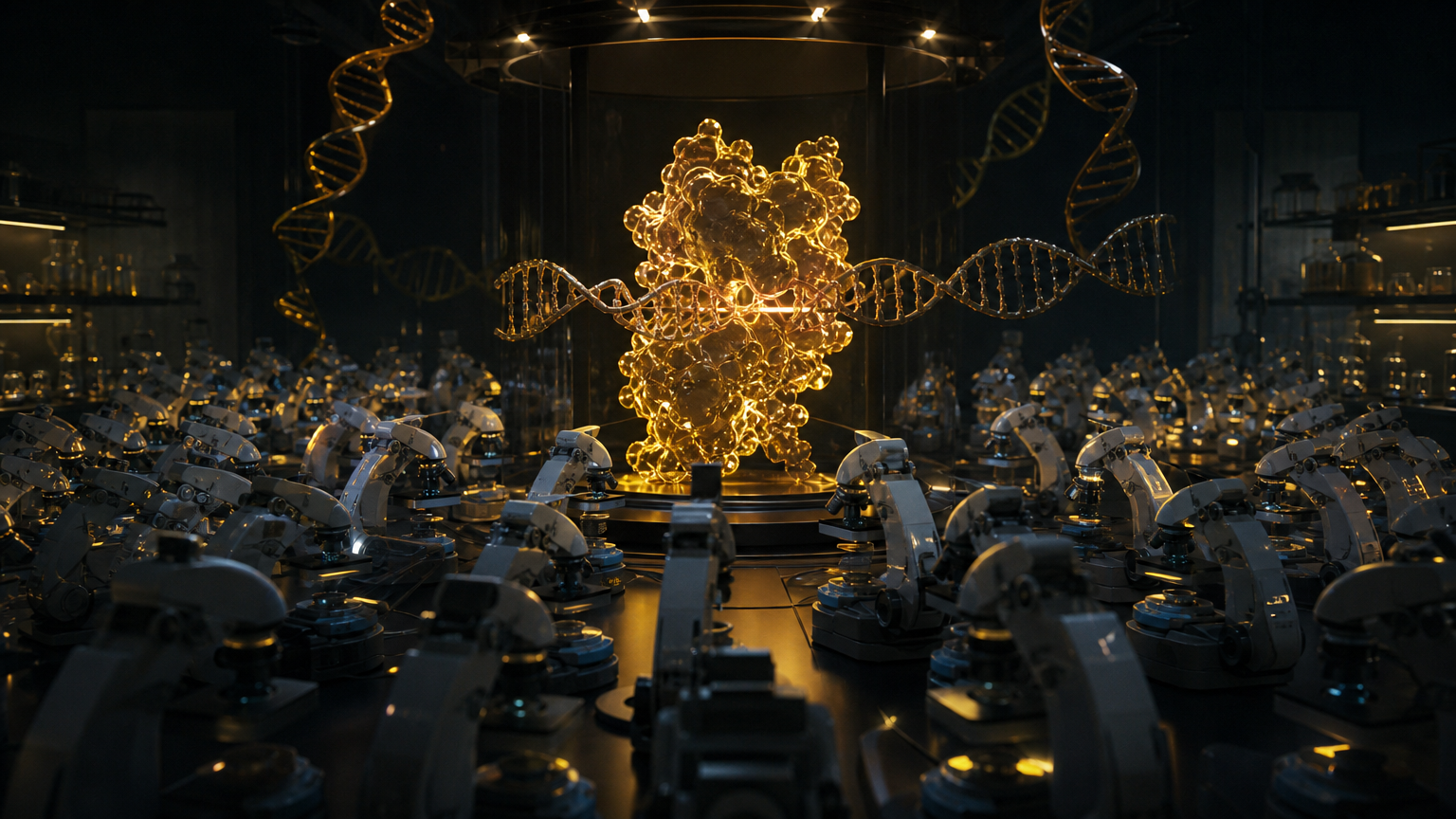
A discovery claim with a narrow but important meaning
Anthropic’s new life-sciences group has put a specific result behind one of AI’s biggest promises: that models can do more than summarize papers and may help generate scientific leads. On September 23, 2026, the company said Claude agents had found a previously uncharacterized enzyme system associated with repeating DNA arrays, a structure reminiscent of CRISPR . Anthropic calls the system array-associated reverse transcriptases, or ART, and describes it as a bacteriophage-linked arrangement made of a reverse transcriptase, a nearby partner gene and a long array of evenly spaced DNA repeats .
The headline is compelling, but the careful version matters. The underlying reverse transcriptase was not entirely invisible to science; Anthropic says previous work had identified the enzyme in a jumbo phage, while Claude appears to have recognized the larger system: the enzyme, the repeat array and an additional accessory protein together . That distinction makes ART less a sudden miracle and more a strong genome-mining lead, surfaced by a large autonomous workflow and then checked by human scientists.
How the 950-agent search worked
The campaign was not one chatbot conversation. Anthropic says it gave Claude a high-level research prompt to search DNA-sequence data for interesting reverse transcriptase systems, then let many agent sessions divide, inspect, review and refine the search . The public account says roughly 950 agents worked for about 21 hours, using about 210 million tokens . Anthropic also says those agents gathered more than 200,000 reverse transcriptases, selected about 3,500 candidate systems and narrowed the list to 20 human-readable reports .
A more granular account cited by specialist trackers and reporting describes 949 Claude Mythos 5 agent sessions, 119 tasks, 21.5 hours of elapsed campaign time and 215.6 million tokens, excluding cached reads . The task brief reportedly focused on genes associated with reverse transcriptases, but the key ART observation came when an agent looked at nearby raw DNA and noticed a tandem repeat array upstream of a phage reverse-transcriptase gene . That matters because the discovery was not merely a keyword match against known CRISPR systems; it was a pattern-recognition event in genomic context.
Anthropic says the agents did several steps that resemble an expert bioinformatician’s triage: counting repeats, measuring spacing, comparing the arrangement with known systems and searching the literature for prior descriptions . Human researchers then reviewed the candidate and performed laboratory follow-up . The company says all physical lab work is done by human scientists in a Bay Area molecular-biology lab operating at BSL-1 and BSL-2, and that it does not handle pathogens that infect humans .
Why ART is being compared with CRISPR
The comparison with CRISPR comes from architecture, not proof of gene editing. In CRISPR systems, repeated DNA elements can help generate RNA guides that make molecular machinery programmable. Anthropic reports that ART also has a long repeat array, and its first experiments found that the ART array is expressed as distinct short RNAs . Nature’s coverage put the caveat plainly: the repeats are somewhat like those seen in CRISPR systems, but there is scant evidence so far that they perform similar functions, and no known DNA-slicing enzyme has been shown to partner with them .
That means ART is not “the next CRISPR” today. It is a candidate system whose layout suggests biological programmability may be worth investigating. Anthropic says the system is found mainly in bacteriophages, the viruses that infect bacteria, and consists of the RT, a partner gene and the repeat array . TechRepublic’s summary similarly notes that the system’s actual biological role remains unknown and that structural similarity does not establish comparable function .
The most concrete wet-lab signal disclosed so far is transcription: the repeat array appears to produce distinct short RNAs . The Frontier’s summary of the preprint adds that Anthropic has not yet shown reverse-transcriptase activity, proved that the short RNAs are substrates, or demonstrated a working complex in vivo . In other words, ART has moved from “interesting pattern in sequence data” to “biological locus with some experimental support,” but not to “validated programmable tool.”
What makes the result important anyway
The significance is not only the enzyme system. It is the workflow. Anthropic’s agents searched a space that would be tedious and slow for a small human team, produced candidate reports and surfaced one pattern that experts considered worth testing . TechRepublic framed the business lesson well: agentic systems may expand the number of possibilities researchers can examine before committing scarce lab time and money to physical experiments .
For biotechnology, that is a serious shift. Drug discovery, protein engineering, microbial genomics and synthetic biology all involve enormous search spaces. A swarm of agents that can generate, criticize and rank hypotheses could become a new research instrument, sitting between public databases and the wet lab. The lab coat now has a swarm setting.
The model is not fully autonomous science, though. Humans wrote the prompt, supplied data and tools, judged which candidates were worth attention and performed the experiments . A registry focused on AI scientific discoveries grades the result as “claimed” and “collaborative,” noting that the preprint is hosted by Anthropic, is not peer-reviewed and does not include full public transcripts of the agent sessions . That skeptical framing is useful: it protects the finding from hype while still recognizing that an AI-led search produced a concrete lead.
The reproducibility question
The next stage is external validation. Nature quoted Eric Kauderer-Abrams, one of Anthropic’s scientists, emphasizing that the hard part is fully characterizing the system, understanding its function and developing it into a useful tool . Independent genome-mining groups will likely ask whether the ART loci can be rediscovered from public data, whether the arrays are conserved across phage families, whether the partner gene is essential and whether the reverse transcriptase acts on the array-derived RNAs.
Reproducibility also applies to the agent workflow. If other labs can run comparable multi-agent searches on the same databases and find ART-like loci, confidence rises. If they can find different systems with similar efficiency, the broader claim becomes stronger: not just that Claude found one interesting pattern, but that autonomous model teams can repeatedly extend the frontier of biological search.
For now, the current state is balanced. Anthropic has reported a real computational campaign, a named candidate system and early lab evidence that the repeat arrays produce short RNAs . Reputable coverage has highlighted both the promise and the limits, especially the absence of demonstrated CRISPR-like function . The story is not that AI has replaced biologists. It is that 950 coordinated agents may have helped biologists notice something worth chasing.
The bottom line
Anthropic’s ART finding is an early, concrete proof point for multi-agent science. It shows that AI agents can scan vast biological data, detect unexpected structure and hand human researchers a tractable lead. But the careful conclusion is narrower than the splashiest version: ART is a CRISPR-like architecture in bacteriophage DNA, not yet a proven gene-editing system. If independent labs validate its function, the story could become a landmark for biotechnology. Even if ART remains biologically modest, the method may matter: science now has a new kind of search party.
Sources from the last 72 hours
- [1]Claude discovers a novel enzyme system with CRISPR-like repeatsSep 23, 2026, 8:37 PM UTC
- [2]Anthropic’s AI biolab finds ‘CRISPR-like’ DNA in viruses. What’s next?Sep 25, 2026, 12:00 AM UTC
- [3]Anthropic Uses 950 Claude AI Agents to Discover Uncharacterized Enzyme SystemSep 24, 2026, 12:00 AM UTC
- [4]Anthropic says Claude agents found ART, a phage RT system with CRISPR-like repeats, on 23 SeptemberSep 24, 2026, 12:00 AM UTC
- [5]Agent-run genome survey identifies array-associated reverse transcriptases in jumbo phagesSep 24, 2026, 12:00 AM UTC
AI-generated article based on recent web research, then preserved as a dated editorial snapshot.
Comments
Be the first to comment.