
Daily Podcast full article
SpaceX launches classified USSF-385 payload
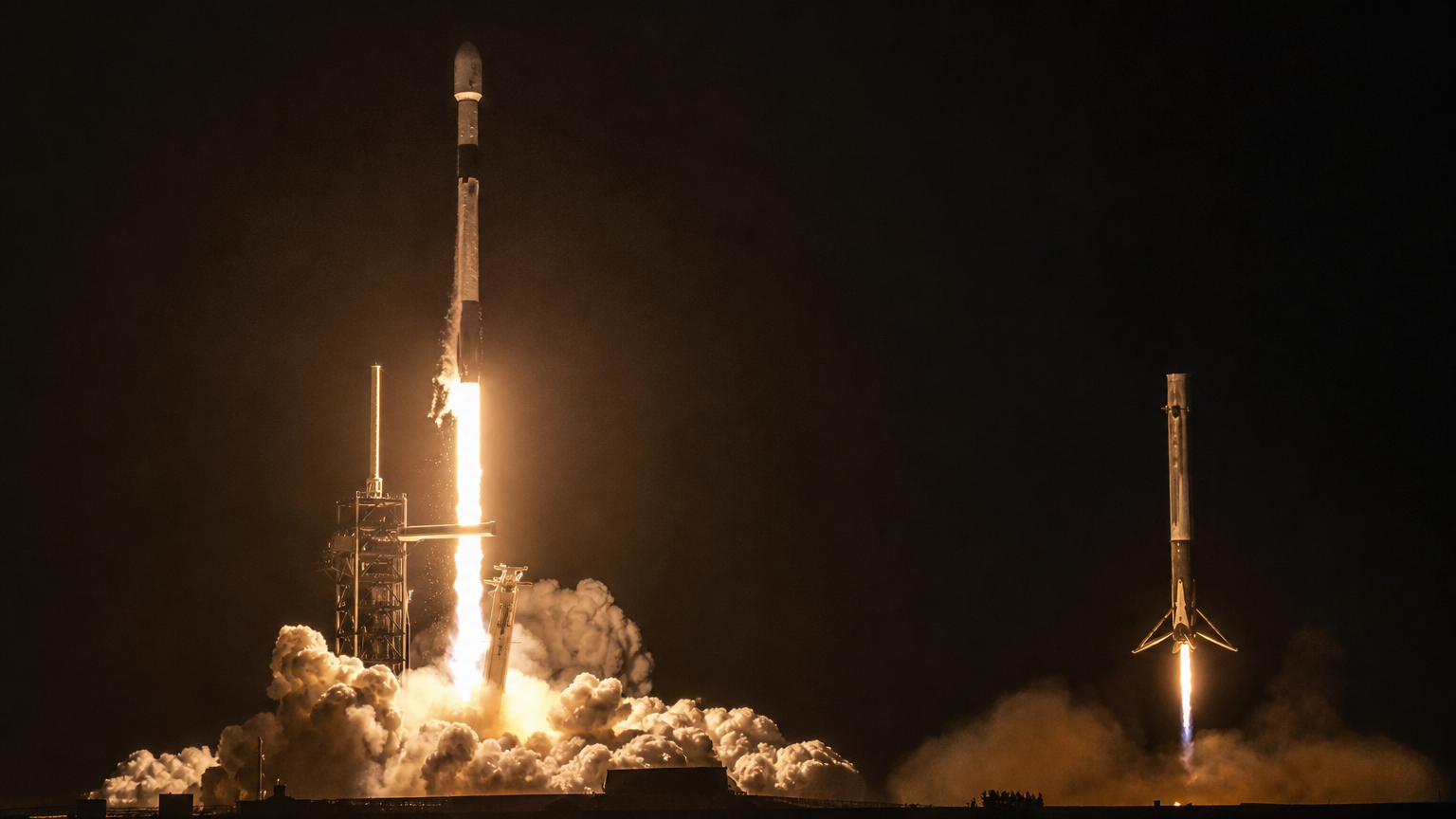
SpaceX’s Falcon 9 lifted the classified USSF-385 mission from Vandenberg Space Force Base for the U.S. Space Force, then landed booster B1100 on the drone ship Of Course I Still Love You after its tenth flight. The payload remains officially undisclosed, but the cadence, trajectory clues and recent satellite cataloging keep attention focused on a suspected Starshield-linked national-security buildout.
A secret payload, a very public launch cadence
SpaceX launched the classified USSF-385 mission from Space Launch Complex 4 East at Vandenberg Space Force Base on Saturday morning, sending a Falcon 9 south through dense coastal fog at 7:00:54 a.m. Pacific time, or 14:00:54 UTC . The customer was the U.S. Space Force, and the destination was described by launch-tracking sources as low Earth orbit for a government or top-secret mission .
The spacecraft, or spacecraft stack, was not publicly identified. That was not a surprise. Local reporting ahead of the launch said payload details had not been publicly provided and were likely classified, consistent with previous Space Force missions from the same range . Spaceflight Now reported that SpaceX did not show views of the payload or the Falcon 9 second stage at the customer’s request, and Teslarati likewise noted that the livestream ended shortly after the booster landing, which is standard for classified payloads .
The visible part of the mission was still significant. Falcon 9 booster B1100 separated from the upper stage and landed on the drone ship Of Course I Still Love You roughly eight and a half minutes after launch . SpaceLaunchNow’s mission page listed the same booster and drone ship pairing and recorded a successful autonomous spaceport drone ship landing after B1100’s tenth flight .
What we know, and what remains hidden
USSF-385 is best understood as a national-security launch whose official public facts stop early. The rocket, pad, customer, launch time and booster recovery are known; the payload’s exact purpose is not. That gap is the story. The Space Force and SpaceX disclosed enough for public safety, launch operations and livestream coverage, but not enough to identify the spacecraft, its operators, its final orbit in detail or its mission design.
That pattern fits the recent run of classified or semi-classified U.S. military launches from Vandenberg. Spaceflight Now reported that USSF-385 is thought to be the third flight in a series deploying satellites based on Starshield, SpaceX’s government-focused version of the Starlink architecture . Teslarati framed the mission as another secret Pentagon launch adding to a suspected Starshield buildout, while making clear that the payload remains officially unidentified .
The suspicion rests on cadence and context rather than on a public manifest. According to Spaceflight Now, USSF-366 launched from Vandenberg on August 15 and USSF-153 followed on September 10, with the Space Force cataloging 23 satellites after each of those missions . A related classified mission, USSF-259, launched on September 17 and appeared to place 17 satellites into a different orbital plane . Teslarati described USSF-385 as the fourth Space Force launch from the same Vandenberg pad in roughly six weeks, following USSF-366, USSF-153 and USSF-259 .
That is not proof of Starshield on USSF-385. It is, however, a strong circumstantial pattern: repeated launches from the same West Coast pad, secrecy around payloads, low-Earth-orbit profiles, and previous satellite counts consistent with batch deployments. For readers, the most honest formulation is therefore “suspected Starshield buildout,” not “confirmed Starshield deployment.”
Why the tenth flight matters
The booster may be the least secret part of the mission, and the most revealing one economically. B1100 flew for the tenth time and landed successfully for the tenth time . KEYT reported before launch that this would be the booster’s tenth flight and that it had previously supported NROL-95 and eight Starlink missions . Teslarati added that its previous flight was a Starlink Group 15 mission on August 22, only 35 days earlier .
For years, sensitive government payloads were associated with conservative launch practices, including a preference for new hardware or very limited reuse. USSF-385 shows how far the baseline has moved. A classified Space Force mission did not require a fresh first stage; it flew on a booster with nine prior missions behind it and then added a tenth landing to its record .
That does not mean reuse is automatic for every national-security launch. Mission assurance remains case-by-case, and classified payload owners still control many details of flight profile and public coverage. But USSF-385 is a concrete example of a military customer accepting substantial flight heritage when the hardware record supports it. In economic terms, that is the quiet revolution: the classified folder now rides on a rocket stage with a résumé.
Reuse also affects capacity. A booster that can return to service after dozens of days, rather than being discarded, helps SpaceX maintain a tempo that would be far harder with expendable or newly built first stages. Teslarati reported that B1100’s prior flight was only 35 days before USSF-385 . When national-security missions are inserted into that rhythm, the Space Force gains not only launch access but also schedule resilience.
Vandenberg’s role is expanding
USSF-385 also underlines the current importance of Vandenberg’s Space Launch Complex 4 East. The mission departed from SLC-4E, the same pad used for recent Space Force missions in the suspected Starshield sequence . Spaceflight Now reported that USSF-385 was the sixth and final Falcon 9 launch of September from Vandenberg, while only one Falcon 9 flew from SpaceX’s East Coast launch site during the month .
That West Coast emphasis makes operational sense. Vandenberg is well suited for missions that need southerly, polar or high-inclination trajectories over the Pacific. In this case, Spaceflight Now reported that the rocket took a southerly trajectory after leaving SLC-4E . The launch also came with the familiar local impacts: KEYT told residents that sonic booms could be heard in the region depending on weather and other conditions, while the booster would head for a drone ship in the Pacific rather than return to land .
For SpaceX and the Space Force, the pad’s value is not just geography. It is repeatability. SLC-4E supported a rapid sequence of Falcon 9 flights in September, including classified military missions and Starlink work. That creates a launch factory on the California coast: routine enough to turn around quickly, but secure and flexible enough for national-security payloads.
The bigger signal
The immediate headline is simple: SpaceX launched USSF-385 for the U.S. Space Force and recovered the Falcon 9 booster after its tenth flight. The deeper signal is more strategic. The United States appears to be accelerating deployment of secretive low-Earth-orbit military space infrastructure, while leaning heavily on SpaceX’s reusable launch system to do it.
Teslarati reported that the recent cadence aligns with Space Force task orders awarded to SpaceX for Falcon 9 missions from Vandenberg through the end of 2027 and noted that SpaceX also holds contracts to build pieces of the same network . Whether USSF-385 ultimately proves to be part of Starshield, a parallel Space Force architecture or another classified program, the operating model is clear: frequent launches, reusable rockets, limited public disclosure and batch-like deployment patterns.
The secrecy is not incidental. It is part of the mission. But secrecy no longer means rare launches on bespoke rockets that disappear from public view for months. In 2026, even a classified payload can be part of an industrial cadence: livestreamed liftoff, booster landing, restricted second-stage coverage, then silence about what was placed in orbit.
That is what makes USSF-385 notable. It is not only another secret satellite launch. It is a snapshot of how U.S. military space operations are being normalized inside SpaceX’s high-tempo, reusable launch machine.
Sources from the last 72 hours
- [1]SpaceX Falcon 9 launches classified mission for U.S. Space Force from West CoastSep 25, 2026, 12:00 AM UTC
- [2]SpaceX completes another secret Pentagon launch, adding to suspected Starshield buildoutSep 26, 2026, 12:00 AM UTC
- [3]USSF-385 Mission Scheduled for Early Saturday Launch From Vandenberg SFBSep 26, 2026, 12:08 AM UTC
- [4]Falcon 9 Block 5 | USSF-385Sep 26, 2026, 2:01 PM UTC
AI-generated article based on recent web research, then preserved as a dated editorial snapshot.
Comments
Be the first to comment.