
Daily Podcast full article
US and China open AI channel
Washington and Beijing have agreed to create a dedicated channel for AI-related incidents, keep an AI dialogue moving by November 2026, and continue trade and military communications after Xi Jinping’s state visit to Washington. The deal is modest, contested in wording, and far from a technology truce — but for chipmakers, model labs and cloud providers, even a narrow hotline between the two largest AI powers could reduce one layer of geopolitical uncertainty.
A new line in a crowded relationship
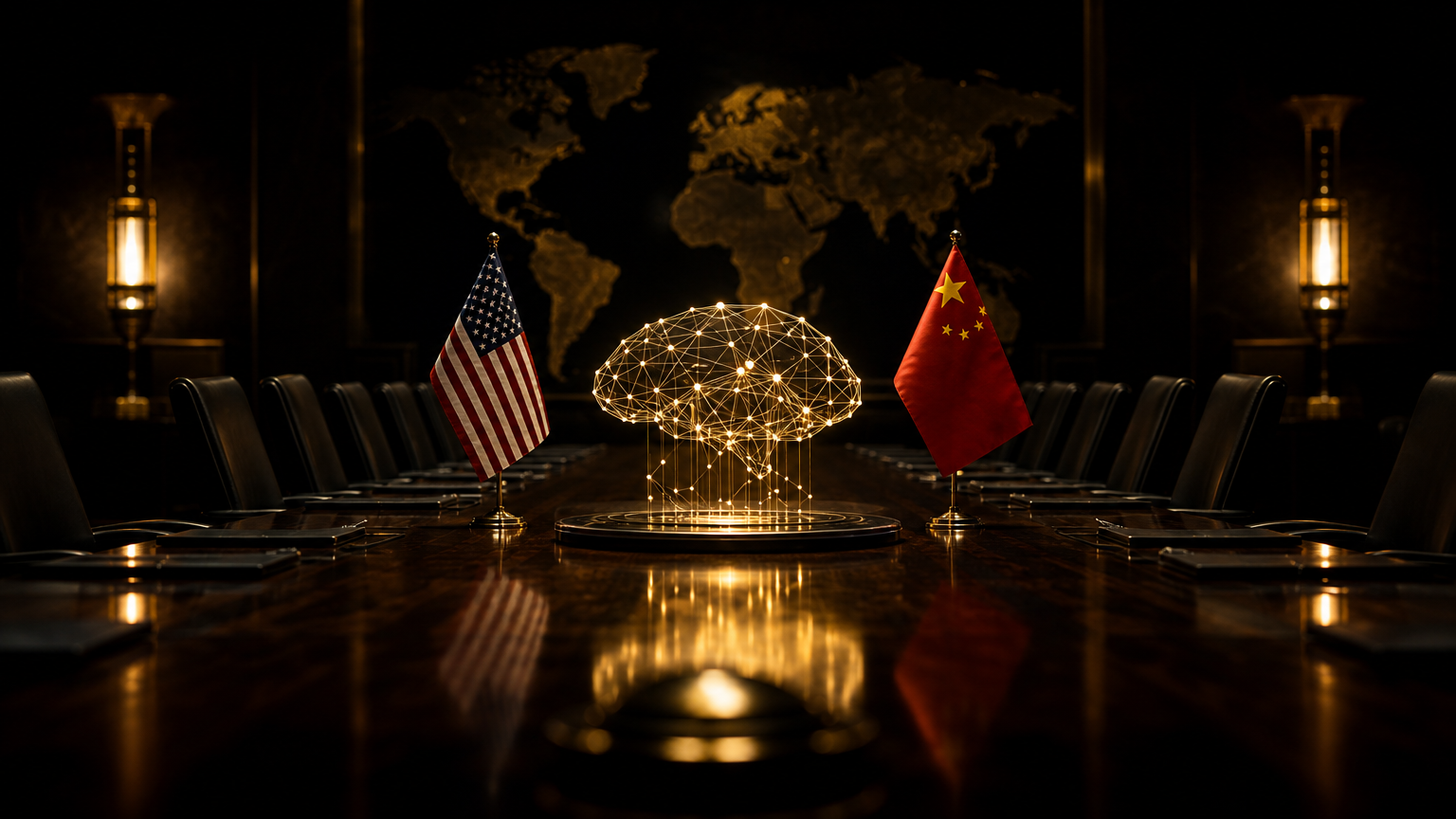
The United States and China have opened a new channel for artificial intelligence safety after a three-day summit in Washington between President Donald Trump and President Xi Jinping, adding AI to a diplomatic menu already crowded with tariffs, rare earths, military risk and regional security . The White House said the two countries established a U.S.-China “Super Intelligence” dialogue to exchange views on risks and benefits and agreed to create a bilateral communication channel for AI-related incidents, with the next exchange to occur by November 2026 . China’s Foreign Ministry, in its readout of the leaders’ talks, framed the issue in more familiar terms: both countries have strong AI capabilities, may compete, but “may cooperate even more,” and should discuss risks and benefits while preventing misuse and abuse .
That difference in vocabulary matters. Washington’s fact sheet says the two leaders agreed to use “super intelligence” rather than “artificial intelligence” for the relevant emerging technologies . Beijing’s English-language statement stayed with “AI,” emphasizing human control, a people-centered approach and the idea that AI should serve human progress . In practice, the same problem sits behind both phrases: the two largest technology powers are trying to build a crisis-management mechanism for systems that are moving faster than most diplomatic institutions.
What was actually agreed
The concrete AI deliverables are limited but not meaningless. The parties agreed to continue a dialogue on AI risks and benefits and to set up a communication mechanism for AI-related incidents . Associated Press reporting described the channel as a way to handle AI-related incidents, while also noting that both sides agreed to accelerate work on military crisis communications after the summit . Reuters, citing China’s Foreign Ministry, reported that the AI dialogue is part of an eight-point consensus reached during Xi’s visit to Washington and that the next round of discussions is scheduled for November .
The narrowness is the point. This is not a common rulebook for frontier models, not an export-control settlement, and not a pledge to stop competing in chips, cloud infrastructure or model deployment. It is closer to a diplomatic circuit breaker: a place to clarify events before they become accusations, sanctions or military signals. For example, an AI-related cyber incident, a deepfake targeting a leader, a model-enabled biosecurity scare, or a malfunction in a military decision-support system could now have a designated channel for urgent discussion. None of the public readouts says the channel will be binding, transparent or open to companies, but the existence of a venue can still matter when mistrust is high.
Tariffs: agreement, but with careful wording
The AI channel was bundled with trade language that both sides presented as progress, though the wording differs across sources. The White House said that, under the Board of Trade, the two countries reached consensus on recommendations for more favorable tariff treatment for 30 billion dollars of non-sensitive goods in each direction . It listed U.S. export categories including agricultural goods, fish and seafood, logs and wood products, cosmetics and medical devices, and U.S. import categories such as small appliances, toys, holiday decorations and children’s car seats . Reuters reported the same package more directly as a 30 billion dollar reciprocal tariff-reduction arrangement .
That gap between “recommendations” and “arrangement” is worth watching. The White House language suggests implementation still depends on follow-through by the new trade mechanisms, while Reuters and the Chinese-side description present the tariff element as an agreed result . AP reported that both sides will continue to work on the pledge to reduce reciprocal tariffs on roughly 30 billion dollars of goods and that the leaders extended a trade truce by two months . In other words, this is a partial easing track, not the end of the trade war.
The economic context is broader than tariffs. The White House said the two countries operationalized a U.S.-China Board of Trade and a Board of Investment, with the investment board intended to discuss opportunities, impediments and commercially meaningful issues . It also said Washington and Beijing would continue working on U.S. concerns over rare earth and critical-mineral supply, aiming to return shipments to appropriate levels . AP noted that China had imposed rare earth export controls last year in response to U.S. tariffs, cutting supply to the United States and other countries .
Why AI companies should care
For chipmakers, model labs and cloud providers, the new AI channel does not remove the biggest constraints: U.S. export controls, Chinese localization requirements, data-security rules, procurement politics and the constant possibility of retaliation remain. But it may reduce a different risk: policy surprise. When Washington and Beijing have no reliable venue to discuss an incident, companies can become collateral damage in a political escalation. A formal channel gives officials a place to ask whether an event was deliberate, accidental, commercial, criminal or state-directed.
The AI supply chain is tightly coupled across hardware, software, energy, talent and customers. Advanced semiconductors may be designed in one jurisdiction, fabricated in another, packaged in a third and deployed in data centers serving global clients. Foundation models can be trained in one regulatory environment and used in another through open-source releases, cloud APIs or downstream applications. That interdependence makes complete technological separation costly, even when national-security policy pushes in that direction.
The agreement also gives companies a signal about the next policy frontier. Governments are no longer only debating who gets access to the most advanced chips. They are also debating what happens when AI systems create cross-border harm, when generated media affects diplomacy, or when automated tools are used in military and cyber contexts. If the U.S.-China channel produces even informal expectations about incident notification, terminology, or escalation thresholds, private AI governance teams will have to track those norms closely.
Military communication is the harder test
The AI channel is linked politically to military crisis management. AP reported that the two sides agreed to sign a memorandum of understanding on strengthening crisis communications and preventing crises between the two militaries, while noting that the Chinese statement was light on details . China’s Foreign Ministry said the leaders discussed major international and regional issues including the Middle East, Ukraine and the Korean Peninsula, and that they agreed to support each other’s hosting of the 2026 APEC Economic Leaders’ Meeting and the G20 Summit . The White House also said both leaders intend to attend each other’s summit, and that they discussed Iran, international waterways and arms-control issues .
This matters because AI risk is not only a consumer-technology issue. The most dangerous scenarios involve misinterpretation, automated analysis, decision-support tools, cyber operations and military command environments. If each side believes the other is using AI to compress decision times or hide escalation, a hotline on “AI incidents” will be useful only if it connects to broader military-to-military channels. The summit’s military language is therefore as important as the AI wording.
A modest opening, not a reset
The summit did not erase the strategic rivalry. AP reported that it produced no major breakthroughs on fundamental differences, even as analysts described the incremental steps toward working-level engagement and crisis-management mechanisms as noteworthy . That is the right frame. The two governments are not converging on a shared vision of technology governance. They are acknowledging that unmanaged competition in AI could become too dangerous, too expensive or too unpredictable.
The most immediate test is procedural. By November 2026, officials are expected to hold the next AI or “super intelligence” exchange . Before then, markets and governments will look for details: who participates, whether military and civilian agencies both have seats, whether the incident channel is always available, and whether companies will be consulted. The tariff process also needs concrete implementation, because a 30 billion dollar easing package has limited value if it remains trapped in bureaucratic language .
Diplomacy has opened a new chat window. The question is whether Washington and Beijing will keep notifications on when the next AI incident arrives.
Sources from the last 72 hours
- [1]Fact Sheet: President Donald J. Trump Advances a Fair and Reciprocal Relationship with China While Hosting Historic State VisitSep 25, 2026, 4:00 AM UTC
- [2]President Xi Jinping Holds Talks with U.S. President Donald J. TrumpSep 24, 2026, 11:50 PM UTC
- [3]China and the US agree to set up a new AI safety channel, and to keep talking on trade, militarySep 26, 2026, 10:55 AM UTC
- [4]China, US agree to $30 billion tariff cut, AI dialogue during Xi visit, Beijing saysSep 26, 2026, 10:48 AM UTC
AI-generated article based on recent web research, then preserved as a dated editorial snapshot.
Comments
Be the first to comment.