
Daily Podcast full article
AI infrastructure bill hits $1.2T
Goldman Sachs has put a new price tag on the AI buildout: the five largest U.S. hyperscalers could spend $1.2 trillion on AI infrastructure in 2027. In South Korea, a parallel warning is landing at the chip level, with analysts projecting a KRW 1,200 trillion data-center AI semiconductor market by 2030 and saying the next three to five years may decide whether Korean firms remain suppliers or become platform contenders.
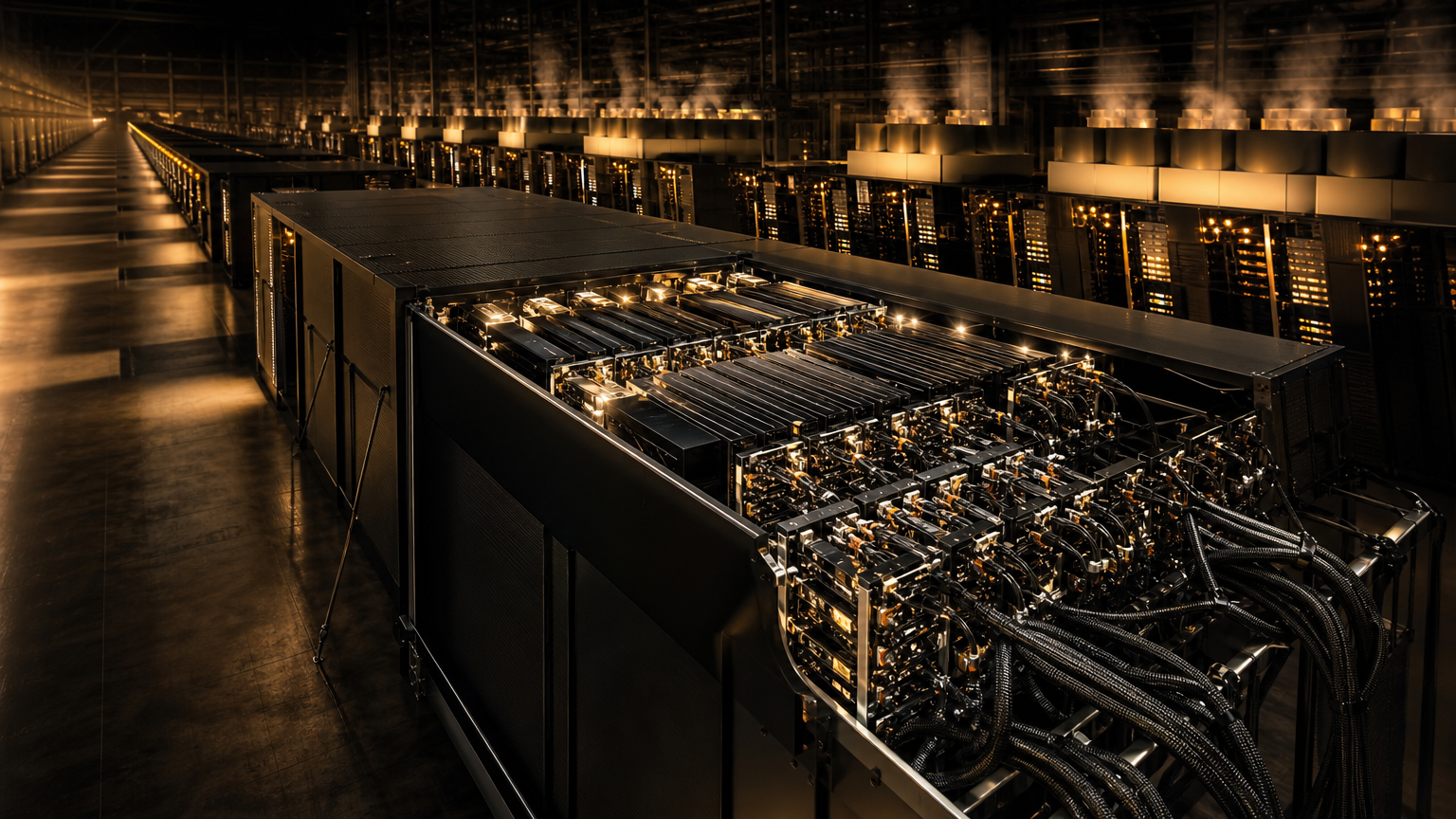
The trillion-dollar number has moved from metaphor to model
The AI infrastructure story has entered a more concrete phase. It is no longer only about model launches, benchmark jumps or chatbot adoption. The latest market signal is a Goldman Sachs forecast that the five largest U.S. hyperscalers will lift AI infrastructure spending by more than half next year to $1.2 trillion in 2027, above Wall Street’s $1.1 trillion consensus estimate .
That figure matters because it turns the AI cycle into a balance-sheet event. The spending is not a single line item for “AI.” It is a stack: accelerators, memory, servers, networking, data-center shells, power gear, cooling systems, land, leases and long-dated supply agreements. In practical terms, the industry is buying an industrial base for machine intelligence before it has fully proven the revenue base that will pay for it.
The Goldman estimate covers the biggest U.S. cloud and platform operators, including Amazon, Alphabet, Microsoft, Oracle and Meta, according to reporting on the note . Those companies are not experimenting at the margin. They are reshaping capital allocation around compute availability, because in the current market, the ability to offer capacity can determine which AI developers, enterprises and governments become locked into a cloud ecosystem.
From $800 billion to $1.2 trillion, then $1.4 trillion
The current run-rate is already extraordinary. The largest U.S. hyperscalers are described as being on track for about $800 billion of capital expenditure this year, up 94% from 2025, before rising to $1.2 trillion in 2027 and $1.4 trillion in 2028 . The growth rate slows after 2027, but the base becomes so large that even a slower increase implies another massive wave of equipment, construction and energy demand.
The implication is simple: AI infrastructure is not a normal upgrade cycle. It is becoming a macro variable. Goldman’s team reportedly framed the 2027 figure as a larger share of GDP than any technological investment cycle since the railroad buildout of the late 1800s . That comparison is useful not because the businesses are identical, but because both cycles required vast upfront fixed investment before the final economics were visible.
This is the crucial tension. Cloud providers are spending as if future AI demand will be enormous and sticky. Investors are asking whether the depreciation clock will start ticking faster than the revenue flywheel spins. Hardware gets bought now; depreciation and financing costs follow; customer workloads must arrive later at prices high enough to justify the sunk capital.
The break-even bar is becoming visible
Goldman’s analysis does not only raise the spending estimate. It also gives the market a revenue threshold to watch. The bank’s strategists said the hyperscalers would need roughly $300 billion in annual AI revenue in coming years just to break even on the infrastructure outlay .
That number is important because cloud revenue and AI revenue are not the same thing. General cloud growth can look strong while the incremental AI return remains harder to isolate. The question is whether AI workloads are genuinely expanding the profit pool or merely forcing cloud providers to spend more capital to defend existing customers.
A detailed market analysis of second-quarter filings shows how tight the cash-flow math is becoming. Amazon, Alphabet and Meta together spent $129.2 billion on property and equipment in the three months to June, equal to 111.1% of their combined operating cash flow, up from 82.9% a year earlier . In other words, at least for those companies in that quarter, physical infrastructure spending outran the cash generated by operations.
The same analysis calculated that Amazon’s property and equipment purchases reached $54.2 billion against $45.4 billion of operating cash flow, while Alphabet spent $44.9 billion against $39.1 billion of operating cash flow . Meta remained closer to balance, spending $30.1 billion against $31.9 billion in operating cash flow before finance lease payments . These figures do not mean the companies are weak; they mean the AI buildout is large enough to change how even the strongest balance sheets behave.
Why chips are the pressure point
If the hyperscaler bill is the demand-side number, the semiconductor market is the supply-side battlefield. A South Korean market outlook published on September 27 said the data-center AI semiconductor market could expand from $124 billion in 2024 to $860 billion, or about KRW 1,200 trillion, by 2030, implying an average annual growth rate of 38% .
That projection frames the next stage of competition. Memory remains essential, and Korea’s strength in high-bandwidth memory is strategically valuable. But the value chain is shifting toward complete accelerator platforms: GPUs, NPUs, custom ASICs, advanced packaging, networking, software libraries and customer integration. In that environment, selling memory into someone else’s platform is not the same as controlling the platform.
The Korean analysis warns that the next three to five years could become a survival window for domestic companies because the global AI semiconductor supply chain may become much more fixed during that period . Once large cloud buyers standardize around specific chips, software stacks and deployment tools, late entrants face not only technical barriers but ecosystem lock-in.
Nvidia’s dominance, Korea’s opening
The Korean report underlines the scale of the incumbent advantage. Nvidia held 78.2% of the data-center AI semiconductor market last year, ahead of Google at 4.7%, AMD at 4.1%, Intel at 3.7% and Huawei at 2.6% . NewDaily’s coverage of the same outlook adds that Nvidia’s share in data-center GPUs exceeds 90%, reinforcing the point that GPU dominance is both a hardware and software phenomenon .
Yet the report also identifies a possible opening: inference. As AI usage shifts from training large models to serving them repeatedly in real products, cost per query, power efficiency and availability become more important. Neural processing units, or NPUs, are being positioned as lower-cost, lower-power alternatives for inference workloads, and Korean companies are targeting that niche .
FuriosaAI and Rebellions are cited as domestic players moving second-generation NPU products toward commercialization, with FuriosaAI beginning mass production of its Renegade chip earlier this year and Rebellions expected to launch REBEL 100 in the second half . That is not yet a challenge to Nvidia’s full-stack dominance, but it is a sign that the market may not be one-dimensional if inference architectures diversify.
The missing piece is not only technology
The Korean warning is not that local firms lack engineering talent. It is that chip performance alone rarely wins a data-center market. The report says Korean companies have secured chip-design capabilities but remain more than three years behind global leaders in capital strength, customer acquisition, software ecosystems and real data-center deployment experience .
That distinction is central. A cloud operator buying AI silicon is not just buying a chip. It is buying uptime, developer tools, compilers, drivers, thermal predictability, supply assurance and a roadmap. If one of those layers is weak, the buyer’s operational risk rises. This is why the recommendation is not only more R&D funding, but market-entry support: tax incentives or subsidies for companies that adopt domestic AI semiconductors, early demand creation and government-to-government help for Korean suppliers trying to enter overseas data-center supply chains .
The Middle East is specifically described as a potential target market as regional AI infrastructure investment rises and buyers look for alternatives amid U.S. export-control risk, high Nvidia GPU prices, and constraints around power and land . That does not guarantee Korean wins, but it shows where a non-Nvidia supplier could find customers willing to diversify.
The same story, seen from two ends
The Goldman and Korean forecasts are not separate stories. They describe the same AI infrastructure bill from opposite ends. Goldman’s $1.2 trillion figure shows how much the biggest buyers may spend to secure compute. Korea’s KRW 1,200 trillion semiconductor-market outlook shows why every chip ecosystem wants a larger role in supplying that compute.
The core question is whether AI demand compounds fast enough to validate the buildout. If it does, the winners are likely to include cloud platforms, accelerator vendors, memory suppliers, networking firms, power-equipment makers and data-center operators. If it does not, the industry will still own the assets, but depreciation, financing costs and underutilized capacity will become the new AI story.
For now, the spending curve is still pointing upward. The health bar is trillion-dollar sized, and no one has found an easy mode.
Sources from the last 72 hours
- [1]Goldman Sees Hyperscaler AI Capex Rising 50% to $1.2 TrillionSep 25, 2026, 12:10 PM UTC
- [2]Goldman Sees 1.2 Trillion Dollars of Hyperscaler Capex in 2027 as Amazon and Alphabet Outspend Cash FlowSep 26, 2026, 7:23 AM UTC
- [3]AI반도체 1200조 시장 열린다…“향후 3~5년이 韓기업 생존 분수령”Sep 27, 2026, 12:16 AM UTC
- [4]엔비디아 독주 틈새 노리는 K-AI반도체 … "정부가 판로 열어야"Sep 27, 2026, 12:30 AM UTC
AI-generated article based on recent web research, then preserved as a dated editorial snapshot.
Comments
Be the first to comment.