
Daily Podcast full article
SpaceX clears Starship Flight 14
SpaceX has moved Starship Flight 14 from “almost ready” to a cleared orbital attempt after a completed wet dress rehearsal and a late FAA-license update, setting up a September 28 launch from Starbase with a roughly 75-minute Eastern window. The flight matters because it is designed to push Starship beyond the safety-shaped suborbital profiles of earlier tests and into a true orbital validation of the architecture SpaceX needs for Starlink expansion, NASA’s Artemis lunar lander plans and, eventually, Mars.
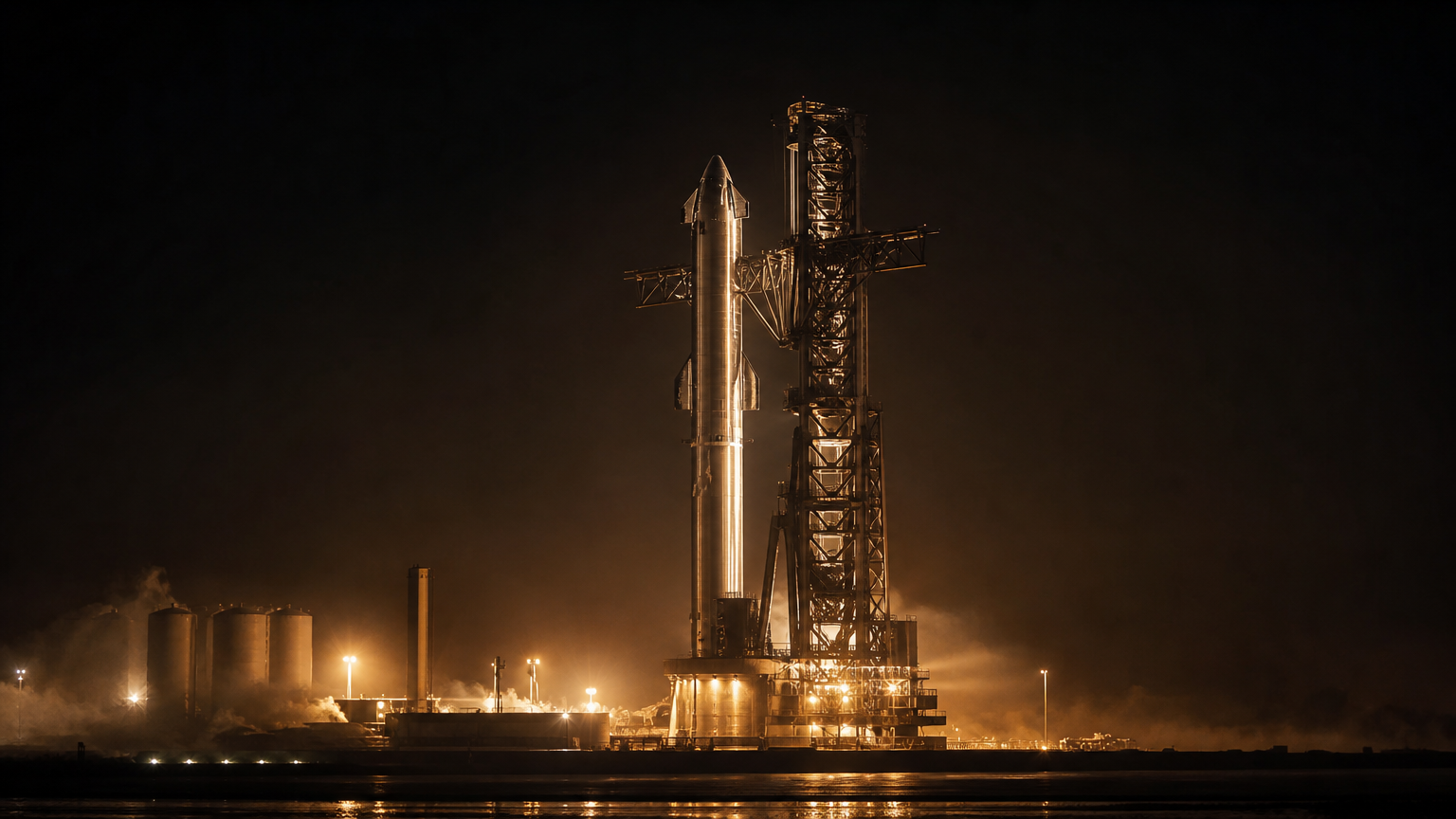
The clearance that changes the test
SpaceX’s Starship program has reached the threshold of its most consequential flight yet: Flight 14 has cleared the regulatory and operational gates needed for a September 28 orbital attempt from Starbase, Texas. The latest public update tied to the FAA launch license says the authorization has been issued for the Monday attempt, turning what had been a “pending regulatory approval” launch campaign into a countdown with permission to fly .
That matters because Flight 14 is not just another integrated test. Earlier Starship flights deliberately used passively safe suborbital trajectories, letting SpaceX learn about ascent, staging, heat-shield performance and vehicle control while avoiding a long-duration orbital object. Flight 14 is intended to cross that line: the plan described in the latest mission discussion is for Starship to enter an initial orbit around Earth at roughly 275 kilometers, complete about six circuits of the planet over nearly ten hours, and then target a controlled splashdown in the Pacific west of Chile .
The immediate launch target remains September 28 from SpaceX’s Starbase facility. Fresh reporting around the completed rehearsal describes a 75-minute window, with the local Texas timing translating into an Eastern morning window rather than an evening spectacle . The exact launch clock is less important than the change in category: SpaceX is now attempting to prove that the full Starship stack can place a massive upper stage and payload into orbit, operate there for hours, and bring the vehicle back through reentry planning rather than a short suborbital arc.
A wet dress rehearsal, then the license
The clearance followed a full wet dress rehearsal at Starbase. During that rehearsal, SpaceX loaded liquid methane and liquid oxygen into the fully stacked Super Heavy booster and Starship upper stage, ran through launch-day procedures and stopped short of engine ignition . A second account of the same campaign said the test also exercised ground-support infrastructure, propellant-loading systems, countdown procedures, telemetry and the safe draining of propellants after the simulated countdown .
In practical launch operations, that rehearsal is the bridge between “vehicle assembled” and “vehicle ready to count.” Starship is not a small rocket waiting for a button press. It is a 124-meter-class integrated system whose ground segment is almost as important as the vehicle: tanks, quick-disconnects, chilldown flows, avionics checks, pad software, range coordination and abort logic all have to behave under cryogenic conditions. A wet dress rehearsal does not prove the rocket can fly, but it does prove that teams can put the stack into a launch-like state and back out safely .
That is why the sequence is important: first, SpaceX showed the launch system could rehearse the countdown; then, the license update removed the largest non-technical hold. Together, those two developments explain why Flight 14 has moved from aspiration to imminent attempt .
Why orbit is the milestone
The word “orbit” is doing the heavy lifting here. Flight 14 is significant because it is designed to validate the next phase of Starship’s development: not simply surviving ascent, but becoming a reusable orbital transportation system. The latest mission descriptions say the upper stage is expected to make about six trips around Earth before splashing down in the Pacific west of Chile . That profile is a much tougher test of guidance, navigation, communications, thermal control, orbital operations and reentry planning than a shorter suborbital shot.
It also introduces a new payload story. SpaceX plans to fly 26 next-generation Starlink satellites on this mission, making Flight 14 a bridge between experimental Starship development and the commercial network SpaceX wants Starship to expand . Forbes reported that each of those next-generation satellites is expected to provide ten times the broadband capacity of the current generation, which helps explain why SpaceX wants Starship’s payload volume and mass so badly .
In other words, Flight 14 is not only about proving the rocket. It is about proving the business case that justifies the rocket. Falcon 9 made Starlink possible at scale; Starship is meant to change the scale again. If Starship can regularly orbit large batches of heavier, more capable satellites, the economics of SpaceX’s internet network and broader launch business begin to look very different .
Super Heavy’s job is still foundational
The booster’s mission is less glamorous but just as important. The Flight 14 plan described in the license discussion includes Super Heavy completing launch, ascent, stage separation, a boostback burn and a landing burn toward a simulated offshore landing point in the Gulf of America . This is not a tower-catch attempt. It is a controlled booster test designed to collect data and retire risk before SpaceX returns to more aggressive recovery attempts.
That distinction matters. Starship’s long-term promise depends on full and rapid reuse of both stages, but Flight 14 is not expected to demonstrate the whole end state. Forbes noted that the mission is important while also pointing out what it will not yet prove: no booster catch, no ship catch and no reflight of a V3 stage . Those omissions do not make the flight small. They define the boundary of what a successful Flight 14 would mean.
A clean ascent, separation, orbital insertion, payload deployment, multiple orbits, deorbit sequence and controlled ocean return would still be a major validation. It would show that Starship can move from spectacular test vehicle to orbital transport platform. But SpaceX would still need to demonstrate repeatability, recovery, refurbishment speed and reuse before the architecture becomes the airline-like launch system the company keeps describing.
NASA, the Moon and the pressure behind the countdown
Flight 14 also sits inside a larger NASA and Artemis context. India Today’s fresh report notes that NASA is developing a Starship-based Human Landing System with SpaceX for Artemis, including lunar versions intended to move astronauts between lunar orbit and the Moon’s surface . That is why this test is bigger than one company’s launch manifest.
For Artemis, Starship is not merely a rocket; it is supposed to become a lander architecture. For that to work, SpaceX eventually has to master orbital operations, propellant transfer, long-duration cryogenic management, high-cadence launches and reuse. Flight 14 does not solve all of those problems, but an orbital Starship mission is the gateway to testing them seriously.
For Mars, the logic is even more direct. SpaceX’s long-term Mars ambitions require a vehicle that can be launched often, refueled in orbit and reused. A six-orbit Starship test with payload deployment and planned reentry is not Mars. But it is the kind of foundational step without which Mars remains a poster, not a transportation architecture.
A Kerbal moment, with real consequences
This is why the moment feels strange: for years, Starship has looked like a live-action version of Kerbal Space Program, all stainless steel scale, dramatic test failures, fast iteration and physics made visible. Flight 14 is where the joke starts to feel like onboarding. The mission is still experimental, and a scrub, delay or partial failure would not be shocking. But the campaign has now combined a loaded-stack rehearsal, a license update and a mission profile that finally aims beyond the suborbital training ground.
If SpaceX gets Flight 14 right, it will have done more than launch another giant rocket. It will have taken the reusable Starship architecture into the domain where Starlink economics, Artemis schedules and Mars rhetoric all begin to meet reality.
Sources from the last 72 hours
- [1]FAA Launch License issued for Starship Flight 14, set for this Monday 8:15-9:30 EasternSep 27, 2026, 3:15 AM UTC
- [2]SpaceX's megarocket Starship completes wet dress rehearsal ahead of Flight 14Sep 25, 2026, 7:59 AM UTC
- [3]SpaceX’s Starship Rocket Is Heading To Orbit–With A Lot On The LineSep 26, 2026, 4:00 PM UTC
- [4]SpaceX completes launch rehearsal for Starship Flight 14Sep 26, 2026, 12:00 AM UTC
AI-generated article based on recent web research, then preserved as a dated editorial snapshot.
Comments
Be the first to comment.