
Daily Podcast full article
Google unveils Project Suncatcher: AI data centers look toward orbit
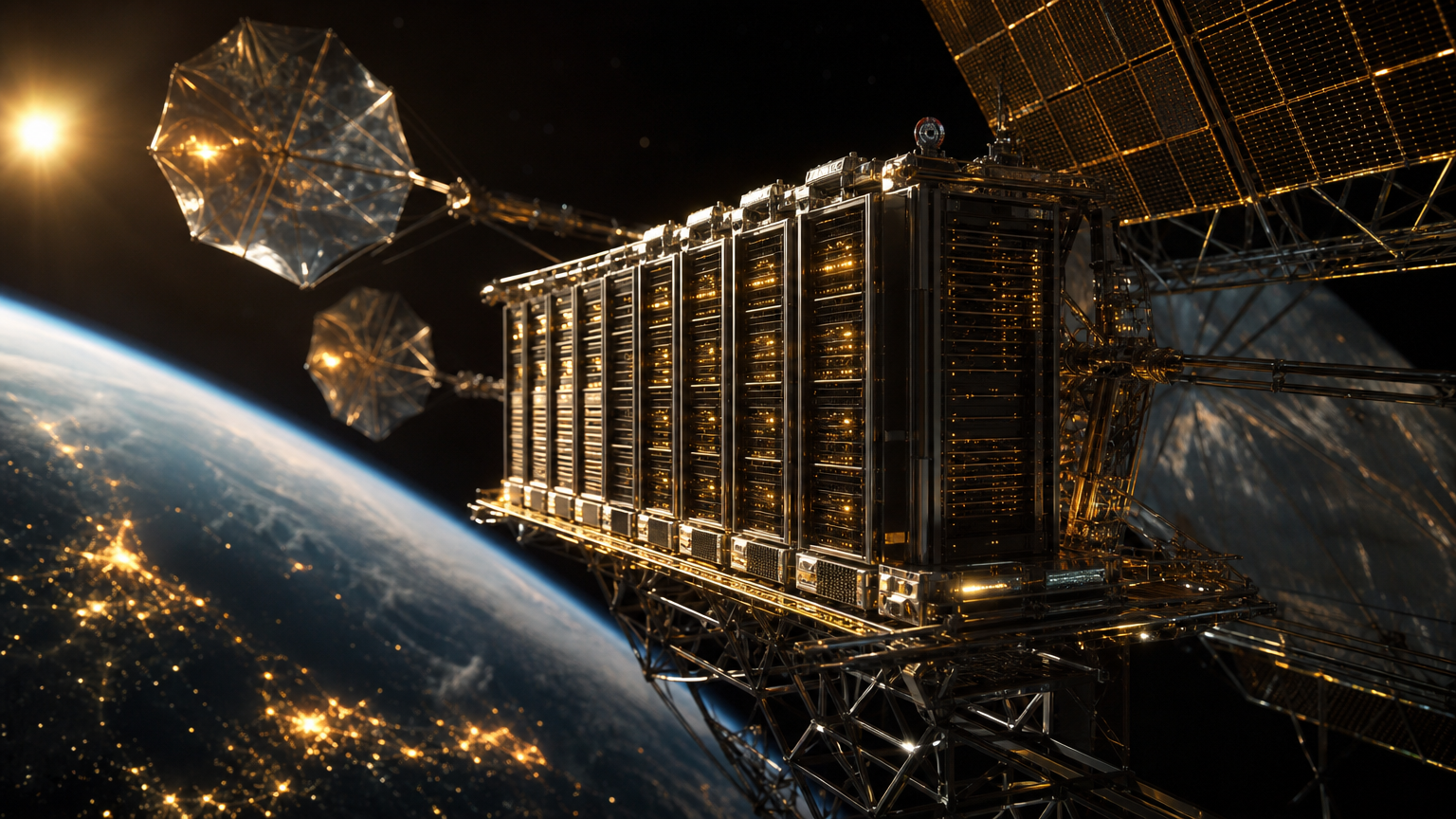
Google’s Project Suncatcher turns the phrase “cloud computing” into a literal engineering challenge: put AI processors in space, power them with sunlight and see whether orbital infrastructure can ever compete with Earth-bound data centers. The current step is still a tightly scoped test, not a commercial space cloud, but it links two of the most capital-intensive technology races of the decade: accelerated computing and orbital systems.
A moonshot with a near-term test
Google’s Project Suncatcher is no longer just a provocative infrastructure idea. The company is preparing a first orbital test tied to the project, with a prototype satellite scheduled for October 1, 2026, to examine how Google Tensor Processing Unit chips behave in the space environment . That framing matters: this is not Google announcing a working orbital data center, and it is not a new cloud region ready for customers. It is an engineering experiment designed to answer whether the core hardware of modern AI can survive, run and cool itself in low Earth orbit.
The project’s underlying concept is simple to describe and hard to execute. AI workloads need huge amounts of compute. Compute needs electricity, cooling, networking, physical space and a supply chain that can keep accelerators arriving faster than demand grows. Project Suncatcher asks whether some of that future capacity could be built above Earth, using satellites carrying AI chips and drawing power from abundant sunlight rather than from terrestrial grids.
The current mission will focus on practical stresses: radiation, vibration, launch loads and thermal extremes . Google also plans to run Gemini models on the TPUs during the mission to evaluate real AI workload behavior in orbit . In other words, the first question is not “can Google replace a hyperscale data center?” It is “what breaks when a data-center-class accelerator leaves the data center?”
Why space is tempting for AI infrastructure
The attraction of orbit starts with energy. On Earth, data centers increasingly collide with grid interconnection queues, community opposition, water constraints and the cost of building power infrastructure. In orbit, sunlight is more consistent, and solar panels can operate without clouds, weather or nighttime interruptions for many orbital configurations. That does not make space cheap, but it changes the energy equation.
There is also a strategic dimension. AI infrastructure has become a chokepoint for the biggest technology companies. If a company can find a new way to add compute capacity that is not limited by local land, water rights, transmission lines or data-center permitting, it could gain a long-term advantage. Yahoo Finance framed Project Suncatcher as only one part of Alphabet’s broader investor story, but noted that the project embeds custom AI chips into a Planet Labs satellite for an upcoming orbital deployment .
The phrase “AI data center in space” can sound like marketing, but the infrastructure logic is real. A terrestrial AI cluster is more than chips: it is a power plant problem, a cooling problem, a network problem and a capital-allocation problem. Suncatcher takes those same problems and moves them into an even harsher environment. That may sound absurd, but the point of the test is to measure which parts are absurd and which parts are merely difficult.
The cooling problem is the reality check
The strongest reminder that Suncatcher is still experimental is cooling. In a normal data center, airflow, liquid cooling, chillers and heat exchangers move waste heat away from servers. In a vacuum, there is no air to carry heat off the hardware. Google’s test will use heat pipes to move heat from the chips to radiators that dissipate it into space .
That sounds elegant until the duty cycle appears. According to current reporting, the chips are expected to operate only in brief periods of about 15 minutes before shutting down so the radiators can catch up . That single detail separates the real engineering story from the science-fiction headline. A production AI cluster needs sustained availability, predictable maintenance and high utilization. A chip that must pause frequently for thermal recovery is a test article, not a commercial server fleet.
Lumacta’s September 27 analysis made the same distinction: the useful question is not only whether a chip survives space, but whether an entire computing system can work there reliably . That system includes power conditioning, heat transport, radiation tolerance, software resilience, communications, fault detection and recovery. In space, every failure is harder to inspect, repair or replace.
Radiation, errors and reliability
Radiation is the other obvious enemy. Space radiation can disrupt electronics, cause data errors and degrade components over time. For AI workloads, errors are not all equal. A flipped bit in a noncritical operation might be corrected or tolerated; a recurring error in memory, networking or model weights could corrupt results or reduce reliability.
The current mission will evaluate how Google’s chips handle radiation, vibration and the physical stresses of launch . That makes the test a combined hardware and systems experiment. Launch stresses can damage connectors, boards or packaging before the satellite even begins computing. Thermal cycling can expose weaknesses that never appear in a lab. Radiation can create rare errors that only become visible over time.
This is why ground testing is not enough. A lab can simulate vibration, vacuum, temperature and radiation separately or in controlled combinations. Orbit provides the messy version. The point of Project Suncatcher’s first flight is to gather that messy data, identify failure points and refine later designs .
Networking: the hidden data-center challenge
If Suncatcher ever grows beyond a single satellite, networking becomes central. AI training and large-scale inference depend on moving data rapidly between accelerators. On Earth, that happens inside racks, across fiber and through carefully engineered data-center fabrics. In orbit, the equivalent would require satellites to communicate with high bandwidth and low enough latency to act as a distributed compute cluster.
Google’s current public emphasis remains on testing the chips and cooling system, but follow-on testing in 2027 is expected as part of the broader Project Suncatcher program . That next stage matters because a lone TPU payload is not a data center. A useful orbital AI platform would need many processors, coordinated software and fast inter-satellite links.
This is where orbital infrastructure and accelerated computing truly meet. Satellite operators think in terms of mass, power, pointing, orbital debris and launch cadence. AI infrastructure teams think in terms of accelerator utilization, memory bandwidth, model parallelism and latency. Suncatcher forces those disciplines into the same design review.
Capital intensity without a commercial timetable
Google has not disclosed a budget or a full commercial deployment date for an orbital AI data-center service. Current reports also stress that Suncatcher remains years away from becoming a product . That caution is important because the concept links two expensive curves: the cost of launch and the cost of AI compute.
A terrestrial data center can be upgraded, repaired and expanded with trucks, cranes and technicians. An orbital system needs launches, spacecraft production, radiation-aware design and a plan for hardware obsolescence. AI chips evolve quickly. A satellite designed around today’s accelerator could look dated before it reaches the end of its orbital life. If launch costs fall enough and satellite manufacturing scales enough, that trade-off could improve. If they do not, Earth will remain the cheaper place to compute.
Data Center Dynamics described the step as Google launching its AI chips into orbit for the first time as Project Suncatcher advances, while also placing it inside a wider wave of space data-center experiments by large technology and space companies . That wider context matters, but Google’s test should still be read narrowly: it is an attempt to learn, not a declaration that the economics already work.
What to watch next
The first milestone is the October 1 launch attempt and whether the payload reaches orbit in working condition . After that, the most important signals will be thermal data, radiation-related error rates, workload stability and how often the hardware can run before cooling constraints force a pause. Any public results should be judged against the modest scope of the test.
The second milestone is whether Google proceeds with follow-on Suncatcher testing in 2027 . If the first mission produces useful data, the next logical questions will involve inter-satellite communications, larger payloads, longer duty cycles and more realistic AI workloads. If the first mission exposes fundamental thermal or reliability issues, Suncatcher may remain a research program rather than a product path.
For now, Project Suncatcher is best understood as an infrastructure thought experiment made physical. It does not solve AI’s energy problem today. It does not remove the need for terrestrial data centers. It does, however, show how far the search for compute capacity is pushing the industry. Google is taking cloud computing so literally that, sooner or later, the servers may need spacesuits.
Sources from the last 72 hours
- [1]Google plans first test of AI chips in space under Project SuncatcherSep 25, 2026, 5:37 AM UTC
- [2]Project Suncatcher: Google to launch first space data center test in orbit next weekSep 25, 2026, 12:00 PM UTC
- [3]Google is preparing to test AI chips in orbit. Keeping them cool is part of the experiment.Sep 27, 2026, 12:00 PM UTC
- [4]Does Alphabet (GOOGL) Change Its AI Story With An Orbital Data Center Bet?Sep 27, 2026, 3:07 PM UTC
AI-generated article based on recent web research, then preserved as a dated editorial snapshot.
Comments
Be the first to comment.