
Daily Podcast full article
Japan runs 50 qubits at room temperature
Japan’s Shunkai quantum computer is now being framed as a practical milestone: a full-stack, neutral-atom machine starting at about 50 qubits, operating without cryogenic refrigeration, and aimed at a much larger fault-tolerant system by 2031.
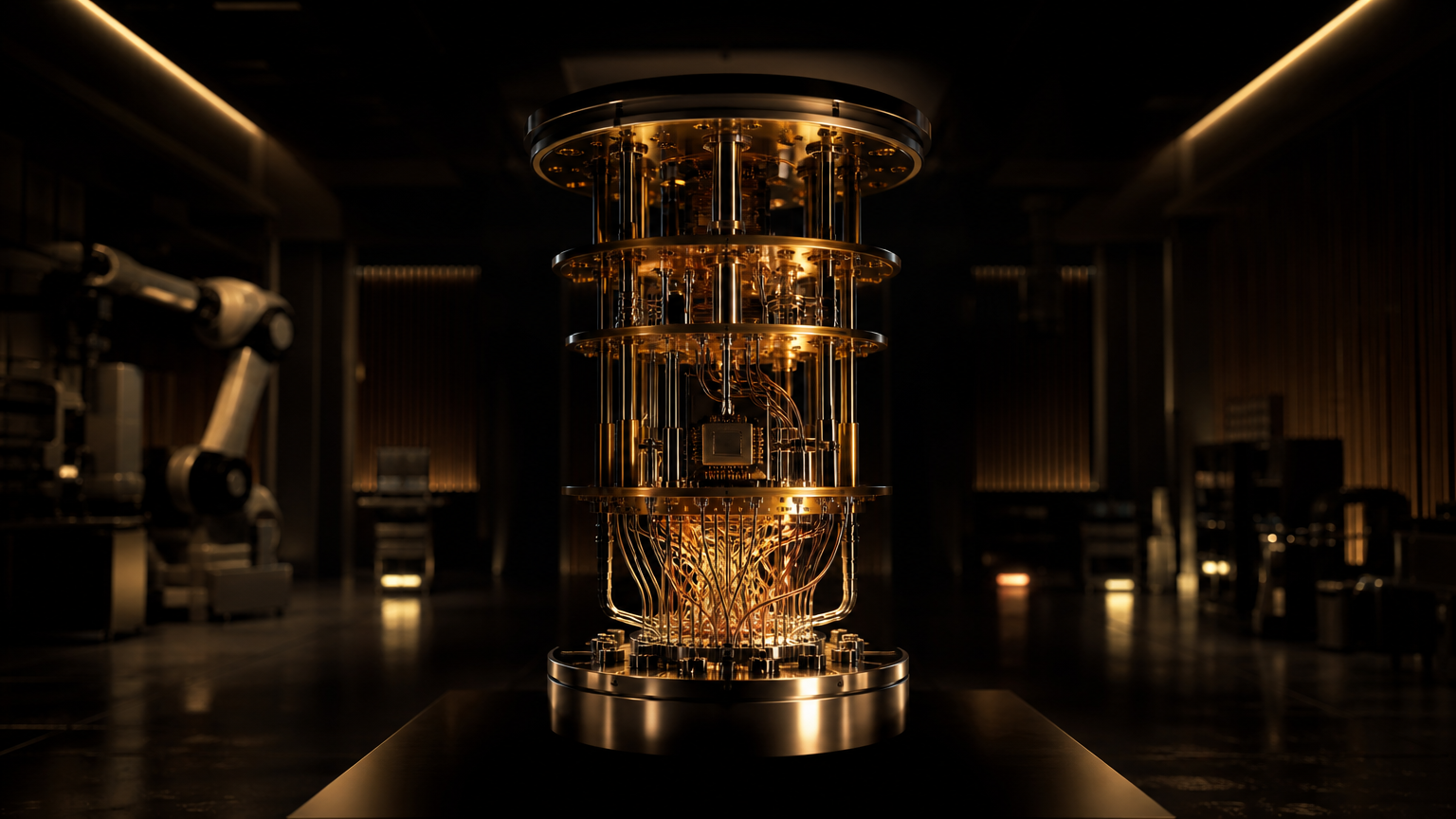
Japan’s 50-qubit milestone is about the stack, not just the number
Japan’s new quantum headline is simple enough to travel: a 50-qubit quantum computer is running at room temperature. The fuller story is more interesting. The system, called Shunkai, is Japan’s first operational full-stack neutral-atom quantum computer, built around roughly 50 qubits and designed to operate without the dilution refrigerators associated with superconducting quantum machines . It was developed by the Institute for Molecular Science within Japan’s National Institutes of Natural Sciences, with Hitachi involved in the software stack and Infleqtion supplying the quantum processing unit .
That “full-stack” label matters. In quantum computing, a research-grade device is not automatically a usable computer. A full-stack system connects the layers that translate a user’s problem into control instructions, drive the physical qubits, and return a computational output . In Shunkai’s case, recent reporting describes an integrated system that combines software, control, and hardware layers rather than a lab demonstration of isolated components . That is why the launch is being treated as a national platform, not merely as another qubit-count announcement.
The other headline feature is temperature. Shunkai uses neutral atoms as qubits, held and manipulated with laser-based optical tweezers rather than superconducting circuits that must be cooled to near absolute zero . Current summaries of the system emphasize that this architecture can operate at room temperature and avoid a refrigerator, while still requiring sophisticated lasers, optical systems, vacuum equipment, and control electronics . In other words, “room temperature” does not mean a quantum laptop on a desk. It means one major engineering burden—cryogenic refrigeration—has been removed from the design.
How Shunkai works
Neutral-atom quantum computers use individual atoms as qubits. In Shunkai, atoms are captured in arrays using tightly focused laser light, and calculations are performed by irradiating them with microwaves or laser light . The system reads results by observing fluorescence from individual atoms with a camera . Because the atoms can be moved during computation, the architecture can in principle alter which qubits interact with which others, giving it a flexible form of connectivity that is difficult to reproduce in some fixed-chip designs .
The room-temperature point should be understood carefully. The qubits themselves are controlled with precise atomic physics, and neutral-atom systems often rely on laser cooling and ultra-high vacuum environments. But the machine does not require the large cryogenic refrigeration stack that has become a defining visual symbol of superconducting quantum computers . That distinction is not cosmetic: refrigeration adds cost, increases physical footprint, raises maintenance complexity, and constrains where machines can be deployed.
Shunkai’s initial scale is modest by the standards of quantum roadmaps. The system is expected to start at about 50 qubits and later expand to about 500 qubits . Japan’s longer target is much more ambitious: by March 2031, the project aims for a large-scale neutral-atom fault-tolerant quantum computer with 10,000 physical qubits and quantum error detection and correction capabilities . A recent quantum-industry weekly summary likewise described Shunkai as a full-stack, room-temperature neutral-atom system starting near 50 qubits, with the March 2031 10,000-physical-qubit target as the longer horizon .
Why 50 qubits is not the same as quantum advantage
The launch is important, but it should not be oversold. Fifty qubits does not automatically imply commercial advantage, and it does not mean the machine can outperform classical supercomputers on practical workloads. The decisive metrics are qubit quality, gate fidelity, connectivity, coherence time, error rates, calibration stability, and the ability to run useful circuits repeatedly. Recent coverage of Shunkai focuses on the system’s architecture, integration, room-temperature operation, and roadmap, rather than on public benchmark results proving a useful advantage .
That distinction is central to understanding the news. Quantum computing has repeatedly shown that raw qubit counts can be misleading. A smaller machine with high-fidelity operations and useful connectivity can be more valuable than a larger machine with high noise. A full-stack device also has to be evaluated by how reliably it takes real user programs through the stack, not just by how many physical qubits it can trap.
Shunkai’s likely near-term role is therefore experimental and infrastructural. It is expected to support outside researchers working on applications and quantum error correction . That makes sense: the room-temperature design could make experimentation easier, while the full-stack architecture gives software and theory teams a machine they can actually program against. The payoff would be not immediate commercial supremacy, but faster learning cycles.
The significance of avoiding the coldest layer
Many leading quantum computers use superconducting qubits, which generally require ultra-low temperatures. Those cryogenic systems are engineering achievements, but they introduce obvious scaling headaches. A refrigerator that can cool a small device is not necessarily easy to scale into a serviceable, maintainable, high-volume computing platform. It also complicates installation outside specialized facilities.
Neutral-atom machines offer a different bargain. They trade the refrigerator problem for precision optical control, atom trapping, vacuum engineering, and laser stability. This is not “easy mode.” It is simply a different engineering frontier. Shunkai is notable because Japan has placed that frontier inside an operational full-stack system rather than keeping it only as a physics experiment .
The design also aligns with a broader trend in quantum computing: national programs are no longer only asking whether a lab can demonstrate qubits. They are asking who controls the platform, who writes the software stack, who supplies the quantum processor, and how external users will access the machine. Shunkai’s collaboration model—IMS leadership, Hitachi software participation, and an Infleqtion quantum processing unit—shows how national quantum infrastructure can be assembled through a mix of domestic and international capabilities .
What happens next
The roadmap is clear but challenging. Shunkai is expected to grow from about 50 qubits toward roughly 500, while the broader Moonshot effort targets a fault-tolerant 10,000-physical-qubit neutral-atom machine by March 2031 . That next phase is not just a matter of adding atoms. It requires stable control, repeatable gates, error detection, error correction, and useful integration with the software layer.
The system is also expected to be opened partly to outside users, including researchers developing applications and error-correction methods . If that access becomes practical, Shunkai could serve as a testbed for Japan’s quantum ecosystem: universities, corporate researchers, and software teams would have a domestic platform for neutral-atom experimentation rather than relying entirely on overseas cloud access.
The most sober reading is the most useful one. Japan has not announced a general-purpose quantum computer that will upend industry tomorrow. It has brought online a full-stack neutral-atom system with about 50 qubits, room-temperature operation, and an aggressive roadmap toward fault-tolerant scale. That is a real milestone because it attacks one of quantum computing’s persistent side quests: building machines that are not dominated by refrigeration infrastructure. Whether Shunkai becomes a stepping stone to useful quantum computing will depend on the less flashy numbers that come next: fidelity, error correction, uptime, access, and performance on real workloads.
Sources from the last 72 hours
- [1]Japan's Full-Stack Quantum Computer That Works At Room Temperature Has Just Gone Live, Powered By 50 QubitsSep 28, 2026, 7:00 PM
- [2]Japan activates Shunkai, a room-temperature quantum computerSep 27, 2026, 2:00 AM
- [3]Quantum Computing Weekly Round-Up: Week Ending September 26, 2026Sep 27, 2026, 2:00 AM
- [4]From The National Institutes of Natural Sciences (JP): ‘Japan’s first full-stack neutral-atom quantum computer “Shunkai” is operational’Sep 26, 2026, 2:00 AM
AI-generated article based on recent web research, then preserved as a dated editorial snapshot.
Comments
Be the first to comment.