
Daily Podcast full article
SpaceX puts Starship in orbit
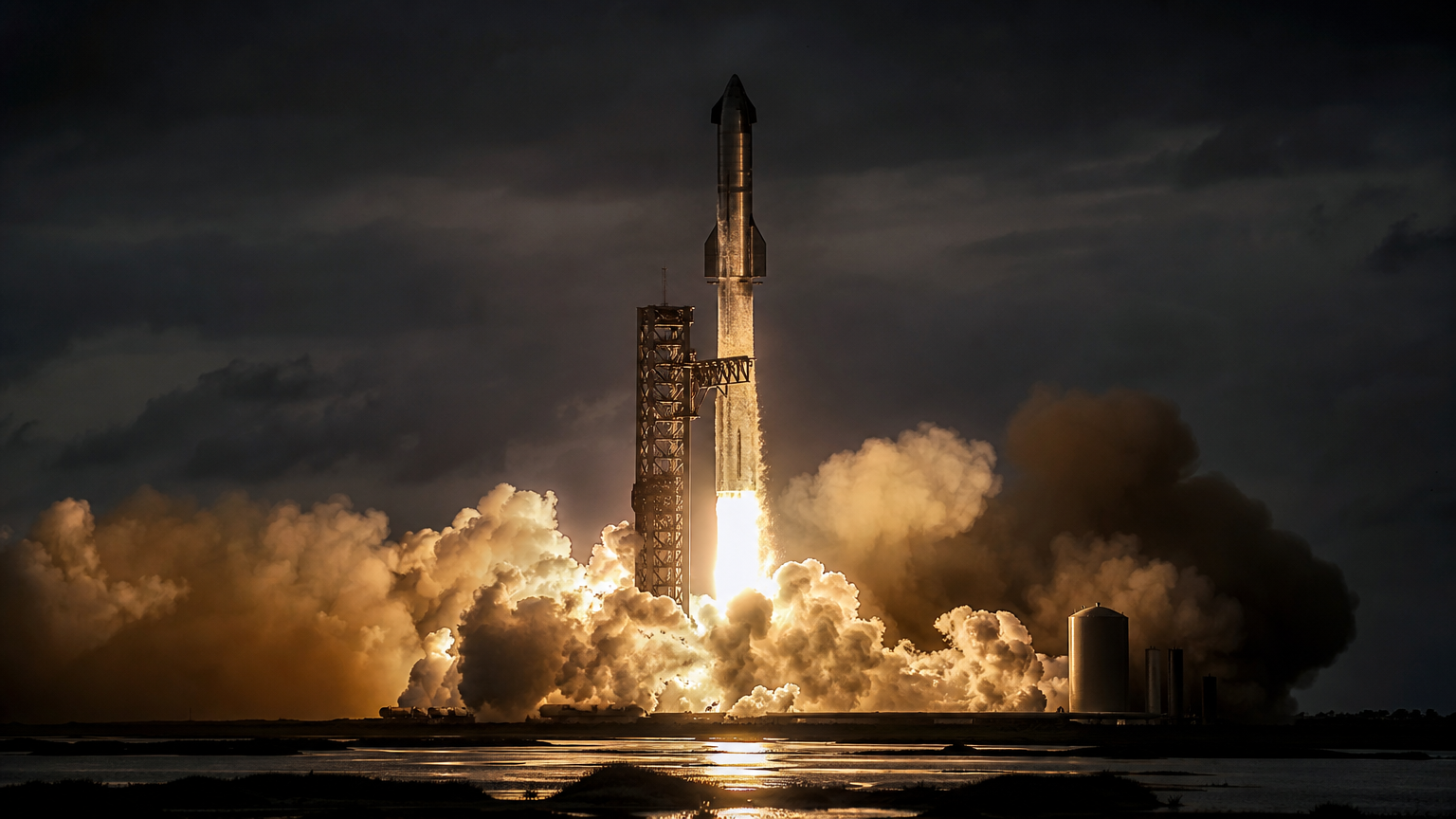
SpaceX’s Flight 14 turned Starship from a spectacular test vehicle into an orbital launcher on September 28, pairing the program’s first trip around Earth with a first operational Starlink V3 deployment attempt and a renewed debate over Elon Musk’s aircraft-like launch-cadence ambitions.
The milestone SpaceX needed
SpaceX has finally put Starship into Earth orbit, making Flight 14 the clearest technical breakthrough yet for the vehicle that the company wants to turn into a fully reusable heavy-lift transportation system . The achievement matters because Starship’s previous integrated flights were deliberately kept on suborbital paths: useful for learning, but not the same as proving that the upper stage can complete an orbital insertion, survive a long coast phase, and execute the steps needed to come home safely .
The September 28 mission also changed the tone of the program. Until now, Starship’s story has been dominated by spectacular ascent footage, ocean splashdowns, explosive failures, heat-shield experiments and the slow expansion of what SpaceX was willing to risk on each test. Flight 14 moved the vehicle into the category that matters commercially: an orbital launcher carrying payloads meant to support a revenue business.
That payload link is crucial. Flight 14 targeted deployment of 26 next-generation Starlink V3 satellites, tying the first orbital Starship mission directly to SpaceX’s broadband network rather than to an empty test profile . The mission therefore served two strategic goals at once: prove the rocket can reach orbit, and show why SpaceX wants such a large rocket in the first place.
Why Flight 14 was not just “another test”
The mission profile was more cautious than the headline might suggest. Before committing the ship to orbit, SpaceX planned a coast-phase health check, then an orbital insertion burn using one of the sea-level Raptor engines roughly 25 minutes after liftoff . That sequence reflected the risk of putting such a large vehicle into orbit: once circularized, Starship had to retain enough functional redundancy to perform a later deorbit burn rather than become a dangerous uncontrolled object.
The plan called for Starship to fly about six orbits at roughly 275 kilometers altitude, with a mission duration just under ten hours and a controlled splashdown in the Pacific Ocean west of Chile . The Super Heavy booster was not meant to return to the launch tower; instead, it was assigned an offshore landing point in the Gulf, while the upper stage was assigned a Pacific splashdown after reentry .
That restraint is important. SpaceX has made dramatic tower catches part of the public Starship narrative, but Flight 14 prioritized orbital demonstration, payload deployment and reentry data over a maximum-complexity recovery attempt. Aviation Week reported that a return-to-pad goal had been pushed toward Flight 15, depending on Flight 14’s outcome .
The Starlink reason for the giant rocket
The 26 Starlink V3 satellites on board were not a side story. They were the first operational batch of the larger Starlink generation that SpaceX wants Starship to deploy at scale . Space.com reported that each V3 satellite is expected to add about 1 terabit per second of capacity, making the 26-satellite stack a potential 26-terabit-per-second capacity addition from one Starship flight .
That figure explains the commercial logic behind the program. Falcon 9 made Starlink possible, but Starship is meant to change the economics and scale of the network. A bigger payload bay and higher mass capacity could allow SpaceX to launch larger satellites in larger batches, improving broadband capacity faster than Falcon 9 can manage with smaller Starlink spacecraft.
Flight 14 therefore marks a transition from “can Starship fly?” to “can Starship do useful work?” Even if the company still has to prove rapid reuse, orbital refueling, high launch cadence and reliable recovery, putting Starlink hardware into orbit is a concrete step toward the business case. It also gives SpaceX a built-in customer: its own broadband constellation.
The hard part comes after orbit
Orbit is a milestone, not the finish line. Starship’s long-term promise depends on reusability, and Flight 14 still involved ocean splashdowns rather than recovered stages ready to fly again . That leaves the central engineering challenge unresolved: can SpaceX make a 124-meter-class rocket operate less like a bespoke launch vehicle and more like transport infrastructure?
The heat shield remains one of the key questions. Flight 14 included Starlink V3 satellites equipped with extra imaging capability to observe the ship’s thermal protection system during flight . That kind of inspection is not a gimmick. For a vehicle that must eventually return from orbital velocity, land, be inspected and fly again quickly, heat-shield reliability is foundational.
The mission also carried programmatic weight beyond Starlink. NASA is watching Starship because a lunar variant remains central to the Artemis plan for returning astronauts to the Moon . An orbital Starship does not automatically solve the Human Landing System challenge, which also requires propellant transfer, repeated launches, lunar operations and crew-rated reliability. But it removes a major question mark: whether the base transportation system can get to orbit in the first place.
Musk’s hourly-flight claim
Elon Musk added a deliberately provocative benchmark around the mission, saying Starship is “2 to 3 years away from hourly flights” . Taken literally, that would imply a launch-and-turnaround system closer to aviation than to today’s rocket industry. It would require robust hardware, automated inspections, rapid fueling, resilient pads, streamlined range operations and a regulatory environment able to process flights at a pace no orbital rocket currently approaches.
For now, the statement should be treated as an ambition, not a demonstrated capability. Flight 14 shows SpaceX crossing the orbital threshold; it does not show hourly operations, routine reuse or launch-site throughput at that scale. Still, Musk’s claim is useful because it clarifies what SpaceX thinks Starship is for. The company is not merely building a bigger Falcon. It is trying to create a high-frequency transport system for satellites, Moon missions, Mars logistics and other large orbital payloads.
That ambition is why Flight 14’s success will echo beyond one launch day. Heavy-lift rockets have reached orbit before, but Starship’s pitch is capacity plus reuse plus cadence. The September 28 flight validates one part of that equation. The rest now has to move from promise to operations.
A new phase for Starship
The cleanest way to read Flight 14 is as a door opening. Starship has moved from suborbital experimentation to orbital demonstration, from empty test flights to operational satellite deployment, and from proving ascent basics to testing the harder full-system loop of orbit, payload release, reentry and eventual recovery.
The next questions are immediate. Can SpaceX repeat the result? Can it recover more hardware? Can it fly often enough to make Starlink V3 deployment routine? Can it use the same platform to serve NASA’s Moon architecture and, later, Musk’s Mars ambitions? Flight 14 does not answer all of that. But by reaching orbit, it gives those questions a much more serious foundation.
Starfleet might indeed call it a successful warp-core check. The harder exam begins now.
Sources from the last 72 hours
- [1]Live coverage: SpaceX to launch first Starlink V3 satellites to orbit on StarshipSep 28, 2026, 2:00 AM
- [2]FAA Clears SpaceX For Starship 14 FlightSep 27, 2026, 2:00 AM
- [3]SpaceX Starship to attempt first orbit and deploy 26 Starlink satellitesSep 28, 2026, 2:00 AM
- [4]What time will SpaceX launch its 1st orbital Starship test on Flight 14 on Sept. 28? (Full mission timeline)Sep 26, 2026, 2:00 AM
- [5]Elon Musk Says Starship Is Just ‘2 to 3 Years Away’ From Hourly Flights—Reaffirms Sept. 28 Launch for First Orbital AttemptSep 28, 2026, 5:47 AM
- [6]SpaceX sends Starship into orbitSep 28, 2026, 2:00 AM
AI-generated article based on recent web research, then preserved as a dated editorial snapshot.
Comments
Be the first to comment.