
Daily Podcast full article
Elon Just Revealed Insane SpaceXAI Goals With Huge Implications As Opus 5.5 Blows Minds
Elon Musk’s latest SpaceXAI comments shift the AI race away from a simple model-versus-model scoreboard and toward a more consequential question: who can bring the most usable compute online fastest, cheaply enough to serve customers and powerful enough to train the next Grok systems as Claude Opus 5.5 raises the frontier bar.
The headline is no longer just Grok versus Claude
Elon Musk’s newest SpaceXAI claims landed at a moment when the market was already digesting Claude Opus 5.5, Grok 4.7 and a brutal new price-performance cycle in frontier AI. Musk said SpaceX could produce a Fable/GPT-6-level model within two to three months and potentially reach “pole position” in AI within about six months if its rate of improvement holds . That is a bold model claim, but the deeper story is not a chatbot launch. It is the claim that SpaceXAI can turn infrastructure speed into strategic leverage.
The key line was Musk’s argument that “hardware is hard.” Recent reporting says he framed rapid deployment of massive compute as one of SpaceX’s advantages, while also arguing that additional intelligence becomes less useful once a system already exceeds the needs of a given task . That is a subtle but important pivot. Instead of saying SpaceXAI only needs the smartest single model, Musk is saying the company may win by combining capable models with unusually abundant compute.
That matters because Claude Opus 5.5 has just reinforced the opposite side of the same equation. The new Anthropic model is being discussed as a strong coding, agentic and knowledge-work release, with reporting from the week placing it at 40% lower typical workload cost than Opus 5 and listing strong benchmark claims across Terminal-Bench, CursorBench and OSWorld . In other words, Anthropic did not merely push quality; it pushed usable quality down the cost curve.
Colossus is the real product layer
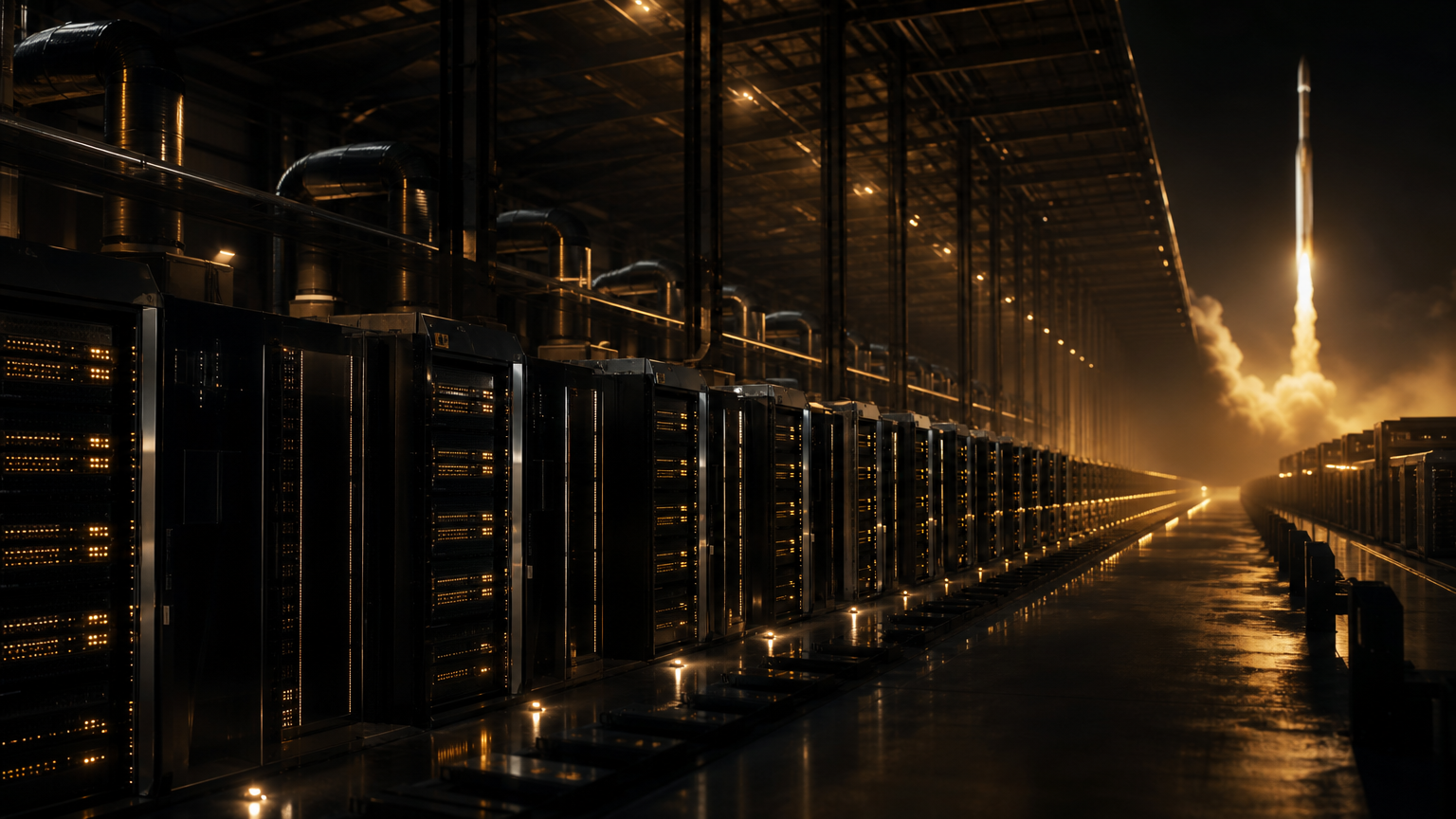
The most concrete update is the size and timetable of the Colossus buildout. Musk said Colossus 1 contains 150,000 H100s, 50,000 H200s and 30,000 GB200s, while Colossus 2 already has 110,000 GB200s and 440,000 GB300s . He also said another 220,000 GB300s are expected to become fully operational within the next week, another 220,000 in November, and a possible additional 220,000 by late December if execution goes well .
If that full schedule holds, Colossus 2 would reach about 1.21 million GB200 and GB300 chips by year-end, according to multiple summaries of Musk’s figures . Invezz calculated that adding Colossus 1’s 230,000 chips would put the broader Memphis footprint near 1.44 million chips by the end of 2026 if every planned wave arrives on time . The exact dates may slip, especially on the December tranche, but the direction is clear: SpaceXAI wants the market to view Colossus not as a back-office cost center but as a core product.
That is why the Opus 5.5 reaction matters. A frontier model that is both better and cheaper increases consumption. Better coding agents invite more runs, longer contexts, more retries and more automated workflows. More convincing research agents increase the number of experiments customers are willing to run. Cheaper high-end models do not necessarily reduce infrastructure demand; they can expand it by making advanced usage economically rational for more customers.
Compute supply may become more important than benchmark bragging
The frozen story’s central argument is that compute is becoming a strategic commodity. The current news supports that framing. SpaceXAI is presenting the Colossus network as a way to serve external demand while also supporting its own Grok roadmap. Benzinga reported that Musk’s comments came after criticism of Grok 4.7 and that he responded by emphasizing both model acceleration and the difficulty of bringing large-scale compute online .
That distinction is crucial. If Grok is behind Opus 5.5 on some agentic or coding tasks today, SpaceXAI can still argue that its long-term edge comes from build speed, power, networking, cooling and customer capacity. AI labs need not only brilliant weights but also cheap inference and enough training cycles to keep improving. In that world, a compute provider can capture value even when another lab owns the week’s most impressive benchmark chart.
Recent coverage also emphasizes the constraints behind the chip counts. AI Weekly noted that Musk connected the 110,000-chip increments to networking, specifically the number of fiber-optic cables that can plug into a central switch . The same report highlighted the unresolved power question around the Memphis cluster and noted earlier reporting about temporary gas turbines and a planned 1.2-gigawatt permanent plant . That is the less glamorous side of “AI acceleration”: switch fabric, transformers, cooling loops, permits and grid capacity.
The business implication: selling picks and shovels to the model race
The huge implication is that SpaceXAI may not need to beat Anthropic and OpenAI on every model release to become one of the most important companies in AI. If compute remains scarce, the ability to rent capacity to other labs, route internal workloads and train Grok on enormous clusters can be a stronger business position than winning a single week’s model discourse.
This is where the strategy becomes financially powerful. Reporting on Musk’s wider AI push says SpaceX’s AI narrative is evolving beyond rockets and Starlink, with the Cursor acquisition viewed as an enterprise distribution and coding-data asset for improving Grok . The same reporting notes that analysts see overlap among SpaceX, Tesla and physical AI infrastructure as increasingly relevant to investors . The market is not merely valuing a model family; it is trying to value a compute network attached to distribution, robotics ambitions and space infrastructure.
The risk is that investors start treating chip-count announcements as guaranteed revenue. They are not. A million-plus accelerators need utilization, reliable power, competitive pricing and workloads that can pay. If Opus 5.5 and other models keep getting cheaper, compute providers must either lower prices or deliver more value per watt. SpaceXAI’s advantage, if real, must show up in uptime, cost, latency and customer demand, not only in spectacular numbers.
Why Opus 5.5 “blowing minds” strengthens Musk’s compute thesis
At first glance, Opus 5.5 makes Musk’s promise harder. If Anthropic has just reset expectations on cost and capability, SpaceXAI’s target moves farther away. SNEOS described the week as a “flagship stampede,” with Grok 4.7, Opus 5.5 and other releases compressing major model upgrades into a tight window while keeping prices flat or cutting them . That means Musk is chasing rivals that are not standing still.
But the same event strengthens his infrastructure case. Every time a model becomes more useful, users run it more. Every time agentic coding improves, companies move from occasional prompting to continuous automation. Every time research agents become credible, organizations spend tokens on exploration that previously would not have happened. The frontier model race therefore increases the importance of inference capacity, not just training capacity.
That is the real SpaceXAI bet: the company can be both a frontier lab and a compute utility. The lab side wants Grok to catch Claude and GPT-6. The utility side wants everyone, including competitors and enterprise developers, to need what Colossus supplies. If both are true, Musk can lose individual benchmark rounds and still win a large portion of the economics.
The open questions
The first question is execution. Colossus 2’s late-December expansion is explicitly conditional, and power and networking bottlenecks may matter more than chip procurement . The second question is model translation: more compute does not automatically produce a better model unless data, training recipes, evaluation and post-training also improve. The third question is governance. As clusters approach million-chip scale, the public-policy issues around power, emissions, safety and market concentration will intensify.
Still, the strategic message is coherent. Opus 5.5 shows that frontier AI is getting more capable and cheaper to use. Musk’s Colossus update says SpaceXAI wants to meet that demand at infrastructure scale. The result is a race where the winning asset may not be a single chatbot interface, but the scarce ability to deliver massive, reliable, affordable compute when every serious AI product is hungry for more.
Sources from the last 72 hours
- [1]Elon Musk Says SpaceX Could Have GPT-6-Level AI in 3 Months, Reach ‘Pole Position’ Within 6; SpaceXAI Plans Massive GPU ExpansionSep 25, 2026, 1:20 PM
- [2]Best of the Week in AI: September 20–26, 2026 — The Week Four Flagships Answered the Slowdown LawsuitSep 26, 2026, 2:00 AM
- [3]Elon Musk Says SpaceXAI’s Colossus 2 Could Run More Than 1.2 Million Nvidia GB200 And GB300 Chips By Year-End ‘If We Get Lucky’Sep 25, 2026, 4:20 PM
- [4]Elon Musk says xAI's Colossus 2 could more than double Nvidia chip count by year-endSep 25, 2026, 3:26 PM
- [5]Musk: xAI's Colossus 2 Aims for 1.21M Nvidia GPUs by Year-EndSep 26, 2026, 3:58 PM
AI-generated article based on recent web research, then preserved as a dated editorial snapshot.
Comments
Be the first to comment.