
Daily Podcast full article
Elon Musk's Next-Gen Motor Destroys the Entire EV Industry
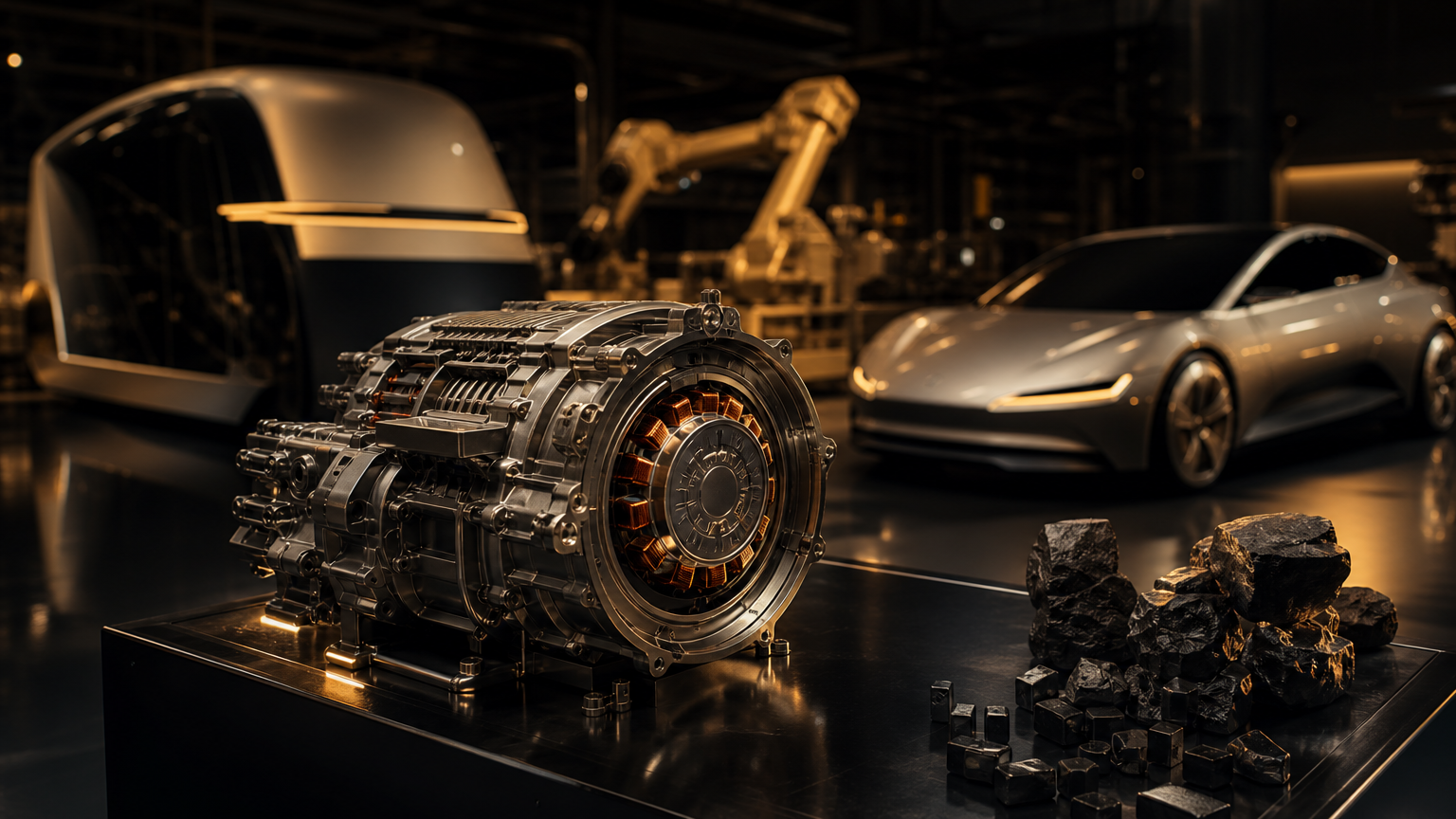
Tesla’s rare earth-free Cybercab drive unit is not just another motor claim. It is a supply-chain maneuver, a cost-control experiment and a signal that Tesla wants the next EV battle to be fought over manufacturing independence as much as acceleration.
The headline is dramatic, but the risk is real
“Destroys the entire EV industry” sounds like a YouTube-sized headline. The more precise reading is this: Tesla is trying to remove one of the EV industry’s most politically fragile dependencies from a high-volume future product. The focus is the Cybercab drive unit, which Tesla is developing without rare earth elements such as neodymium, dysprosium and terbium, materials traditionally used in powerful permanent magnets for compact, efficient EV motors .
That matters because Tesla itself helped normalize modern rare earth permanent-magnet motors when it moved away from its earlier induction-only approach and introduced a neodymium-based permanent-magnet rear drive unit with the Model 3 era in 2017 . The permanent-magnet route gave automakers excellent efficiency and packaging, but it also tied the industry to a narrow supply chain. Heavy rare earths such as dysprosium and terbium are used in small amounts to help magnets retain strength under heat, and the problem is not only mining; it is processing, refining and magnet production concentration .
The Cybercab motor is therefore not a magic wand. It is a strategic hedge. If Tesla can make a compact, efficient, low-noise, durable traction motor without rare earth magnets, the company reduces exposure to price spikes, export controls and geopolitical bottlenecks. If it cannot scale the design cheaply, then the claim remains a clever prototype rather than an industry reset.
What Tesla is really trying to delete
The innovation is not simply “no rare earths.” Automakers have avoided rare earths before by using induction motors, wound-field motors or ferrite-based designs. The hard part is doing so without giving up the power density, efficiency, thermal behavior and manufacturability that made rare earth permanent magnets dominant in the first place.
The Cybercab makes the challenge sharper because it is supposed to be a cost-per-mile machine. A private performance car can justify expensive materials; a robotaxi fleet cannot. Every gram, watt-hour, assembly second and maintenance item matters. Tesla’s claim is that the Cybercab drive unit can remove rare earth metals while preserving range, reducing weight and shrinking the package . In a two-seat autonomous cab, that packaging advantage can cascade: a smaller motor can help simplify the body, reduce mass, protect cabin room and lower energy demand.
This is why the story is bigger than motor chemistry. It is about Tesla designing the vehicle, powertrain and factory as one system. A rare earth-free drive unit is most valuable if it also fits the production logic of Cybercab: fewer parts, faster assembly, lower service exposure and less dependence on external suppliers.
Why the existing EV industry should pay attention
Most rival automakers do not need to panic tomorrow. Many already use mixed motor strategies. Some combine induction and permanent-magnet machines; others use externally excited synchronous motors or supplier-built systems that reduce rare earth content. But Tesla’s threat is different because of scale and integration.
If Tesla proves that a rare earth-free Cybercab motor is not just efficient but cheap to build at high volume, suppliers of rare earth magnets lose pricing leverage in one of the most visible EV programs in the world. Competitors would then face a difficult question: keep optimizing around today’s magnet supply chain, or spend heavily to redesign motors, inverters, thermal systems and factories for an architecture Tesla has already industrialized.
The “destroys” part is not that every EV motor becomes obsolete overnight. It is that Tesla may be moving the benchmark from “best motor efficiency” to “best total system cost under supply-chain stress.” That is a harsher contest. It rewards companies that control software, power electronics, vehicle layout, procurement and production engineering at the same time.
The Roadster clue: Tesla is still chasing extremes
The same 72-hour news window also added a second Tesla engineering signal: the next-generation Roadster may be tied to active aerodynamics. A newly published patent application describes a deployable and active rear wing assembly with safety features, and the drawings have been widely interpreted as resembling the long-delayed Roadster .
Electrek reported that the USPTO published application US 2026/0285418 A1 on September 24, one week before Tesla’s scheduled October 1 Roadster unveiling in Texas, and that the design describes a two-piece wing that can hide flush in the bodywork and produce up to 700 kg of downforce when deployed . The filing also describes a drag-reduction style mode and safety-related retraction behavior, which matters because active aero on a road car is only valuable if it can balance grip, efficiency and crash considerations .
TeslaMagz, covering the same filing on September 26, stressed the caveat: the application does not officially name the Roadster, and a patent filing does not guarantee production hardware . That distinction is important. The Roadster rumor mill has been running for years, including talk of SpaceX-linked features, extreme acceleration and theatrical unveilings. A patent is evidence of engineering exploration, not proof of a final specification.
Still, the Roadster patent fits the same pattern as the Cybercab motor. Tesla is not presenting EV innovation as a single better battery cell or a single faster car. It is stacking control systems, aerodynamics, motors, software, manufacturing and supply-chain design into one narrative.
Cybercab and Roadster are opposite products with the same message
The Cybercab is supposed to be austere: two seats, autonomy-first design, low operating cost and fleet economics. The Roadster is supposed to be excessive: a halo car, extreme acceleration and possibly active aero that makes the body itself part of the performance system. Yet both projects point to the same Tesla thesis.
For Cybercab, the motor is about deleting dependency and cost. For Roadster, active aero is about expanding the performance envelope. In both cases, the value comes from integration. A rare earth-free motor is only meaningful if the vehicle still has range, durability and manufacturability. A deployable rear wing is only meaningful if the car’s sensors, controllers, structure and crash logic can use it safely.
That is why the current story should not be read as “Tesla found one secret motor and everyone else is finished.” The better reading is that Tesla is trying to make the motor one part of a broader platform strategy. HelloBro’s wider September 27 analysis of “physical AI” framed Tesla’s factories, vehicles, batteries, autonomy data and robots as layers in a system for moving intelligence into the physical world . Under that lens, a cheaper, supply-secure traction motor is not just a car part. It is an actuator for fleets.
The unresolved engineering questions
The biggest unknown is verification. Tesla has not yet released the full magnet chemistry, efficiency map, torque-speed curve, thermal data, acoustic profile or long-duration durability data for the Cybercab drive unit. Without those, the industry cannot independently judge whether the design beats rare earth permanent-magnet systems on total cost, efficiency and reliability across real duty cycles.
There is also the question of transferability. A robotaxi has a narrow mission profile: urban routes, controlled fleet charging, predictable maintenance and optimized duty cycles. A mass-market crossover must satisfy broader customer behavior, towing, climate variation, highway cruising and global regulatory requirements. A Cybercab motor that works brilliantly in one use case may not automatically replace motors in every Tesla model.
But that does not weaken the strategic point. It may strengthen it. Tesla does not need one universal motor to pressure the EV industry. It only needs to prove that rare earth-free drive units can be matched to specific high-volume products where supply risk and cost matter most.
The real disruption
The EV industry has spent years measuring disruption in battery range, charging speed and zero-to-60 times. Tesla’s next-gen motor story shifts attention to something less glamorous but more durable: material independence.
If Cybercab scales with a rare earth-free drive unit, Tesla will have shown that one of the most sensitive pieces of the EV supply chain can be redesigned out of a mass-production vehicle. If the Roadster’s active-aero clues reach production, Tesla will also remind the market that it still wants to define the emotional edge of EV performance.
The lesson is not that rivals are doomed. It is that the next EV fight may be won by the company that removes the most constraints: rare earths from motors, excess parts from factories, drag from bodywork and cost from every mile. That is how a motor can threaten an industry without literally destroying it.
Sources from the last 72 hours
- [1]Elon Musk's Next-Gen Motor Destroys the Entire EV IndustrySep 28, 2026, 2:00 AM
- [2]Tesla patent shows new Roadster with a hidden 700 kg-downforce rear wingSep 25, 2026, 6:13 PM
- [3]Tesla patent details active rear wing system ahead of Roadster revealSep 26, 2026, 2:00 AM
- [4]Why Did He Dodge the Tesla-SpaceX Merger Question?Sep 27, 2026, 2:00 AM
AI-generated article based on recent web research, then preserved as a dated editorial snapshot.
Comments
Be the first to comment.