
Daily Podcast full article
AI faces $6T revenue test
Bain’s latest technology report turns the AI boom into a hard commercial equation: by 2031, the industry may need about $6 trillion in annual revenue to justify the data centers, chips, power and construction now being committed. That does not end the AI story, but it changes the question from “How capable are the models?” to “Who pays for all this compute, at what utilization, and for how long?”
The new AI question is not intelligence. It is payback.
The AI infrastructure boom has reached the point where the central test is no longer whether models can improve, but whether the industry can turn compute into enough durable revenue to fund the physical machine behind them. Bain & Company’s new Global Technology Report says funding AI’s demand for compute would require roughly $6 trillion in annual revenue by 2031, with the largest value pool needing to come from innovation beyond the current productivity story . In other words, the spreadsheet has become AI’s final boss.
That number matters because it reframes the entire boom. The market has spent the past two years rewarding larger models, faster accelerators, bigger clusters and more ambitious data-center announcements. Bain’s framing asks a colder question: can consumer subscriptions, enterprise software budgets, advertising, robotics, autonomous systems, drug discovery, energy applications and other new markets grow fast enough to absorb the infrastructure now being built ?
Bain estimates existing consumer and enterprise AI uses could generate between $1.2 trillion and $1.8 trillion in revenue, leaving about $4.2 trillion of new annual revenue to be created elsewhere . A Bloomberg report carried by Business Standard put the same arithmetic bluntly: AI must earn $6 trillion a year by 2031 to justify the capital being deployed globally into data centers, while current and near-term consumer and enterprise services may cover only a minority of that requirement .
The $6 trillion figure is a revenue hurdle, not a price tag
One reason the number is already causing confusion is that it sounds like a construction budget. It is not. FourWeekMBA’s analysis of the Bain report emphasizes that the $6 trillion is a revenue requirement, not the cost of the buildout itself . The infrastructure spending figure is separate: Bain says annual AI infrastructure spending could reach about $1.5 trillion by 2031, while the much larger $6 trillion figure is the implied annual market size needed to make that level of spending economically sustainable .
This distinction is essential. If the $6 trillion were treated as a capex estimate, the story would be about whether companies can finance enough data centers. As a revenue hurdle, the story is harder: it asks whether end users, advertisers, enterprises, governments and whole new categories of customers will pay enough, every year, to support the capital cycle .
That is why utilization will become as important as benchmark performance. A GPU cluster that delivers impressive model scores but sits underused, sells tokens below full economic cost, or depends on a handful of loss-making customers is not the same as a productive utility. Investors are likely to shift attention toward revenue per unit of compute, contracted demand, gross margins after power and depreciation, and the ability of cloud providers to keep accelerators busy across training, inference and enterprise workloads.
The supply chain is already acting as if the boom is real
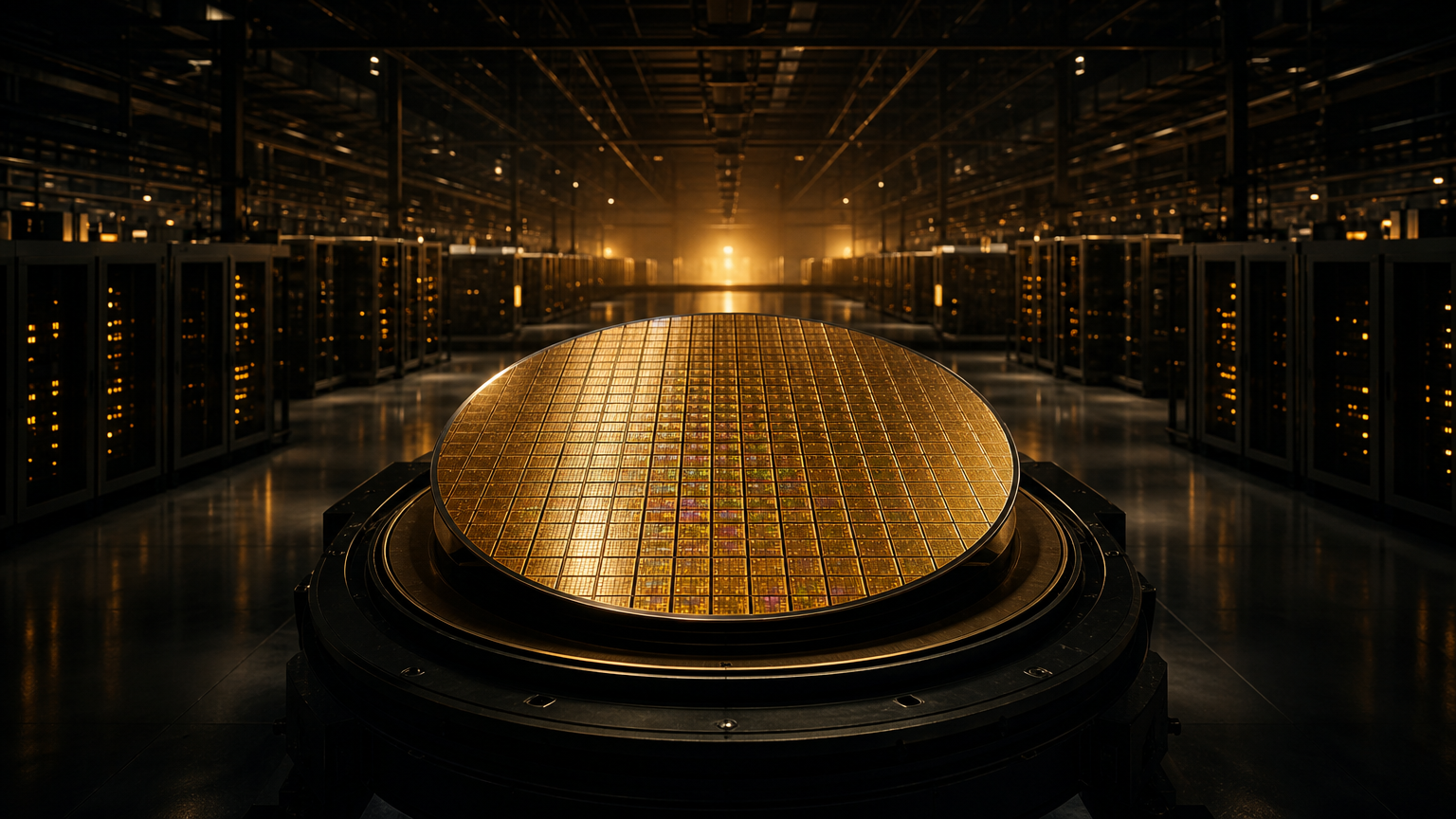
The other side of the story is silicon. The subject’s earlier TSMC-symposium frame — AI pushing the semiconductor economy toward extraordinary 2026 scale — now looks like the supply-side mirror of Bain’s demand-side test. Bain’s current report says the AI compute cycle has revived hardware: hardware and semiconductor companies’ market capitalization grew at a 24% compound annual rate from 2020 to 2026, compared with 6% for software . It also identifies high-bandwidth memory, advanced packaging and custom silicon as three of the fastest-growing areas tied to AI compute demand .
That is why TSMC sits near the center of the economics even when the public conversation focuses on model labs. Leading AI chip designers rely on foundry capacity, advanced process nodes and packaging systems that can bind compute dies, memory and interconnect into usable accelerator packages. The more the AI market depends on dense training and inference clusters, the more the revenue test flows backward into wafers, HBM, substrates, networking equipment, cooling systems and power delivery.
Bain also notes that special-purpose accelerators are moving from niche to mainstream as hyperscalers and AI-native companies design chips for their own workloads . That trend supports the semiconductor upside, but it also raises the stakes: if AI revenue disappoints, the correction would not be confined to software valuations. It would ripple through memory suppliers, packaging capacity, equipment orders, foundry utilization and power infrastructure.
The data-center boom is colliding with power, water and politics
The physical buildout is enormous. Bain projects $5 trillion to $6.5 trillion of data-center spending by 2030, adding at least 150 gigawatts of capacity and putting further strain on energy resources . The same reporting says AI infrastructure spending — including data centers, compute capacity and upgrades in accelerators and memory — could reach as much as $1.5 trillion annually by 2031 .
Those figures make clear why local politics has become part of the AI revenue equation. Data-center developers already face constraints in transformers, water and power, while local opposition has blocked or delayed $68 billion of U.S. projects in one recent quarter, according to the Bloomberg report carried by Business Standard . A data center that cannot get grid approval, water access, transformers or community support cannot generate compute revenue, no matter how strong demand appears on a slide deck.
That backlash is now producing organized counter-mobilization. On September 28, the American Infrastructure Alliance launched as a labor-and-business coalition focused on data-center development guardrails at the state and local level, with inaugural members including IBEW, Iron Workers, UA, SMART, QTS, SoftBank, SB Energy, OpenAI, Blackstone, CoreWeave, Prologis, Digital Realty and others . The group says it wants standards that protect water resources, keep energy costs from being shifted to households, create local jobs and deliver community benefits .
Axios reported that the coalition plans initial campaigns in Texas, Georgia, Ohio, Iowa, Pennsylvania, Indiana and South Carolina, and wants to help shape standards and guardrails for data centers in 2027 to head off moratoriums on new construction . That is a sign the AI infrastructure race has moved beyond the engineering department. The industry now needs permits, transmission capacity, political legitimacy and a social license to build.
Enterprise demand must become more than experimentation
The central business risk is that AI adoption and AI monetization are not the same thing. Many companies are testing coding assistants, customer-service agents, internal search, marketing tools and workflow automation. But Bain’s gap implies that current categories are not enough; new markets must emerge at industrial scale .
Bain points to four broad revenue pools: AI providers replacing or reshaping search and advertising, autonomous systems in vehicles and industry, physical AI through simulations and robotics, and new applications such as drug discovery, mental health and energy generation . The challenge is that several of these areas face regulatory, safety, liability and adoption hurdles. They may become very large, but they must mature quickly enough to support infrastructure economics by 2031.
That is why pricing will matter. If token prices fall faster than usage rises, model providers may improve adoption while weakening revenue yield. If enterprise buyers demand measurable ROI before scaling deployments, vendors will need to prove that AI changes operating performance, not just demo quality. If cloud providers overbuild, they could face a version of the telecom fiber problem: strategically important infrastructure that takes longer than expected to earn its cost of capital.
The real test: compute that pays for itself
The AI boom is not automatically a bubble, and Bain’s report does not say the target is impossible. It does, however, turn hype into a measurable hurdle. The industry must show that compute can be priced, allocated and utilized in ways that generate lasting revenue, not only strategic excitement.
For investors, the next phase should be less about abstract model leadership and more about unit economics: accelerator utilization, revenue per megawatt, enterprise renewal rates, inference margins, chip supply commitments and the durability of demand across business cycles. For cloud providers, the question is whether expensive accelerators can stay productive as models change and workloads shift. For chip suppliers, the upside remains huge, but the dependence on AI spending makes capacity risk more cyclical.
The lesson is simple. AI may still transform software, industry and science. But by 2031, the infrastructure boom will need customers large enough to pay for it. The models can keep getting smarter; the balance sheet still has to pass the test.
Sources from the last 72 hours
- [1]Global AI market could hit $6 trillion annually by 2031 through unlocking value and innovation - Bain & Co's 7th Global Technology ReportSep 29, 2026, 6:05 AM
- [2]Global AI industry needs to earn $6 trillion to justify data centres: BainSep 29, 2026, 5:39 AM
- [3]Bain’s $6 Trillion Is A Revenue Requirement, Not A CostSep 29, 2026, 2:00 AM
- [4]Exclusive: AI giants, unions join forces for data center fightSep 28, 2026, 12:57 PM
- [5]American Infrastructure Alliance Launches First Nationwide Partnership Between Labor & Business to Advance Responsible Data Center Infrastructure GrowthSep 28, 2026, 2:00 AM
AI-generated article based on recent web research, then preserved as a dated editorial snapshot.
Comments
Be the first to comment.