
Daily Podcast full article
Gemini replaces Google Assistant on Android: Google turns the default phone assistant into an AI agent
Google’s Android assistant transition has reached its decisive moment: Gemini is now the default assistant experience on Android phones, tablets and paired devices, while the old Google Assistant rollback path has disappeared for many users. The change is more than a product rename; it moves generative AI from a standalone chatbot into the daily muscle memory of mobile search, voice commands, reminders, timers, smart-home requests and Android navigation.
The switch has moved from plan to reality
The working headline is the story: Gemini replaces Google Assistant. Google’s long-running migration away from Assistant has now crossed the practical line on Android. According to 9to5Google’s September 28 report, the Google Assistant deprecation that began earlier in the month is now widely rolling out, with Assistant gone on every device and account the publication checked in the United States and Europe .
The clearest sign is not just that Gemini launches when users summon an assistant. It is that the escape hatch is disappearing. 9to5Google reports that the Gemini app no longer shows the “Switch to Google Assistant” shortcut in the account menu on Google app 17.60 stable and 17.62 beta . In other words, for affected users, this is no longer a trial setting or a preference toggle. The Android assistant slot has been claimed by Gemini.
That matters because the assistant on Android is not a niche app. It is the voice layer sitting on top of phone actions: long-pressing the power button, swiping from the corners, saying “Hey Google,” setting timers, asking for directions, controlling lights, sending messages, and making quick searches. 9to5Google says Gemini is now the “voice assistant experience on Android” when users invoke the assistant from the power button or screen-corner gestures .
What is replaced, and what is not
The replacement applies to the mobile assistant experience and to devices paired through the phone. 9to5Google lists the affected grouping as phones, tablets and paired devices, including Wear OS, headphones and Android Auto . That makes the rollout broader than a simple app update. If the phone becomes Gemini-first, the accessories that lean on the phone for assistant behavior move with it.
There are still boundaries. The same report says there are no changes “just yet” for Google Nest and Google Home smart speakers, displays, or other Assistant-enabled speakers and displays . That distinction is important: Google is not erasing every Assistant surface at once. It is first locking down the mobile and paired-device layer, which is also the layer where personal context, location, apps and daily tasks are most tightly connected.
This creates a two-speed Google ecosystem. On Android phones, Gemini is now the front door. In the home, Assistant remains present on many speakers and displays for now. In cars, the picture depends on whether the experience is Android Auto projected from a phone or a vehicle with Google built in; the current Android rollout is focused on the phone-linked assistant path .
Why Google wants Gemini in the assistant slot
Strategically, this is a distribution story. Chatbots depend on users deciding to open a chatbot. A default mobile assistant does not. By placing Gemini where Assistant used to live, Google turns generative AI into an ambient layer of Android rather than a destination users must remember to visit.
That gives Google three advantages. First, it defends engagement on Android. If users begin asking richer questions to an AI assistant instead of typing short search queries, Google needs that behavior to happen inside its own stack. Second, it creates a feedback loop at massive scale: every failed reminder, successful timer, ambiguous smart-home command and follow-up question teaches Google where agentic AI still breaks in ordinary life. Third, it gives Gemini a job beyond conversation. It must execute.
That last point is the hardest part. Google Assistant was limited, but it was built around commands. Gemini is built around generation and reasoning. The product challenge is to make a model that can talk naturally also behave reliably when the user simply wants a 15-minute timer, a text message sent, a thermostat adjusted or a route started.
Users are already testing the fault line
The first wave of user reaction shows exactly where the transition will be judged. On Reddit’s Android community, users responding to the replacement report complained about timers, music playback and car commands, while others argued that permissions and setup explain at least some failures . One commenter said Gemini still opened a silent web timer instead of the phone’s Clock timer, while another said their timer worked but deleting it became unnecessarily confusing .
A separate Google-focused Reddit thread captured a more basic reality: some users are finding that Assistant is simply gone for them. One commenter said they could still run Assistant on a Pixel 8 Pro only by uninstalling Google app updates, while another wrote, “Can confirm it’s gone for me” . That is anecdotal, but it matches the reported removal of the official switch-back setting .
The Pixel community is surfacing the most consequential complaint: Gemini sometimes feels less deterministic than the tool it replaces. In one thread, the original poster said alarms worked but reminders behaved inconsistently depending on how the date was phrased, while other users argued Gemini now requires additional permissions and app access that Assistant users did not previously think about . That is not a small usability detail. An assistant replacement has to be boringly reliable before users will trust it with everyday tasks.
The command era gives way to the agent era
Google Assistant belonged to an era of structured commands. Its best interactions were short and transactional: “set an alarm,” “turn off the kitchen lights,” “navigate home.” Gemini points to a different model: a conversational agent that can interpret messy requests, summarize context, reason across apps and eventually take multi-step actions.
The trade-off is that command systems are often brittle but predictable, while generative systems are flexible but probabilistic. Android users are now living inside that trade-off. When Gemini succeeds, the assistant can feel more capable than the older product. When it fails, the failure is more frustrating because the replacement is mandatory and the old, familiar fallback has been removed.
This is why the removal of “Switch to Google Assistant” is the real milestone. Google is no longer asking Android users to compare two assistants. It is forcing the comparison to end.
What happens next
The immediate question is whether Google can close the gap between Gemini’s AI promise and Assistant’s muscle-memory reliability. The company has won the distribution battle by taking over the Android assistant slot. Now it has to win the habit battle.
That means making simple commands faster, reducing unnecessary conversational replies, clarifying permissions, and ensuring that timers, reminders, messages, navigation and smart-home controls work in the expected apps every time. The Reddit reaction is noisy, but it points to a serious product truth: people forgive an AI chatbot for being experimental; they do not forgive a default phone assistant for missing a reminder or failing a hands-free command .
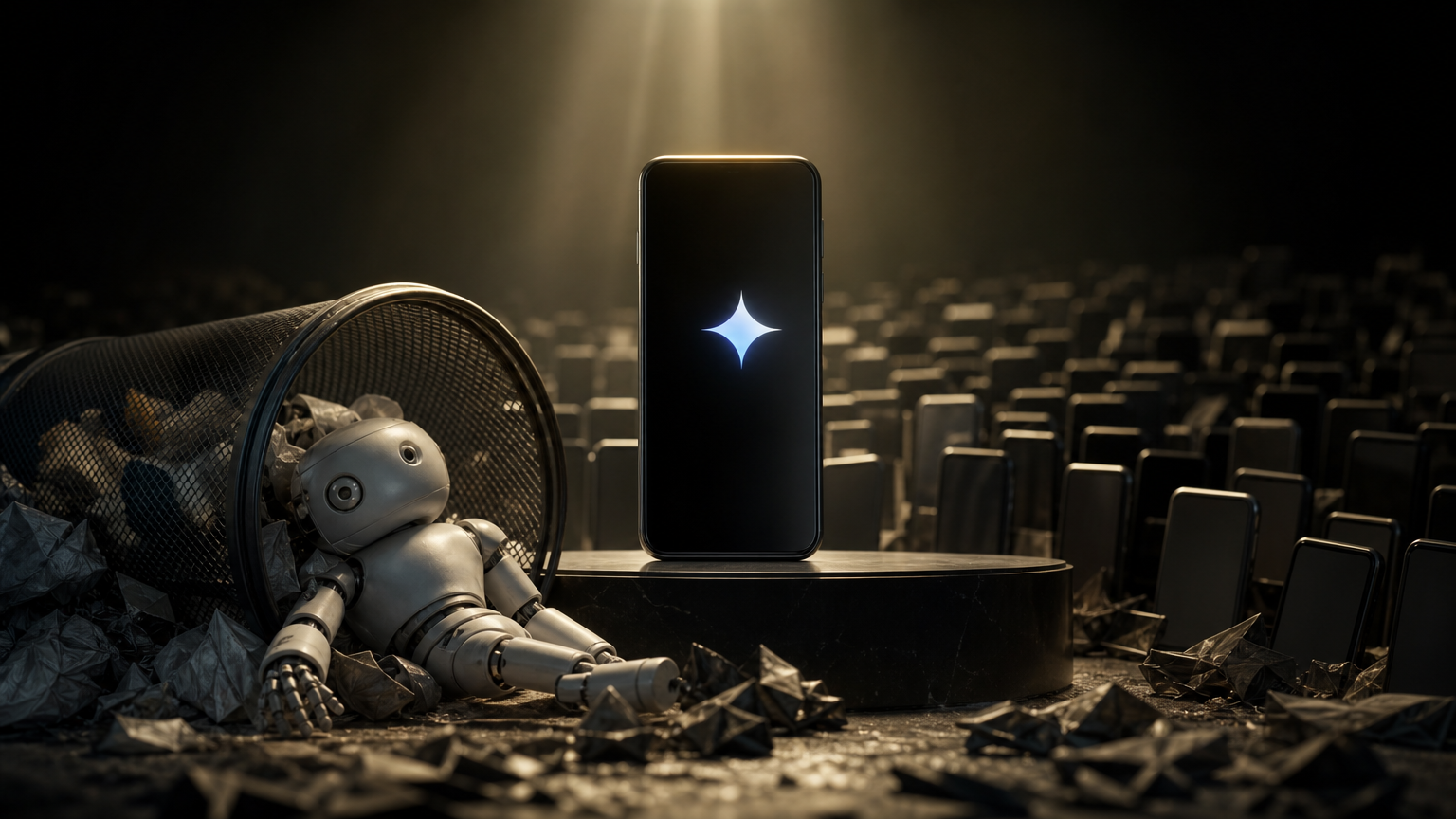
Assistant’s trip to the great recycle bin in the sky is therefore not just the end of a product. It is the start of a much larger test. Gemini is no longer merely Google’s chatbot brand. On Android, it is becoming the operating system’s everyday agent. That gives Google enormous reach, but also removes its excuse. If Gemini is the default assistant now, it has to act like one.
Sources from the last 72 hours
- [1]Gemini fully replaces Google Assistant on AndroidSep 28, 2026, 10:48 PM
- [2]Gemini fully replaces Google Assistant on Android : r/AndroidSep 28, 2026, 2:00 AM
- [3]Gemini fully replaces Google Assistant on Android : r/googleSep 28, 2026, 2:00 AM
- [4]Google Assistant replaced with Gemini : r/GooglePixelSep 28, 2026, 2:00 AM
AI-generated article based on recent web research, then preserved as a dated editorial snapshot.
Comments
Be the first to comment.