
Daily Podcast full article
Quantum processor reaches orbit: programmable photonics takes a hard step into space
A programmable quantum photonic processor has operated in low Earth orbit, showing that fragile light-based quantum hardware can survive launch, thermal cycling and radiation well enough to run controlled two-photon operations. The result is still an early demonstration, not a practical orbital quantum computer, but it turns space-based quantum processing from an architecture slide into tested hardware.
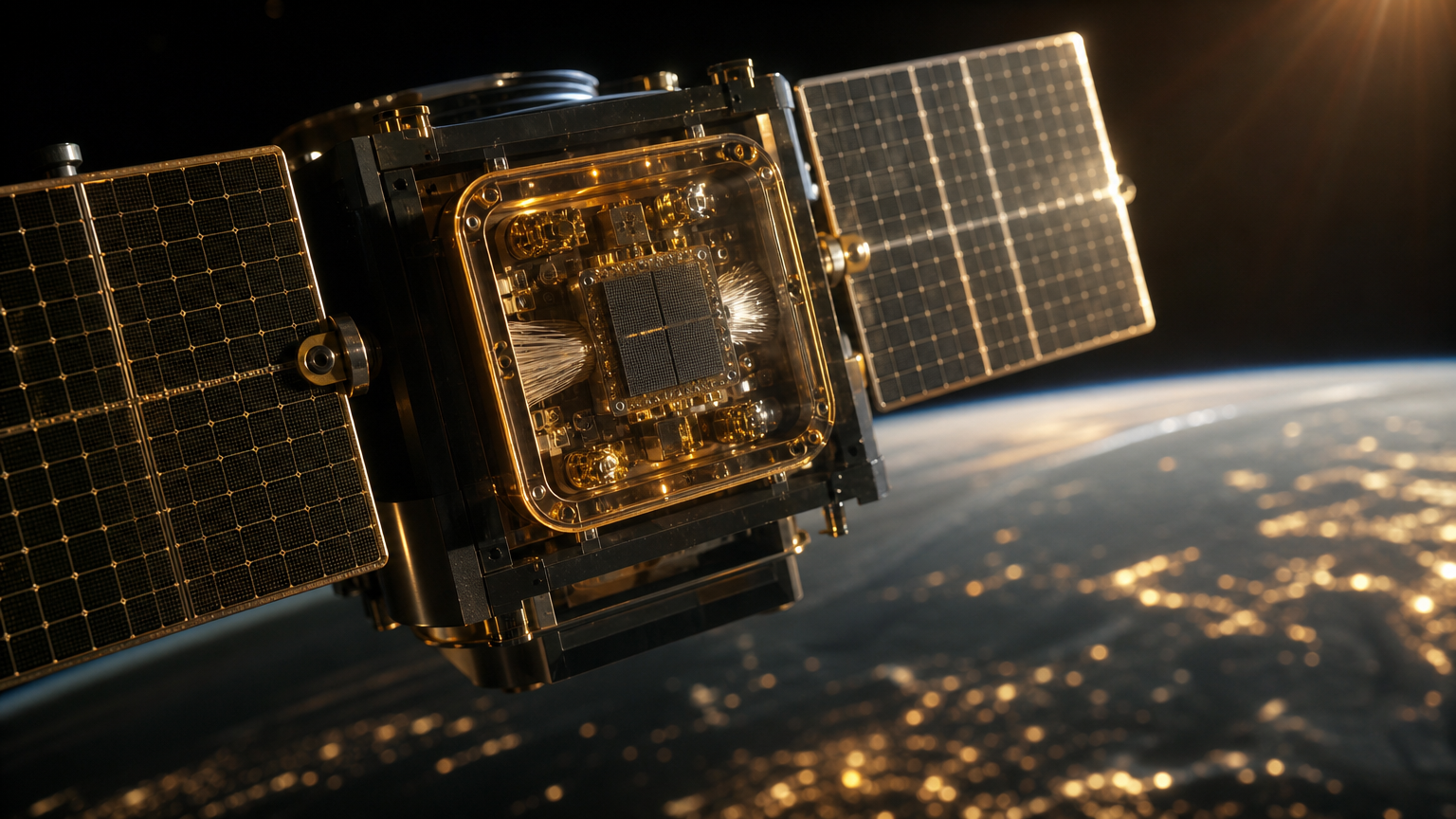
A quantum processor, actually in orbit
The headline is simple, but the engineering behind it is not: researchers have operated a programmable quantum photonic processor in low Earth orbit, using photons on an integrated glass circuit to generate, manipulate and detect quantum states aboard a spacecraft . The system was launched on a SpaceX Falcon 9 on June 23, 2025, and Phys.org reported on September 28, 2026 that it performed its core quantum-photonic functions over the first eight months in orbit . The Quantum Insider framed the result as a milestone for moving reconfigurable quantum hardware beyond ground laboratories and into a satellite environment .
That matters because photonic quantum technologies are naturally linked to communication, sensing and distributed processing: photons are already the carriers of choice for long-distance optical links, and quantum states of light can be routed through compact chips. What is new here is not that quantum light can exist in space, but that a programmable processor using quantum photonic operations was demonstrated on orbit rather than on an optical table .
The device consisted of a photon-pair source, a six-mode integrated glass circuit chip, single-photon detectors and control electronics . In operation, a laser generated photon pairs, the chip steered those photons through microscopic optical paths, and heaters on the circuit controlled the interference behavior by changing the photons’ effective routes . The experiment then used detectors to measure where the photons emerged, making it possible to verify two-photon interference under orbital conditions .
Why two photons in space are a serious test
The key experimental signature was two-photon interference, the effect that appears when indistinguishable photons behave collectively rather than like two independent classical particles . For photonic quantum computing, this is not a decorative physics trick. Interference is the resource that allows linear optical circuits to implement non-classical operations and, eventually, more complex photonic processing.
The orbital setting makes the result more demanding. Quantum photonic systems are sensitive to alignment, temperature and component stability; satellites add launch vibration, vacuum, radiation and thermal swings . The mission also had to cope with damage: three of the six single-photon detectors stopped working after launch, leaving only half the intended detection capacity . Despite that, the processor still generated, manipulated and detected photon pairs and performed several programmed operations over the first eight months .
The Good News Brief summary of the Phys.org report emphasizes the same practical boundary: the result is significant because the core hardware worked, but limited because the demonstration relied on a preprint, used a damaged detector set and did not yet implement operational quantum-assisted satellite data processing . That distinction is important. This was not a commercial quantum computer in space. It was a proof that the essential photonic operations can remain coherent and measurable in a real orbital environment .
The satellite bottleneck this could eventually address
The near-term motivation is not to replace terrestrial quantum computers with orbiting ones. It is to process data where the data is generated. Earth-observation satellites collect far more raw data than they can always downlink efficiently, and bandwidth limitations can force operators to choose what to send, compress or discard . Phys.org reports that the research team sees in-orbit quantum photonic processing as a possible route toward handling some information directly aboard satellites before transmission .
That goal remains future-facing. According to the report, the next step is to close the loop between an onboard sensor and the processor, encoding Earth-observation data directly into the programmed unitary operation on the circuit . In plainer language: the processor has shown that it can run quantum photonic operations in space, but it has not yet been tied into a live satellite sensor pipeline in a way that proves practical advantage for imaging, compression, classification or secure networking.
The remaining engineering list is long. Detector reliability has to improve, component degradation has to be slowed or compensated, and the coincidence rate must remain high enough over the long acquisition times required by inference tasks . Thermal stabilization and radiation-hardening will matter as much as optical elegance. In space hardware, a beautiful circuit that drifts out of calibration is not a product; it is a lesson.
The other clock: faster gates on the ground
The orbital result arrived alongside another quantum-hardware development that speaks to a different but related constraint: time. Quantum Zeitgeist reported on September 29, 2026 that researchers demonstrated a framework for two-qubit operations in the 125–135 nanosecond range using frequency- and amplitude-modulated microwave control . The same report says simulations with typical transmon parameters achieved single-qubit operations in 25–40 nanoseconds, two-qubit operations in 125–135 nanoseconds, and an always-on controlled-Z gate in 80–90 nanoseconds .
This is not the same hardware platform as the orbital photonic processor. The gate-speed work concerns superconducting-style microwave control, while the satellite demonstration concerns photonic quantum hardware. Still, the two stories rhyme because both are about control under harsh constraints. In superconducting processors, qubits lose useful quantum information through decoherence, so faster gates can reduce the time during which calculations are exposed to noise . In orbit, photons and detectors face radiation, thermal cycling and remote operation, so robust control is the difference between a lab curiosity and deployable hardware .
Quantum Zeitgeist also notes the caveat: raw speed alone does not establish scalable advantage . Error rates, connectivity, calibration overhead and repeatability determine whether faster gates translate into deeper, more useful circuits . The same caution applies in space. A photonic chip reaching orbit is impressive; a useful orbital quantum processor will need reliable components, stable calibration and a clear workload where the quantum approach beats a classical optical or electronic payload.
What has been proven, and what has not
What has been proven is concrete: a programmable quantum photonic processor operated in low Earth orbit; it generated, manipulated and detected photon pairs; and it observed two-photon interference despite partial detector failure . That is a step beyond sending quantum states through space for communication experiments, because here the onboard device itself performed programmable quantum photonic operations .
What has not been proven is equally important. The system has not demonstrated fault-tolerant quantum computing, broad quantum advantage, or a satellite service that can process Earth-observation data better than classical onboard processors . The study was reported as an arXiv preprint rather than a peer-reviewed journal article, and the experiment’s hardware degradation shows why orbital quantum systems remain difficult .
Still, the milestone changes the conversation. Space-based quantum networking has often been discussed as a future architecture involving satellites, ground stations and photonic links. This demonstration supplies a hardware datapoint: a small, programmable photonic processor can survive launch and operate in orbit long enough to run meaningful quantum-optical tests . Combined with faster control techniques emerging on the ground, it suggests that quantum engineering is advancing on two fronts at once: making operations quicker inside fragile coherence windows, and making devices tougher outside the comfort of the laboratory .
For now, “quantum processor reaches orbit” should be read as an engineering milestone, not a finish line. The processor did not beam up practical quantum computing. But it did show that programmable quantum photonics can leave Earth, run in space and return data that hardware teams can build on .
Sources from the last 72 hours
- [1]Quantum photonic processor operates in low Earth orbit for eight monthsSep 28, 2026, 2:00 AM
- [2]125 Nanosecond Two-Qubit Gates Advance Quantum ControlSep 29, 2026, 2:00 AM
- [3]One Giant Leap: Researchers Demonstrate Programmable Quantum Photonic Processor in OrbitSep 29, 2026, 2:00 AM
- [4]Quantum computer boldly goes where no quantum computer has gone before: SpaceSep 28, 2026, 2:00 AM
AI-generated article based on recent web research, then preserved as a dated editorial snapshot.
Comments
Be the first to comment.